Is SpaceX’s Starship the Loudest Rocket Ever?

A History of Thunderous Rockets

Rocket launches have always been associated with immense noise, but SpaceX’s Starship, the largest and most powerful rocket to leave the launchpad, has reignited debates about the loudest rocket ever. With thrust levels exceeding all previous rockets, Starship may set new records for launch noise.

Historically, NASA’s Saturn V rocket, used in the Apollo program during the 1960s and 1970s, was among the loudest rockets. Saturn V’s launches, with thrust levels of 35 MN, produced a maximum noise level of 204 decibels (dB), loud enough to be heard miles away and powerful enough to cause potential damage near the launchpad. Spectators were kept at least 3.2 miles (5.1 km) away to mitigate the risks of exposure.

Comparatively, the Soviet N1 rocket, designed for lunar missions, generated 45 MN of thrust, theoretically louder than Saturn V, though its limited launches failed to provide reliable acoustic measurements.

Starship: Breaking New Records

Starship, with its Super Heavy booster, produces an extraordinary 74 MN of thrust, more than double Saturn V’s output. During its fifth test flight in October 2024, researchers from Brigham Young University recorded noise levels exceeding 120 dB at a distance of 6.5 miles (10.5 km) and sonic booms reaching nearly 140 dB at the same distance.

Closer to the launchpad, pre-launch estimates from the FAA suggested noise levels could reach up to 150 dB, a volume that can potentially cause physical damage to structures. Residents in nearby towns reported vibrations, broken windows, and dust storms caused by the force of the rocket’s engines.

The combination of Super Heavy’s thrust and Starship’s massive size makes it a strong contender for the loudest rocket, especially when considering the environmental impact of its launches.

Managing Rocket Noise

Both Saturn V and Starship have highlighted the challenges of managing the acoustic power generated by massive rockets. NASA’s engineers addressed noise concerns during the Apollo era by using water-filled flame trenches at the launchpad to suppress sound waves. This method was also used for the Space Shuttle and the newer Space Launch System (SLS) rockets.

The SLS, used in NASA’s Artemis program, produces 15% more thrust than Saturn V and recorded 136 dB at 0.9 miles (1.5 km) during its Artemis I launch in 2022. Researchers noted the SLS’s crackling sound was “40 million times greater than a bowl of Rice Krispies.”

Starship’s sheer power poses additional challenges. Its April 2023 maiden flight destroyed its launchpad, underscoring the intensity of its thrust and noise. SpaceX has since worked on improving its launch systems, including water-based sound suppression.

Why Rockets Sound Different

Rocket noise isn’t just about volume; its characteristics depend on thrust, design, and atmospheric conditions. Low-frequency rumbles, high-decibel crackles, and the environment’s reflection of sound waves contribute to how launches are experienced. Overcast conditions, for instance, can amplify noise, carrying it farther from the launch site.

Future of Loud Rockets

With Starship’s ongoing development, noise levels may climb further as engineers refine the rocket for missions to Mars. SpaceX’s efforts to optimize performance and safety will include mitigating acoustic impacts, but earplugs and safe viewing distances will remain essential for spectators.
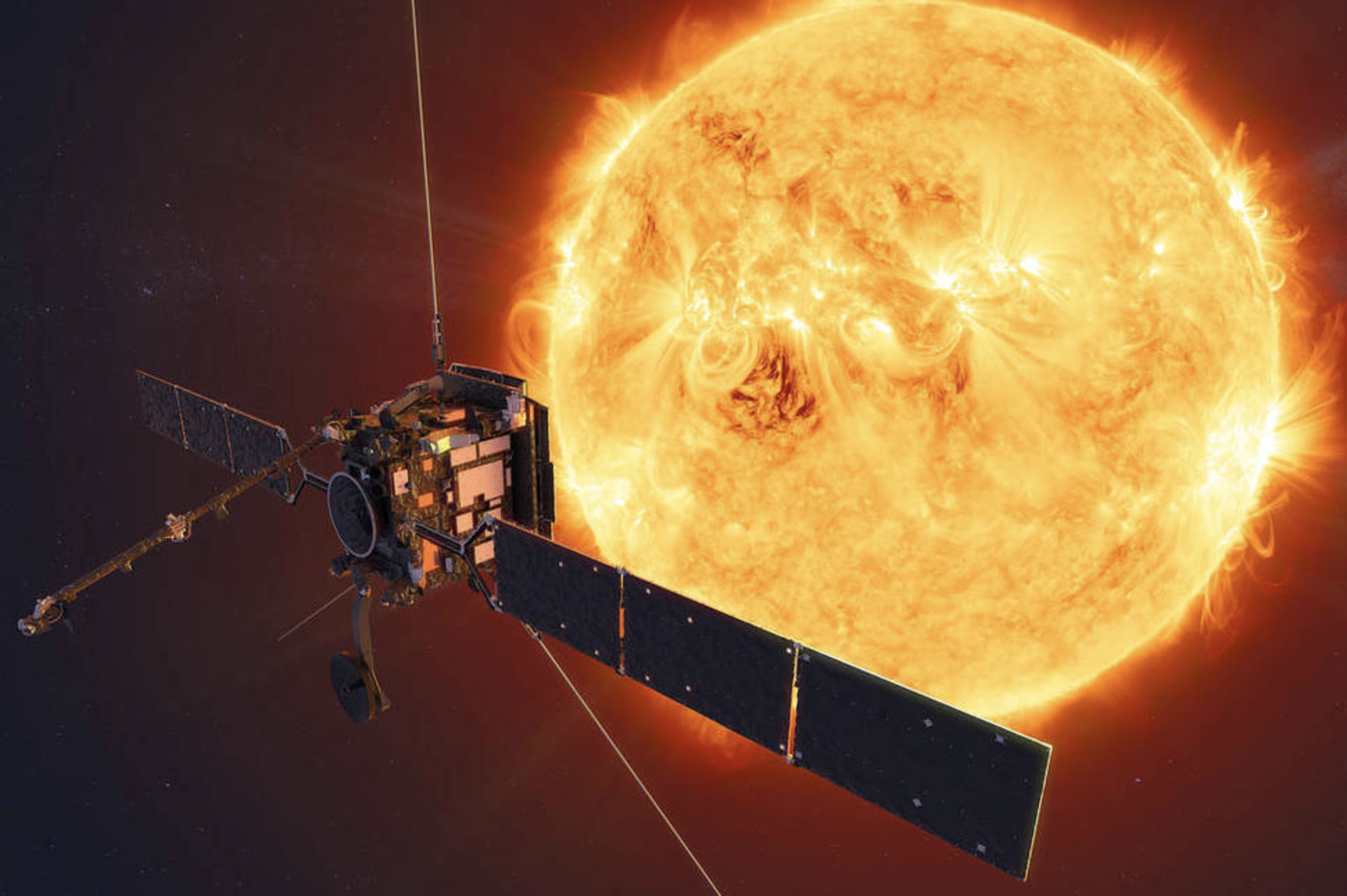
Solar Orbiter Captures Record-Breaking Images of the Sun’s Surface

Unveiling the Sun’s Secrets

The Solar Orbiter mission has captured the highest-resolution images of the sun’s surface, offering unprecedented insights into the dynamics of our star. These stunning visuals reveal intricate details of sunspots, plasma movements, and the magnetic fields that govern solar activity, providing scientists with valuable data to further understand solar phenomena.

The images, taken on March 22, 2023, and released this week, were captured using the spacecraft’s Extreme Ultraviolet Imager (EUI) and Polarimetric and Helioseismic Imager (PHI). Positioned 46 million miles from the sun, the Solar Orbiter, a joint mission by the European Space Agency (ESA) and NASA, captured these extraordinary views, marking a significant leap in heliophysics research.

Cutting-Edge Observations

The Solar Orbiter’s PHI instrument produced the sharpest full-surface views of the sun’s photosphere, where temperatures range between 8,132°F and 10,832°F (4,500°C and 6,000°C). These images reveal sunspots, dark regions caused by the sun’s strong magnetic fields, which disrupt convection and make the spots cooler and darker than their surroundings.

The PHI also created detailed magnetic maps, or magnetograms, showing magnetic field concentrations in sunspot areas. A velocity map, or tachogram, highlighted the speed and direction of plasma flows across the surface, with blue regions indicating movement toward the spacecraft and red regions moving away.

Meanwhile, the EUI focused on the sun’s corona, its outermost atmosphere, where temperatures soar to 1.8 million degrees Fahrenheit (1 million degrees Celsius). The corona’s glowing plasma structures, protruding from sunspot regions, were vividly captured, helping scientists probe why this layer is significantly hotter than the surface below.

Each image released by the Solar Orbiter is a mosaic of 25 individual shots, meticulously pieced together due to the spacecraft’s need to rotate while capturing the sun’s entire face.

Complementing Parker Solar Probe

While NASA’s Parker Solar Probe will soon make its closest approach to the sun, coming within 3.86 million miles on December 24, its mission lacks imaging capabilities due to its proximity to extreme heat. Solar Orbiter’s imaging instruments, however, are filling this gap, offering complementary data for scientists studying the sun’s magnetic field, solar winds, and other phenomena.

“The closer we look, the more we see,” said Mark Miesch, a NOAA scientist. “These high-resolution images bring us closer to understanding the sun’s intricate interplay of magnetic fields and plasma flows.”

Solar Activity Peaks

Solar Orbiter’s observations come at an opportune time, as the sun has reached its solar maximum — the peak of activity in its 11-year cycle. During this phase, sunspots proliferate, magnetic poles flip, and solar activity increases, generating phenomena such as flares and coronal mass ejections (CMEs). These events produce space weather that can affect Earth’s power grids, satellites, and communication systems.

The sun’s heightened activity also creates spectacular auroras, with charged particles from CMEs interacting with Earth’s atmosphere to produce the northern and southern lights.

Solar Orbiter’s mission aligns with this dynamic period, allowing scientists to correlate its high-resolution imagery with real-time solar activity.

Paving the Way for Solar Science

With its groundbreaking instruments, Solar Orbiter is helping answer fundamental questions about the sun, such as the origin of solar winds and the reason behind the corona’s extreme temperatures. Together with the Parker Solar Probe, these missions are reshaping our understanding of the sun’s impact on the solar system and Earth.

One Direction Stars Reunite for Liam Payne’s Funeral

A Farewell to Liam Payne

Family, friends, and former bandmates gathered on Wednesday in Amersham, England, to honor the life of Liam Payne, the former One Direction star, a month after his tragic death at the age of 31. Payne, who rose to global fame alongside Harry Styles, Zayn Malik, Niall Horan, and Louis Tomlinson, passed away after a fatal fall from a hotel balcony in Argentina.

A horse-drawn carriage carried Payne’s dark blue casket adorned with silver fittings to a flint stone church decorated with white roses. Floral tributes reading “son” and “daddy” lay atop the carriage, symbolizing Payne’s deep connections to his family, including his 7-year-old son, Bear, with former partner Cheryl Tweedy.

A Somber Gathering

The funeral drew significant attention as Payne’s former bandmates arrived individually, wearing solemn expressions. Harry Styles, Zayn Malik, Louis Tomlinson, and Niall Horan paid their respects, joining Payne’s family and friends in an emotional farewell. Simon Cowell, who had brought the band together on The X Factor in 2010, consoled Payne’s grieving parents after the ceremony.

Styles, the first band member to arrive, was also the last to leave, sharing a quiet moment with TV host James Corden. Kimberley Walsh and Nicola Roberts from Girls Aloud joined the service to support Tweedy. Payne’s girlfriend at the time of his death, Kate Cassidy, was also in attendance.

Reflections on a Tragic Loss

Payne’s untimely death in Buenos Aires shocked fans worldwide. An investigation revealed that the singer had alcohol, cocaine, and prescription antidepressants in his system at the time of his death. Argentine authorities have charged three individuals in connection with the incident.

The singer’s struggles with mental health and substance abuse had been publicly acknowledged. Payne had celebrated six months of sobriety earlier in 2023 after completing treatment. However, his challenges persisted, including a kidney infection that delayed his planned tour later that year.

In a joint statement, Styles, Malik, Horan, and Tomlinson expressed their grief:

“We will take some time to grieve and process the loss of our brother, who we loved dearly. The memories we shared with him will be treasured forever.”

Payne’s Enduring Legacy

Fans and locals gathered in Amersham to pay tribute, sharing memories of how Payne’s music and persona had touched their lives. Victoria Horwood, a longtime fan, reflected on the solace Payne’s songs provided during tough times, while Alice Chapman joined the crowd to demonstrate support for Payne’s grieving family.

Caroline Jordan, a resident who attended the service, remarked:

“He had so much more to give.”

Payne’s career as part of One Direction catapulted him to global stardom. The band, known for hits like “Best Song Ever” and “Story of My Life,” achieved unprecedented success, breaking records and creating a lasting impact on pop culture.

A Legacy of Music and Brotherhood

While One Direction officially disbanded in 2015, Payne’s bond with his bandmates endured. Their reunion at his funeral highlighted the enduring camaraderie that had fueled their success. Fans worldwide continue to celebrate Payne’s contributions to music while mourning the loss of a talented artist gone too soon.