
India’s Push for Home-Grown Satellite Constellation Attracts 30 Aspirants

India’s initiative to develop home-grown Earth observation (EO) satellite constellations has received a strong response, with 30 companies applying for a role in the project. This effort, managed by the Indian National Space Promotion and Authorisation Centre (IN-SPACe), is part of India’s strategy to reduce its dependence on foreign satellite data for critical sectors like defense, infrastructure management, and mapping.

Pawan Goenka, Chairman of IN-SPACe, announced that nine applications had been received, each representing a consortium of companies. These applicants include a mix of startups, such as Google-backed Pixxel and Baring Private Equity-backed SatSure, as well as larger entities like Tata Group’s Tata Advanced Systems. The project aims to establish satellite constellations that provide crucial data for various industries, including telecoms and climate monitoring. The satellite data market is expected to reach $45 billion by 2030, making it a significant global opportunity.

IN-SPACe issued a call for “expressions of interest” (EoI) in July to develop these homegrown satellite constellations. The initiative is part of India’s broader strategy to commercialize its space sector and ensure data sovereignty. The space regulator set eligibility criteria for the applicants, requiring them to invest at least 850 million rupees ($10 million) in space activities, have a company valuation of 8.5 billion rupees, or a turnover of 2 billion rupees in the last three years. Applicants must also establish spacecraft control centers in India or partner with ground station providers.

The evaluation of technical proposals is expected to be completed by the end of January, with a tender to determine the winning bidder to follow shortly thereafter. The government plans to provide a loan of up to 3.5 billion rupees to the winning company, with private entities expected to cover the rest of the costs. Additionally, India has set up a 10-billion-rupee venture fund to support space startups since the sector was opened to private players in February.

Although India currently relies on foreign EO data from entities like the European Space Agency (ESA) and the Indian Space Research Organisation (ISRO), the country is now focused on expanding its space capabilities and reducing its dependence on external sources.
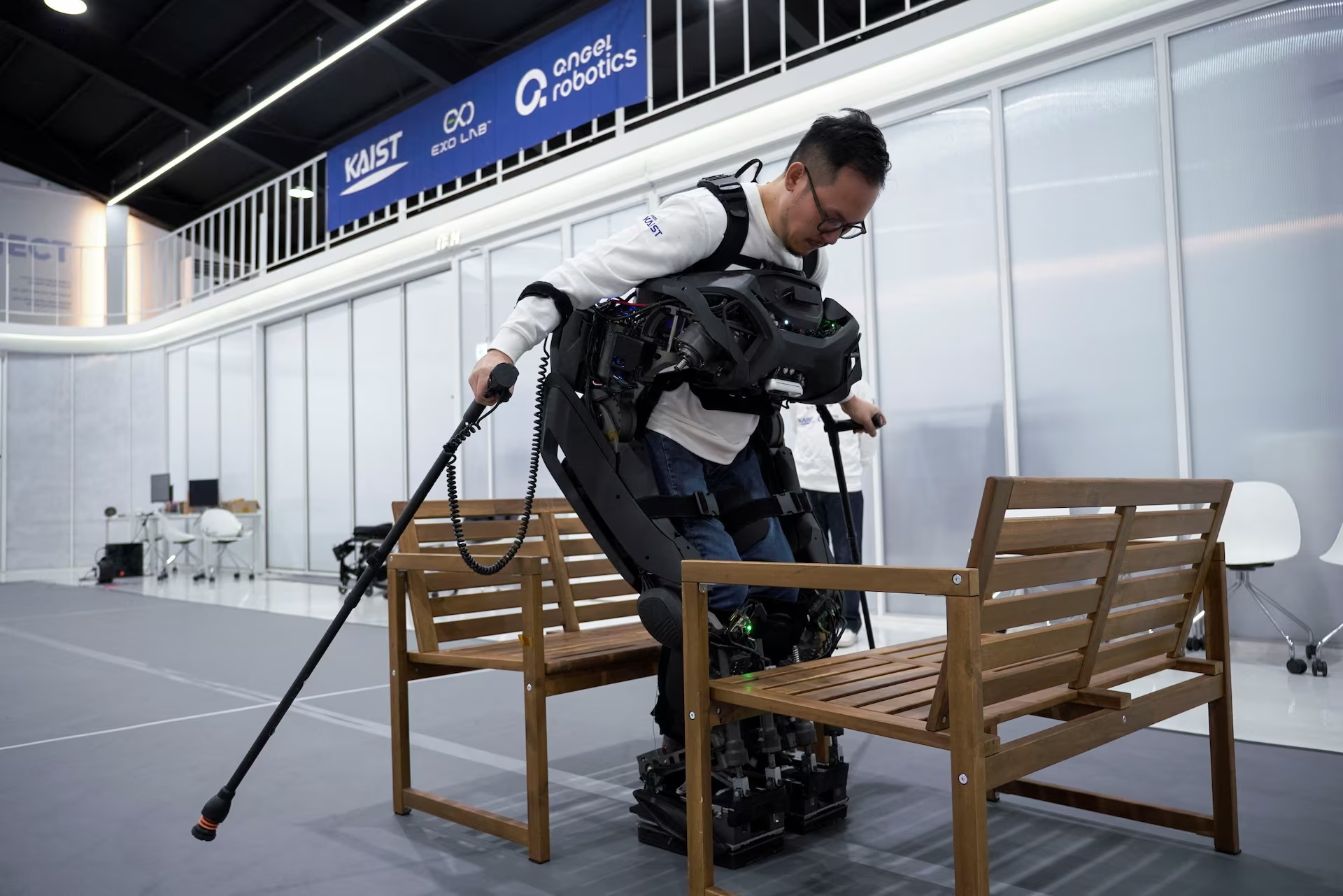

 

South Korean Team Develops ‘Iron Man’ Robot to Help Paraplegics Walk

A team of researchers from South Korea’s Korea Advanced Institute of Science and Technology (KAIST) has developed a revolutionary lightweight wearable robot designed to help paraplegic individuals walk, maneuver obstacles, and even climb stairs. The robot, named the WalkON Suit F1, is a powered exoskeleton weighing 50 kg (110 lb) and is equipped with 12 electronic motors that mimic human joint movements, enabling its user to walk at speeds of up to 3.2 kph (2 mph).

The exoskeleton was developed by the Exoskeleton Laboratory team at KAIST, whose goal is to create a robot that can seamlessly integrate into the daily lives of people with disabilities. Kim Seung-hwan, a paraplegic member of the team, showcased the prototype by using it to walk, climb stairs, and even take sideways steps. One of its most distinct features is its ability to approach and lock onto the user, even when they are sitting in a wheelchair, to assist with standing up.

The robot is made from lightweight materials like aluminum and titanium, providing the strength needed to support its functions while keeping the overall weight manageable. Sensors located on the exoskeleton’s soles and upper body monitor the user’s movements 1,000 times per second, allowing the robot to anticipate their intentions and provide better balance. Additionally, cameras on the robot’s front help detect obstacles and identify the height of stairs, compensating for the sensory limitations of users with complete paraplegia.

Park Jeong-su, another member of the KAIST team, drew inspiration for the project from the film “Iron Man,” hoping to create a real-life solution for helping people through robotics. Kim Seung-hwan, while wearing the WalkON Suit F1, earned a gold medal in the exoskeleton category at the 2024 Cybathlon, an event where developers showcase assistive robots designed for individuals with various physical disabilities.

Kim shared his emotional motivation, stating that he wanted to show his son that he, too, was once able to walk and that he could share a wide range of experiences with him.

Allegro’s Ceneo Sues Google for $568 Million Over Antitrust Claims

A subsidiary of Polish e-commerce giant Allegro, Ceneo, has filed a lawsuit against Alphabet (Google’s parent company), Google Ireland, and Google LLC, seeking damages of 2.33 billion zlotys ($567.6 million). The lawsuit, filed on Monday, claims that Google’s preferential treatment of its own price comparison service in search results has harmed Ceneo’s business by undermining competition.

Ceneo, which operates a popular online price comparison service in Poland, argues that Google’s practices have caused substantial financial losses. According to Allegro, the damages comprise 1.72 billion zlotys for the losses sustained by Ceneo, along with about 615 million zlotys in interest payments, accruing from 2013 to November 29, 2024. Ceneo also seeks statutory interest on the total amount from the date of the lawsuit until the damages are paid.

In response, Google rejected the claims, asserting that its “Shopping remedy” has been successful in supporting a variety of retailers, brands, and comparison shopping sites across Poland and Europe. A Google spokesperson noted that the company was carefully considering its options.

This lawsuit is linked to a previous European Union antitrust case, where Google was fined $2.7 billion for abusing its dominance in the search engine market to favor its own price comparison service. The EU’s ruling in that case also aimed to curb Google’s market power and encourage fair competition in the sector.

In addition, the U.S. Department of Justice has called for Google to divest its Chrome browser and prevent the company from re-entering the browser market for five years, in an effort to limit its control over the digital ecosystem.