
Google Unveils Veo 2 AI Video Generation Model for Gemini Advanced Users

Google has recently unveiled the Veo 2 artificial intelligence (AI) model, now available to paid subscribers of Gemini. This new AI tool allows users to create eight-second video clips by simply providing text prompts in natural language. The Veo 2 model, which was first introduced in December 2024 as a successor to the original Veo model, is also integrated into Google’s Vertex AI platform and plays a key role in powering YouTube’s Dream Screen feature. This launch marks another significant milestone in Google’s push to enhance its AI capabilities within the Gemini ecosystem.

Currently, the Veo 2 model is accessible exclusively to those using Gemini’s paid subscription, Gemini Advanced. Free-tier users will not be able to access this feature. The rollout is taking place globally and will be available in all languages supported by Gemini. However, users should note that while the feature is being introduced gradually, it may take some time before it reaches all eligible subscribers worldwide.

The Veo 2 model allows users to generate high-quality videos in 720p resolution, maintaining a 16:9 aspect ratio. The video clips are produced in response to detailed text prompts and can be downloaded in MP4 format. Users can also share these clips directly on popular social media platforms like TikTok and YouTube. Google has set a monthly limit on the number of videos each user can generate, and notifications will alert users when they are nearing their quota.

The Veo 2 AI model also brings significant advancements in terms of realism and cinematic detail. It can interpret technical film terms, such as camera lenses, movements, and cinematic effects, allowing users to be highly specific in their prompts. This enhanced understanding enables the AI to produce more tailored and professional-looking video content, making it a valuable tool for creators who want to experiment with video production in a more intuitive and accessible way.

Baldur’s Gate 3 Final Update Introduces Cross-Play, Photo Mode, and More as Larian Shifts Focus to New Project

Baldur’s Gate 3, the highly acclaimed RPG from Larian Studios, has officially received its final patch, bringing an end to the game’s ongoing updates. The release of Patch 8 introduces several new features that fans have been eagerly anticipating, including cross-play support across all platforms, new subclasses, a photo mode, and a split-screen option for Xbox Series S players. This final update, released earlier this week, marks the studio’s shift in focus toward new projects, as they confirmed that Baldur’s Gate 3 will not see any further content updates beyond this patch.

In a heartfelt message to the community, Larian Studios acknowledged the immense support and passion from players that helped make Baldur’s Gate 3 a monumental success. The team expressed their gratitude, stating that while they could continue to tweak the game indefinitely, it would ultimately prevent them from moving on to create new experiences. As a result, Patch 8 represents the culmination of years of work and the studio’s commitment to delivering a final, polished experience.

The final patch also serves as a farewell to any major story changes or additions to the game. Larian confirmed that while future patches may address minor bugs and issues, no new narrative content, storylines, or significant updates to characters and companions will be added. The studio emphasized that they have told the story they set out to tell, and now it’s time for them to focus on new adventures and creative projects.

Despite the conclusion of Baldur’s Gate 3’s post-launch updates, Larian Studios made it clear that they are far from finished with the world of gaming. The team is eager to take the lessons learned from the game’s success and apply them to future projects. As they wrap up this chapter, Larian teased the promise of more “chaos” in the future, hinting at exciting new developments that will continue to push the boundaries of game design.

NASA’s James Webb Space Telescope Uncovers Detailed Structure of a Planetary Nebula

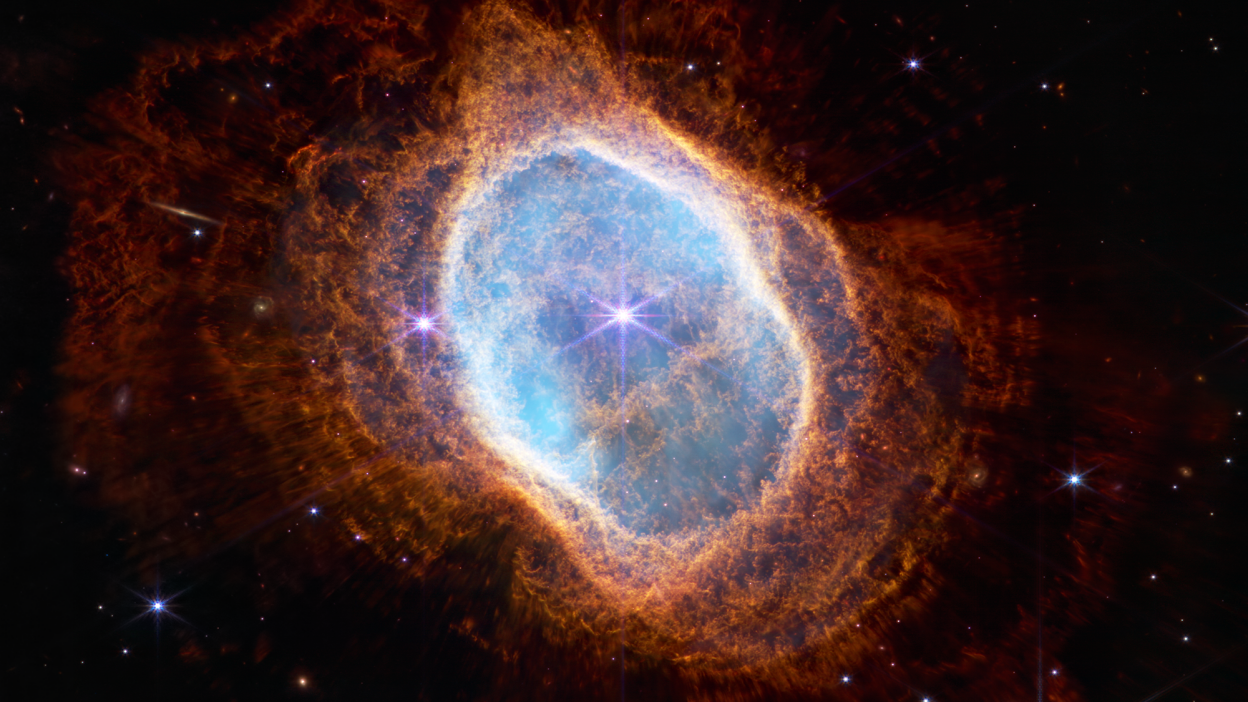
NASA’s James Webb Space Telescope (JWST) has uncovered the intricate details of NGC 1514, a planetary nebula that has been evolving over a span of at least 4,000 years. The nebula, which can only be seen in infrared light, exhibits a series of “fuzzy” clusters arranged in twisted patterns. These patterns highlight the complex structure of the nebula, revealing the presence of sharper holes near the center. These holes indicate areas where faster-moving materials have pierced through, providing insight into the dynamics of the nebula’s formation. An orange arc of dust surrounds the stars at the center of the nebula, which are in a close, elongated orbit that lasts about nine years. One of these stars, which was once several times more massive than the Sun, played a critical role in shaping the nebula’s structure.

The JWST has allowed astronomers to observe the dual gas rings that surround the dying star at the core of the nebula. The star’s interaction with its companion, as well as its evolution, is thought to have influenced the nebula’s distinctive hourglass shape. The rings of gas are unevenly illuminated, with the mid-infrared light casting a textured appearance. In particular, the clumped pink center of the nebula contains high concentrations of oxygen, particularly around the boundaries of the bubble-like holes. The nebula’s structure is of particular interest because of what it lacks: the absence of certain complex molecules. This absence may be due to the merging orbits of the two central stars, which have hindered the formation of these molecules.

NGC 1514, located in the Taurus constellation and situated 1,500 light-years from Earth, offers astronomers a valuable opportunity to study the final stages of a star’s life. The nebula’s dual rings of expelled material, traced back to the interaction of the two central stars, are particularly fascinating. The study of these rings offers a unique glimpse into the ongoing processes that shape star systems over long periods. These insights could help astronomers better understand the role of gravitational pull in shaping the dynamics of star outflows, providing key data on how stars evolve and interact over time.

The stars at the center of NGC 1514 are part of a binary system with one of the longest known orbits—about nine years. Astronomers believe that the creation of the nebula is largely attributed to the more massive of the two stars. As this star aged, it shed layers of gas and dust, producing a hot, compact core known as a white dwarf. The winds from this white dwarf likely carried away the earlier, slower-moving material, forming faint, clumped rings that are visible only in infrared light. Despite the lack of complex carbon-based molecules, JWST’s observations have revealed significant oxygen concentrations in the nebula, furthering the understanding of stellar processes. These findings underscore the importance of the JWST in advancing our knowledge of stellar evolution and the life cycles of stars.