Google Assistant on Android Devices Set to Be Replaced by AI-Driven Gemini

Google is making a significant shift in its virtual assistant strategy by replacing Google Assistant with its AI-powered assistant, Gemini, for Android smartphone users. Announced on Friday, the company revealed that this transition will take place over the next few months, with Gemini gradually becoming the default assistant across more devices. This change will not be limited to smartphones alone, as Google plans to roll out Gemini to other devices like tablets, Android Auto, and accessories such as headphones and earphones that connect to Android smartphones.

Gemini has been available to Android users for some time now, but it was initially offered as an optional feature. Users with compatible devices could choose to make Gemini their default virtual assistant, allowing them to take advantage of its advanced AI capabilities. At the same time, those who preferred the traditional Google Assistant experience had the option to continue using it. However, the upcoming changes will remove this choice, making Gemini the sole default assistant for all Android devices.

The shift to Gemini marks a notable departure from the legacy Google Assistant, which has been a cornerstone of Android’s virtual assistant ecosystem for years. The decision is part of Google’s broader strategy to integrate more AI-driven technologies into its products, providing users with smarter and more responsive digital experiences. Gemini’s advanced features, which are expected to be powered by cutting-edge AI, will enhance how users interact with their devices, offering more context-aware responses and deeper integration with Google’s services.

Although Google will make Gemini the default assistant, users still have the option to install and use third-party virtual assistants if they prefer. This move signifies Google’s confidence in Gemini’s ability to provide a more robust and dynamic assistant experience, but it also offers flexibility for those who may want to explore alternatives. As this transition unfolds, Android users can expect to see a more seamless and AI-enhanced virtual assistant experience across their devices.

Apple to Start AirPods Production in India at Foxconn Plant for Export in April, Report Says

Apple is reportedly set to begin production of its AirPods at Foxconn’s Hyderabad facility, with manufacturing set to start in April. Initially, the production will be focused on exports, rather than catering to the Indian market. This move is seen as part of Apple’s broader strategy to diversify its manufacturing network and reduce its reliance on China. The decision follows Apple’s ongoing efforts to ramp up production in India, where it has been assembling various models of the iPhone 16 series, including the recently launched iPhone 16e.

According to a report by PTI, citing an anonymous industry source, the production of AirPods at the Foxconn plant is expected to begin in April. However, the wireless earphones will initially be produced exclusively for export, with no plans to sell them locally in India at this stage. This will make AirPods the second major Apple product to be assembled in India, joining the iPhone models that have already been manufactured in the country.

The move to assemble AirPods in India is seen as a significant milestone for Apple, marking another step in the company’s diversification strategy. By shifting production to India, Apple is positioning itself to mitigate risks related to its heavy reliance on Chinese manufacturing. The geopolitical tensions between China and other countries have raised concerns about the stability of global supply chains, prompting Apple to explore alternatives in other regions, including India.

In addition to Foxconn, other major Apple suppliers like Pegatron and Tata Electronics have also been increasing their presence in India, helping to expand Apple’s manufacturing footprint in the country. This shift not only supports Apple’s goal of reducing dependency on China but also provides a boost to India’s growing role in global electronics manufacturing. As the tech giant continues to invest in Indian production, it’s clear that the country will play an increasingly important role in Apple’s future manufacturing plans.

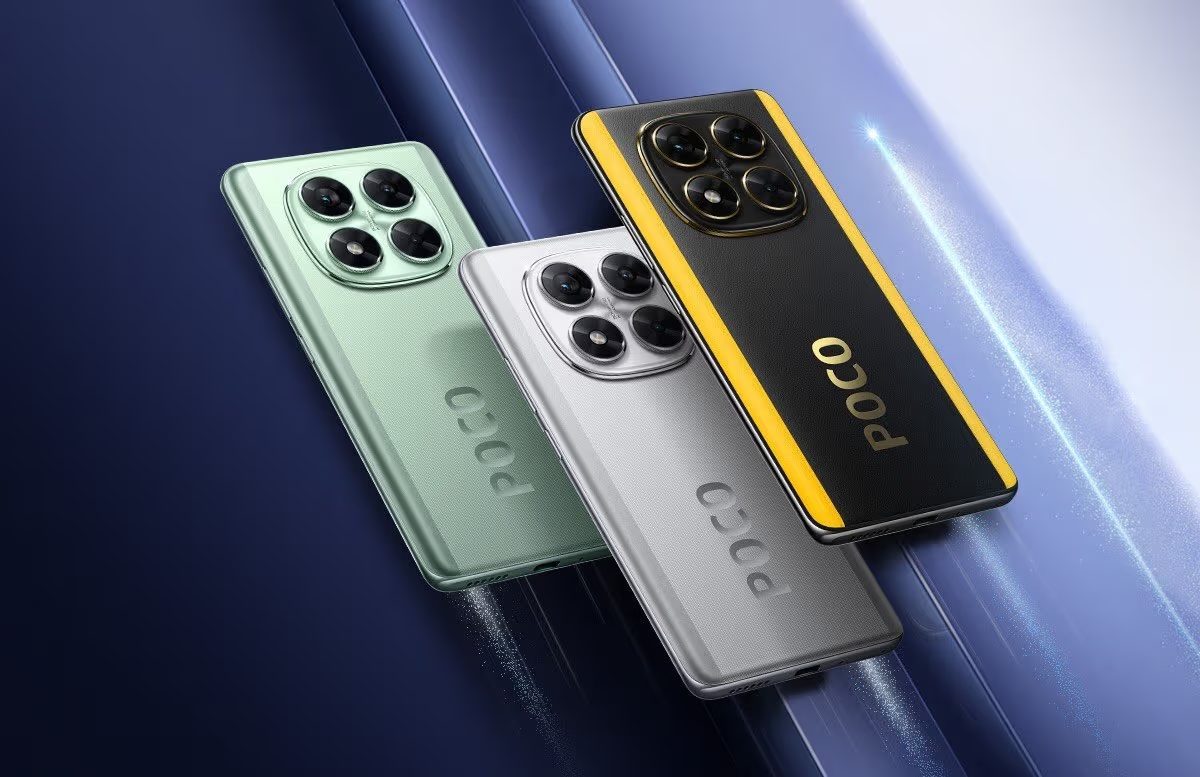
Leaked Renders Reveal Design and Colour Options for Poco F7 Ultra and F7 Pro

The highly anticipated Poco F7 Pro and F7 Ultra smartphones are expected to launch globally on March 27, with numerous leaks suggesting they will share many similarities with the Redmi K80 and K80 Pro models. Ahead of the official announcement, fresh leaks have surfaced, revealing the design, colour options, and potential pricing for the upcoming devices. Additionally, the base Poco F7 is expected to be launched in India shortly, adding to the excitement surrounding the new lineup.

The leaked design, shared by tipster Paras Guglani on X, showcases the sleek look of both the Poco F7 Pro and F7 Ultra. The Poco F7 Ultra is expected to be available in striking black and yellow colour options, while the F7 Pro could be offered in black, blue, and grey. The rear design features a circular camera module positioned towards the upper left, similar to the Redmi K80 series. Inside the module, three camera sensors are expected, complemented by a horizontal pill-shaped LED flash unit next to the cameras. Both models are said to sport slim bezels around their displays, with a centered hole-punch cutout for the front camera. This clean, modern design is aimed at appealing to a wide range of consumers.

In terms of pricing, the leaks suggest that the Poco F7 Pro could be priced around EUR 599 (approximately Rs. 56,600) for the 12GB + 512GB variant in select European markets. Meanwhile, the Poco F7 Ultra is likely to be more expensive, with the 16GB + 512GB model expected to cost EUR 799 (around Rs. 75,500). These price points suggest that the F7 Pro and F7 Ultra will cater to the upper mid-range and premium segments of the market, offering high-end features and specifications.

The Poco F7 Pro is rumored to pack a Snapdragon 8 Gen 3 SoC, providing impressive performance for gaming and multitasking. It is also expected to come with a 5,830mAh battery, supporting 90W wired fast charging for quick power-ups. The device could feature a 6.67-inch QHD+ OLED display with a resolution of 1,440 x 3,200 pixels and a 120Hz refresh rate, ensuring smooth and vibrant visuals. A 50-megapixel dual rear camera system is also expected, promising high-quality photography and video capture. With these features, the Poco F7 Pro is poised to deliver a flagship experience at a competitive price point.