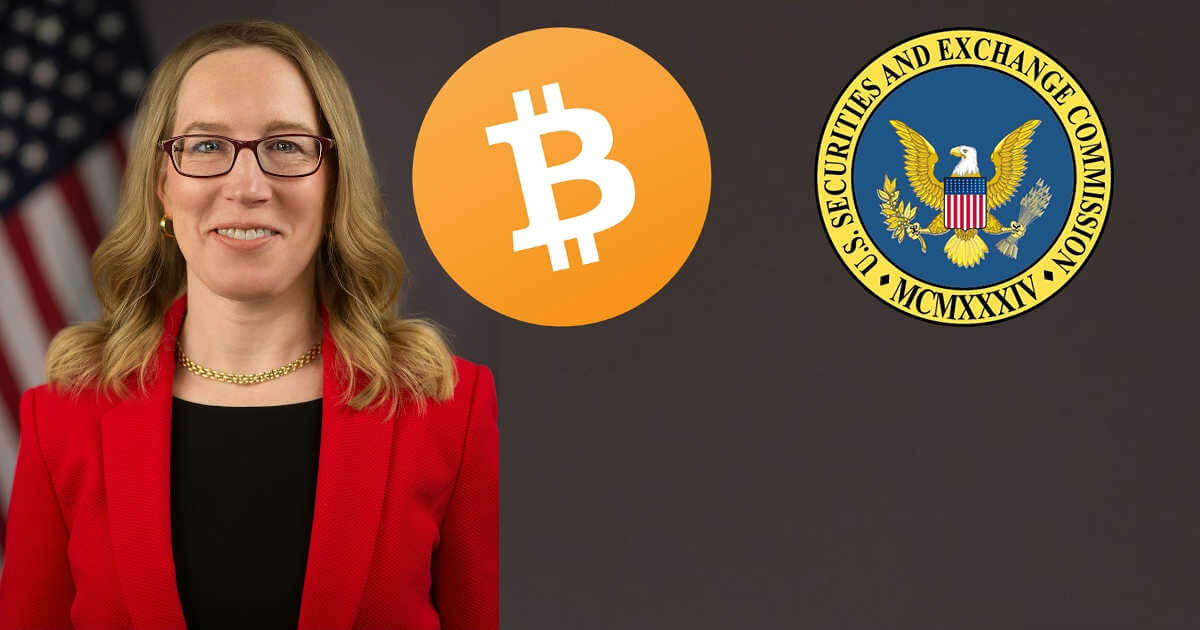
SEC’s ‘Crypto Mom’ affirms tokenized securities remain subject to regulations

Hester Peirce, a Republican commissioner of the U.S. Securities and Exchange Commission (SEC) known as “crypto mom” for her supportive views on cryptocurrencies, emphasized on Wednesday that tokenized securities must comply with existing securities regulations.

Peirce stated, “As powerful as blockchain technology is, it does not have magical abilities to transform the nature of the underlying asset. Tokenized securities are still securities.” Tokenization refers to converting traditional shares into digital tokens traded on blockchain platforms. Investors holding these tokens own a representation of the underlying securities.

She warned that tokens issued by third parties, rather than the original security issuers, carry distinct risks for investors.

The concept of tokenized securities is gaining traction in the crypto and finance industries as a potential way to innovate trading processes. Coinbase recently revealed it is seeking SEC approval to offer blockchain-based stock trading.

SEC Chairman Paul Atkins, also a Republican, voiced support for fostering innovation but stressed regulatory oversight remains important. Critics argue that tokenization could be exploited to bypass SEC rules, putting retail investors at risk.

Nvidia hits $4 trillion market cap, cementing tech’s dominance in stock market

Nvidia Corp’s remarkable rise to a $4 trillion market valuation highlights its pivotal role in the stock market and the broader technology sector. The AI chipmaker’s shares have surged roughly 1,350% since October 2022, with a 22% gain so far in 2025, outperforming the 6% rise of the S&P 500.

The milestone was reached during morning trading on Wednesday, about 13 months after Nvidia first hit the $3 trillion mark. This rapid appreciation has made Nvidia the largest single stock by market value in the S&P 500, where it now accounts for around 7.5% of the index—more than any other company.

Nvidia’s influence is even more pronounced in tech-heavy indexes like the Invesco QQQ Trust ETF and the Philadelphia Semiconductor Index, though it has a smaller presence in price-weighted indexes such as the Dow Jones Industrial Average.

Microsoft ($3.7 trillion) and Apple ($3.1 trillion) trail Nvidia but are closing in on the $4 trillion threshold, underscoring the dominance of tech giants. The top seven companies in the S&P 500—also including Amazon, Alphabet, Meta Platforms, and Broadcom—make up about one-third of the index’s total market value.

This surge illustrates the growing dominance of the technology sector, which now represents about one-third of the S&P 500’s market value, nearing levels last seen during the dot-com bubble peak in 2000.

Other standout tech stocks in 2025 include Microsoft (+19%), Oracle (+40%), and Palantir (+88%).

Huawei aims to expand role in Brazil’s data center market amid pending tax incentives

Chinese technology giant Huawei has expressed interest in strengthening its position as a supplier of data center solutions in Brazil, Reuters reported on Thursday. While Huawei clarified it does not plan to invest directly in data centers, the company is keen to provide connectivity, storage, and energy solutions for the growing market.

Huawei’s Latin America and Caribbean Vice President of Public Relations, Atilio Rulli, emphasized the importance of the Brazilian government implementing upcoming tax-break incentives designed to attract tech investments. “We want the government to implement these incentives, which are good for the country, and the time has to be now,” he said.

Brazil, Latin America’s largest economy, is working to build a strong data center industry leveraging its abundant renewable energy resources. The government’s tax-break plan is expected to be sent to Congress soon, according to a finance ministry adviser.

The country has already attracted attention from major players such as ByteDance, TikTok’s parent company, as part of its digital infrastructure expansion.

Huawei reaffirmed its commitment to supporting Brazil’s digital transformation with reliable, scalable, and sustainable data center solutions once government incentives come into force.