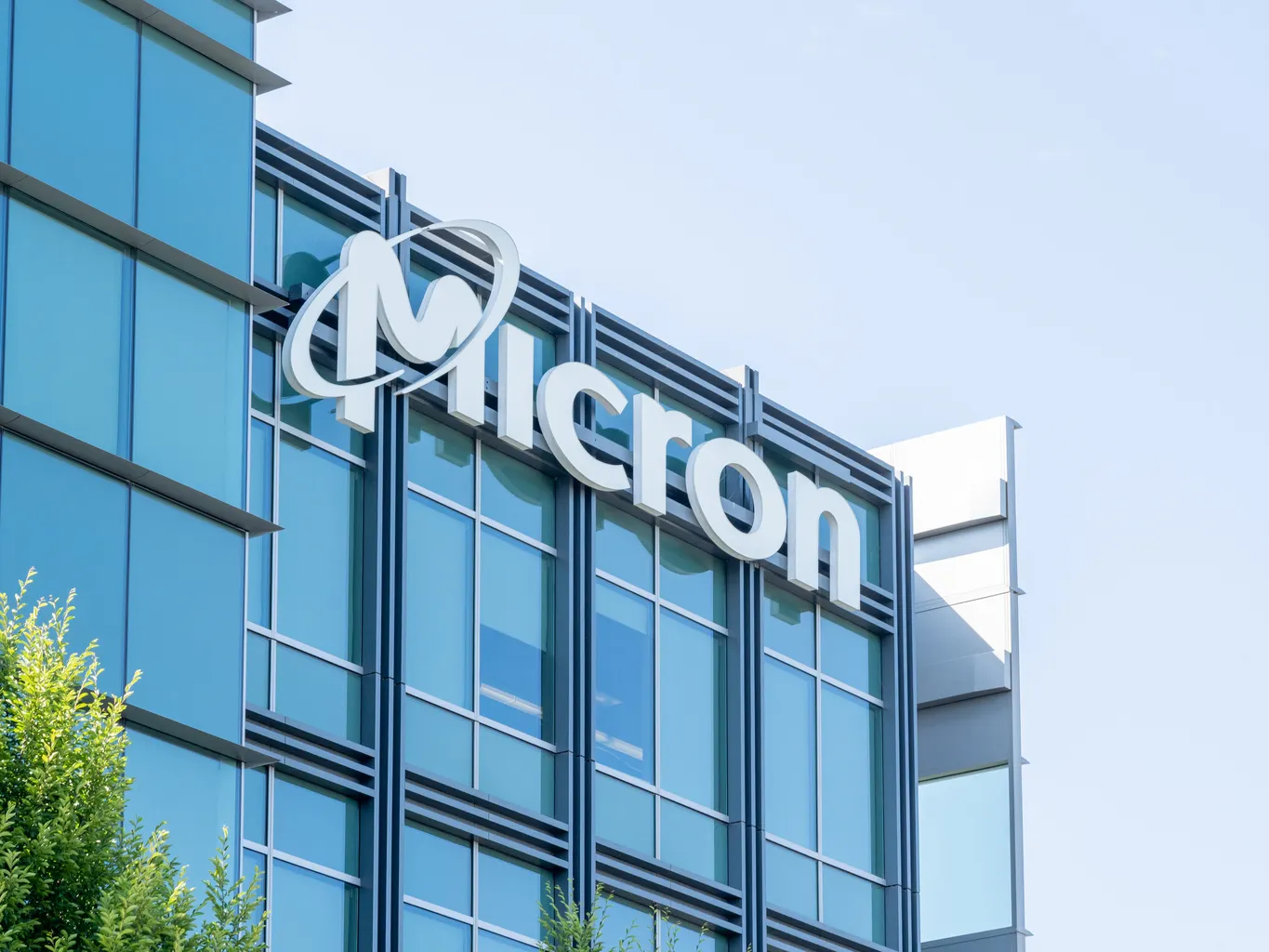
Micron tops forecasts with AI-fueled HBM demand, sees strong Q1 revenue

Micron Technology projected first-quarter revenue of $12.5 billion ± $300 million, well above Wall Street’s estimate of $11.94 billion, as booming demand for its high-bandwidth memory (HBM) chips drives growth amid the AI race.

AI demand supercharges Micron

  • Q4 HBM revenue hit nearly $2 billion, putting Micron on pace for ~$8B annually, CEO Sanjay Mehrotra said.

  • HBM chips, built by stacking DRAM vertically, reduce power use while enabling massive data processing — making them indispensable for training and running advanced AI models.

  • Micron is a key HBM supplier to Nvidia, whose dominance in AI accelerators makes HBM supply one of the most competitive battlegrounds in semiconductors.

2026 outlook already sold out

  • Micron expects to lock in deals for all 2026 HBM capacity in the coming months.

  • HBM3E pricing agreements are nearly complete; HBM4 pricing talks are ongoing.

  • “The pricing on HBM4 is actually significantly higher than the pricing on HBM3E,” said Chief Business Officer Sumit Sadana, citing tight supply and strong ROI expectations.

  • TSMC will partner with Micron to manufacture the base logic die for its HBM4E chips.

Financial performance

  • Adjusted Q4 EPS: $3.03, topping forecasts.

  • Adjusted gross margin forecast (Q1): 51.5%, far above expectations of 45.9%.

  • Analysts said stronger-than-expected pricing drove the margin boost.

U.S. policy and subsidies

  • Micron has received $6.2B under the CHIPS and Science Act, passed under former President Joe Biden.

  • Current Commerce Secretary Howard Lutnick is exploring converting subsidies into equity stakes in chipmakers, but Sadana said Micron does not expect its grant terms to change.

  • Micron recently received a disbursement after completing a milestone at its Idaho fab, Mehrotra confirmed.

Big picture

Micron is riding the wave of AI-driven chip demand, securing long-term contracts at higher prices while boosting profitability. With HBM4 set to command premium pricing, Micron is positioning itself as a critical player alongside Nvidia, Samsung, and SK Hynix in the global AI supply chain.

China summons ByteDance, Alibaba platforms over online content violations

China’s Cyberspace Administration of China (CAC) has summoned ByteDance’s Toutiao news platform and Alibaba’s UCWeb browser unit for alleged content violations, adding them to the growing list of tech firms targeted in Beijing’s online crackdown.

According to separate statements issued Tuesday, both platforms were recently penalized for “disrupting the online ecosystem order,” with CAC imposing strict disciplinary actions against responsible personnel.

Alleged violations:

  • Toutiao: Allowed “harmful content” to appear in trending topic lists and other features.

  • UCWeb: Allowed non-authoritative sources and non-mainstream media to dominate trending topics, including coverage of sensitive and malicious events such as cyberbullying and the privacy of minors.

The summons comes as CAC launches a two-month nationwide campaign to remove violent or hostile content, part of a long-running effort to promote a “clean and healthy cyberspace” that aligns with Communist Party socialist values.

Industry-wide sweep

Toutiao said it welcomed the action, pledging to form a task force to combat non-compliant content and trolling. UCWeb has yet to issue a public statement.
CAC has also taken action in recent weeks against Kuaishou, Weibo, and Xiaohongshu (RedNote) for similar violations.

Wider regulatory push

The crackdown comes amid growing concern about public sentiment, as China faces economic headwinds and persistent youth unemployment. Other regulators are also stepping up:

  • The market watchdog summoned logistics platform Huolala over anti-monopoly compliance.

  • Days earlier, it launched an investigation into Kuaigou, an e-commerce arm of Kuaishou, for suspected e-commerce law violations.

Huolala described its summoning as a “profound wake-up call,” vowing stricter compliance going forward.

Beijing’s message is clear: online platforms must not only police content but also align with the state’s broader political and social stability agenda.

Nvidia’s $100B OpenAI deal sparks funding, valuation, and competition questions

Nvidia’s plan to invest up to $100 billion in OpenAI — while also supplying millions of its GPUs to the ChatGPT maker — is unprecedented in the tech sector and raises major uncertainties about finance, competition, and market impact.

Key open questions:

1. Where does the rest of the money come from?

  • Nvidia has pledged $10B per gigawatt for 10 GW of compute, but CEO Jensen Huang estimates $50B is needed per gigawatt (with $35B of that spent on Nvidia hardware).

  • That leaves a massive $40B funding gap per GW. OpenAI has not disclosed how it will raise the remainder.

2. How does this fit OpenAI’s shift to for-profit?

  • OpenAI is transitioning from a nonprofit into a public benefit corporation overseen by its nonprofit parent.

  • Nvidia’s investment may hinge on this structure, but it’s unclear if funding flows to the nonprofit entity or the restructured PBC.

  • Regulatory approval in Delaware and California is still pending.

3. What does it mean for OpenAI’s valuation?

  • Nvidia’s initial $10B tranche is pegged to OpenAI’s current $500B valuation.

  • But there’s no timeline for deploying the full 10 GW or committing the entire $100B. Future investments may depend on OpenAI’s valuation at the time, raising uncertainty about dilution and pricing.

4. How will competition be affected?

  • Nvidia’s chips remain the most coveted resource in AI. By tying up vast capacity with OpenAI, rivals like Anthropic, Google, or even Microsoft could face constraints in access.

  • Competitors like AMD may find it harder to gain traction if Nvidia prioritizes OpenAI, despite Nvidia’s public pledge to “make every customer a top priority.”

5. What does it mean for Oracle?

  • Oracle has signed hundreds of billions in cloud contracts with OpenAI, but analysts question whether OpenAI has the liquidity to pay.

  • Nvidia’s cash infusion could strengthen Oracle’s revenue outlook, reassuring investors and credit agencies like Moody’s, which flagged funding risks.

Big picture:

The deal deepens the interdependence of AI’s leading players — Nvidia for chips, OpenAI for models, Microsoft for software integration, and Oracle for cloud. But it also amplifies antitrust concerns, as U.S. regulators eye whether such alliances foreclose competition in the AI stack.