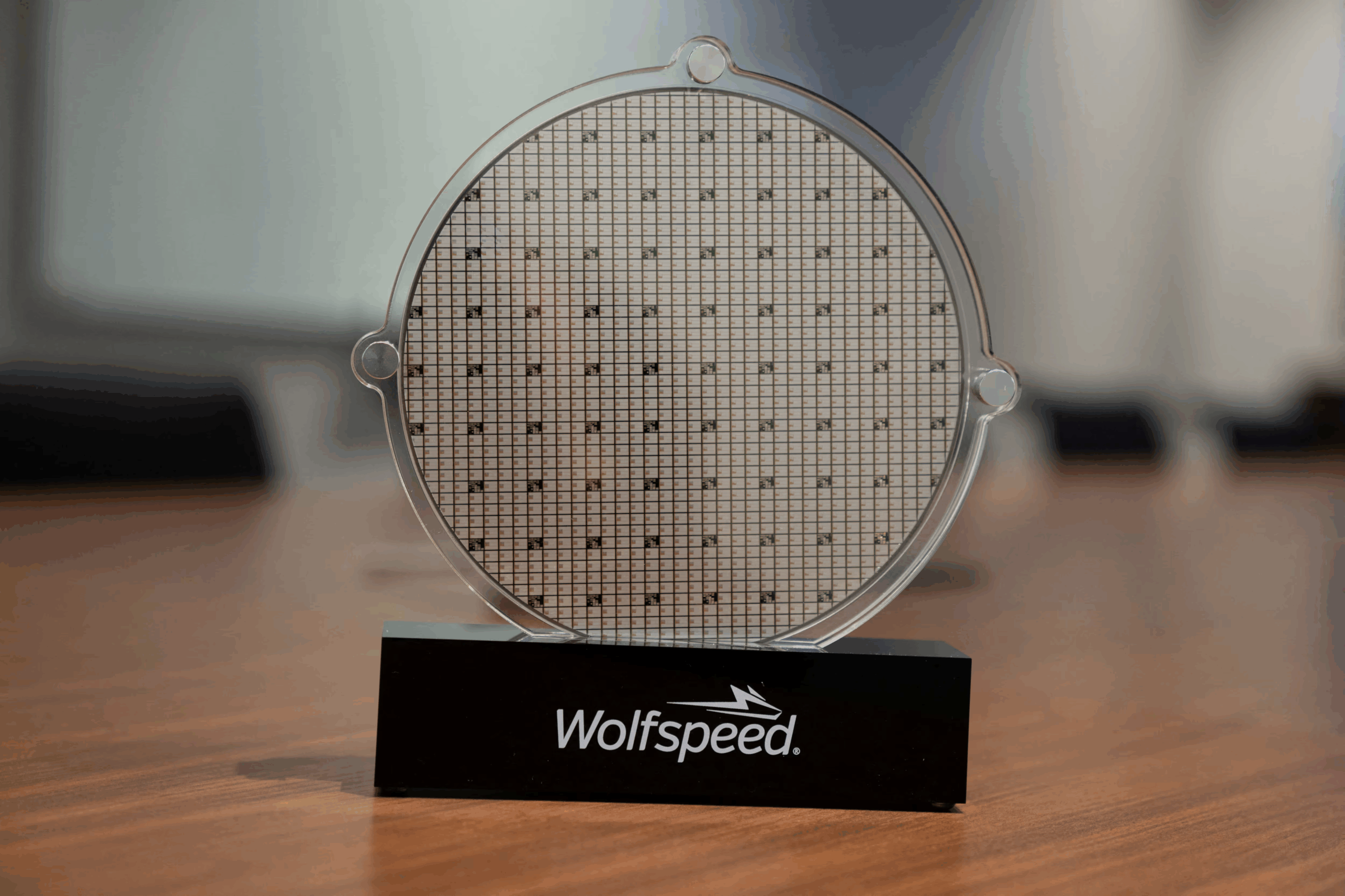
Wolfspeed Shares Soar 48% as Bankruptcy Court Approves Restructuring Plan

Wolfspeed (WOLF.N) saw its shares jump 48% to $1.82 on Tuesday after a U.S. bankruptcy court approved the company’s Chapter 11 reorganization plan, paving the way for an exit from bankruptcy in the coming weeks.

Key details of the restructuring

  • Debt reduction: Wolfspeed will slash its debt by about 70% (~$4.6 billion).

  • Lower costs: Annual cash interest payments will be cut by 60%.

  • Timeline: The company expects to formally emerge from bankruptcy within several weeks.

Industry role

Wolfspeed specializes in silicon carbide chips, which are prized for energy efficiency and are widely used in:

  • Electric vehicles (EVs)

  • Solar inverters

  • Industrial power systems

Leadership statement

CEO Robert Feurle said the ruling “clears the path for us to complete our restructuring process in the coming weeks.”

Background

  • Wolfspeed filed for Chapter 11 bankruptcy in June, citing going concern doubts.

  • The restructuring provides the company a financial lifeline amid surging demand for power-efficient chips, especially in EV and renewable energy markets.

FCC to End EchoStar 5G Probe After $40 Billion in Spectrum Deals with SpaceX and AT&T

The U.S. Federal Communications Commission (FCC) will close its investigation into EchoStar’s 5G buildout obligations, following the company’s recent spectrum sales to SpaceX and AT&T worth a combined $40 billion.

FCC’s decision

  • FCC Chair Brendan Carr said in a letter to EchoStar Chair Charles Ergen that the agency would conclude EchoStar has met its 5G obligations.

  • Carr called the outcome a “potential game changer” for American consumers, freeing up spectrum and injecting new competition into the wireless market.

  • EchoStar’s Boost Mobile brand, which lost 2 million customers in recent years, had been seen as providing limited competitive pressure.

Spectrum sales

  • $17B deal with SpaceX: Enables Starlink Direct-to-Cell services with upgraded satellites.

  • $23B deal with AT&T: Provides AT&T with 50 MHz of nationwide mid- and low-band spectrum.

Background

  • EchoStar was under probe for slow 5G deployment and potential “warehousing” of spectrum.

  • SpaceX had previously pressed the FCC to review EchoStar’s holdings.

  • The FCC’s move confirms EchoStar’s exclusive rights to key spectrum blocks for ground and satellite use.

Political backdrop

  • In June, President Donald Trump encouraged EchoStar and the FCC to resolve disputes over its wireless spectrum licenses.

  • The transactions with SpaceX and AT&T still require final FCC approval.

Industry impact

Carr said the deals could reshape the wireless market:

“The status quo wasn’t working. We have a chance now to do something different … this is much more competitive.”

Sweden Introduces World’s First AI Music Licence to Protect Songwriters

Sweden’s music rights organisation STIM has launched a new licence that allows AI companies to legally train on copyrighted songs while ensuring that songwriters, composers, and publishers receive royalties. The move addresses growing disputes between creators and tech firms over the unauthorized use of copyrighted works in AI training.

STIM, which represents over 100,000 music creators, said the licence is designed to strike a balance between technological innovation and fair compensation.

How the licence works

  • AI firms can train their systems on copyrighted songs under the licence.

  • Creators receive royalties for the use of their works.

  • The licence includes mandatory tracking technology to monitor AI-generated outputs and ensure transparent payments.

Why it matters

  • The International Confederation of Societies of Authors and Composers (CISAC) warns that generative AI could reduce music creators’ income by up to 24% by 2028.

  • CISAC also projects that AI-generated music outputs could reach $17 billion annually by 2028, underscoring the economic stakes.

  • STIM’s acting CEO Lina Heyman said:

    “We show that it is possible to embrace disruption without undermining human creativity. This is not just a commercial initiative but a blueprint for fair compensation and legal certainty for AI firms.”

First adopter: Songfox

Stockholm-based startup Songfox is the first to operate under the new licence. The company allows users to create AI-generated songs and covers legally, with royalties flowing back to original creators.

Sweden’s leadership in digital music

Sweden has a history of setting industry standards in the digital music space, having previously played a central role in shaping platforms like Spotify and TikTok. The AI music licence could similarly become a global benchmark for balancing innovation and rights protection.