New Interstellar Visitor 3I/ATLAS Offers Clues to Distant Worlds’ Mysteries
3I/ATLAS, the third confirmed interstellar object, is currently traveling through our solar system.
Astronomers Confirm Arrival of Third Interstellar Object 3I/ATLAS in Our Solar System
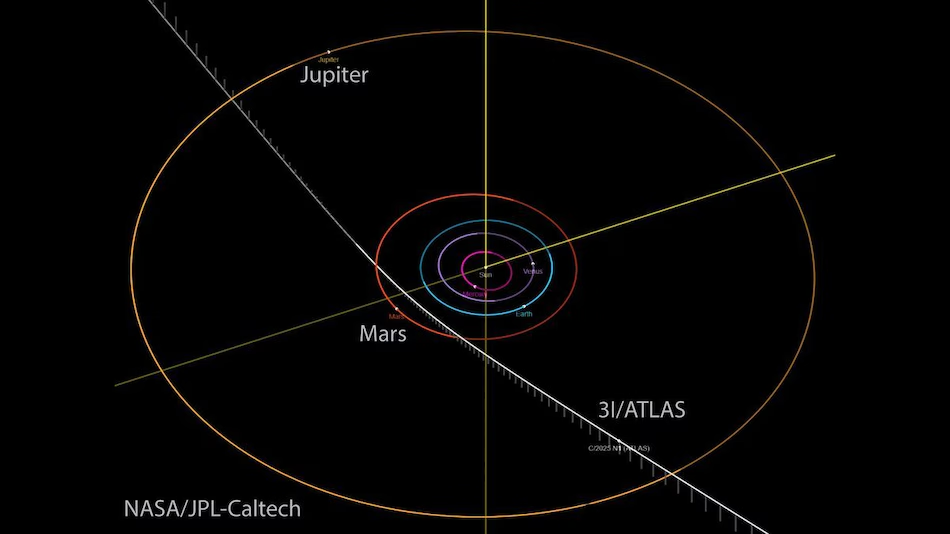
On July 1, 2025, astronomers confirmed the entry of the third known interstellar object into our solar system. Named 3I/ATLAS—where “3I” stands for “Third Interstellar”—this object follows a highly hyperbolic orbit with an eccentricity of approximately 6.2, clearly indicating it is not gravitationally bound to the Sun but a genuine visitor from beyond.
Before 3I/ATLAS, only two interstellar visitors had been detected: 1I/ʻOumuamua in 2017 and 2I/Borisov in 2019. Remarkably, 3I/ATLAS appears to be the largest and brightest of the three.
Comparison with Previous Interstellar Visitors
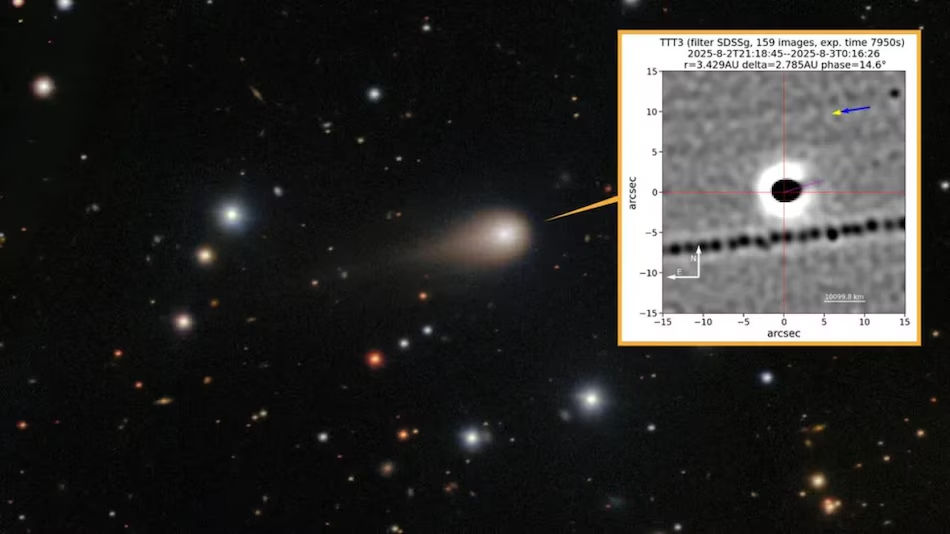
Discovered by astronomers in the ATLAS survey using a telescope in Chile, 3I/ATLAS immediately attracted attention due to its unusual motion. Soon after its discovery, observers detected a faint coma and tail, leading to its classification as comet C/2025 N1 (ATLAS).
This comet-like appearance is reminiscent of 2I/Borisov, the second known interstellar object. Currently, observatories worldwide are tracking 3I/ATLAS closely. While it poses no threat to Earth, it provides a rare opportunity to study material from outside our solar system.
In contrast, 1I/ʻOumuamua was only observed as it was leaving the solar system, limiting astronomers’ ability to study it in detail. This lack of data sparked wild theories—including speculation that it might be an alien spacecraft—though the consensus is that it was likely an asteroid or comet.