Scientists Detect Unprecedented Jet Behavior in 3I/ATLAS Using Hubble Data
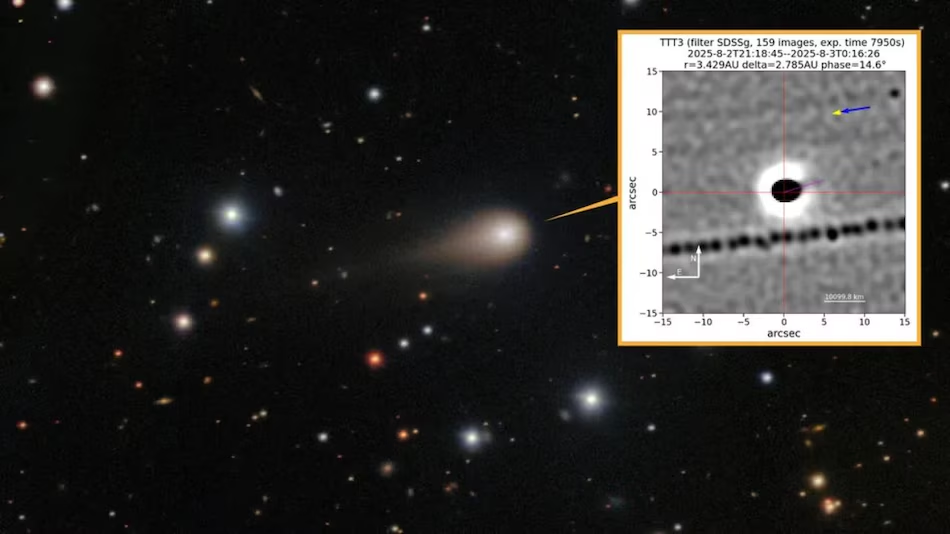
Scientists have identified a previously unseen astrophysical phenomenon in the object known as 3I/ATLAS, after analyzing new observations from the Hubble Space Telescope. The data reveal an unusual pattern of anti-correlated jet flipping, a behavior that challenges simpler models of how energetic outflows operate in space.
In most jet-producing systems, such as active galactic nuclei or X-ray binaries, twin jets emerging from opposite poles behave symmetrically. In 3I/ATLAS, however, researchers observed that changes in one jet are mirrored by opposite behavior in the other. When one jet shifts direction or intensity, the opposing jet responds inversely rather than in sync.
This phenomenon, described as a jet “flip” or oscillation, suggests a highly ordered and rotationally controlled system. Scientists say the effect points to a central engine governed by strong rotation, where angular momentum plays a key role in regulating how energy is released.
The precision of the jet behavior indicates the likely presence of a massive compact object — such as a black hole or neutron star — surrounded by an extremely active accretion disk. Interactions between gravity, spin and magnetic fields appear to generate a gyroscopic effect that stabilizes the jets despite underlying instabilities.
Researchers say the findings mark a significant advance in astrophysics, showing that jet dynamics can be highly structured rather than chaotic. By studying these oscillations, scientists can infer previously inaccessible parameters, including the system’s inclination angle and the precession speed of its rotational axis.
The discovery offers a new window into how energy propagates through galaxies and reinforces the idea that even in extreme cosmic environments, rotation and balance play a fundamental role in shaping the universe.