China Expands Guowang Internet Constellation with New Satellite Launch
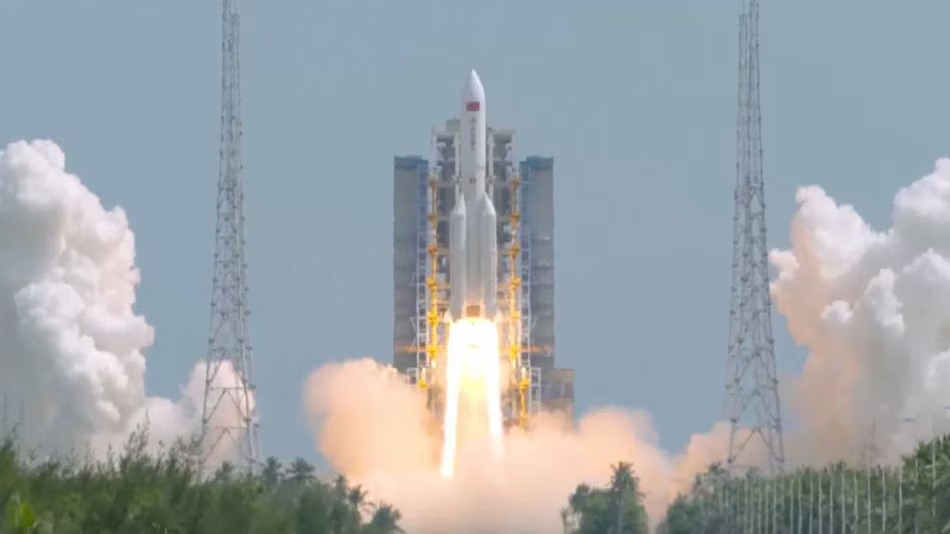
China launched the eighth batch of Guowang satellites on August 13 using a Long March 5B rocket, progressing toward its goal of a 13,000-satellite internet network.
China is accelerating the expansion of its Guowang internet constellation, aiming to rival SpaceX’s Starlink. First launched in December 2024, the Guowang program—meaning “national network”—is operated by the state-owned China SatNet and is planned to ultimately include around 13,000 satellites. On August 13, a Long March 5B rocket successfully deployed the eighth batch of satellites from the Wenchang Space Launch Center on Hainan Island. This marked the fourth Guowang launch in under three weeks, signaling China’s rapid push in the space-based internet sector.
About Guowang
China SatNet, a relatively new state-owned enterprise, was formally established by the Chinese government in April 2021. Its mission is to build Guowang, a “mega-constellation” of internet satellites in low Earth orbit, positioning China in the highly strategic field of space-based broadband mobile communications, an area currently dominated by SpaceX and its Starlink network.
Deployment Strategy
Although the ultimate goal is a 13,000-satellite network, each Guowang launch has so far carried only eight to ten satellites. This is in contrast to SpaceX, which typically launches 24 to 28 Starlink satellites per mission, indicating that each Guowang spacecraft is relatively large. Despite the slower per-launch deployment, the frequent missions demonstrate China’s commitment to steadily building a comprehensive internet constellation.
The Guowang program underscores China’s ambition to compete globally in satellite broadband services, leveraging a state-led approach to accelerate its presence in the strategic space infrastructure sector while challenging American dominance in low Earth orbit connectivity.