Google Claims Willow Quantum Chip Achieves Breakthrough, Solves Algorithm 13,000 Times Faster
Google has announced a major milestone in quantum computing, claiming that its Willow quantum chip has solved a previously intractable algorithm 13,000 times faster than classical supercomputers. The breakthrough demonstrates the tangible advantages of quantum hardware over traditional computing methods, providing the first verifiable proof that quantum processors can outperform even the most advanced classical systems for certain specialized tasks. This achievement is seen as a crucial step toward practical, real-world applications of quantum technology.
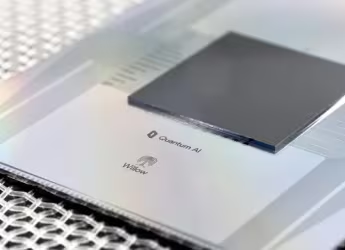
Willow, which powers Google’s quantum supercomputer, was tasked with solving the “Quantum Echoes algorithm,” designed to explore complex interactions in quantum systems. According to the company, the algorithm is considered impossible for conventional computers to solve efficiently, making Willow’s success a significant proof-of-concept. Google emphasizes that the speed and precision of its chip were key in enabling the solution, marking a critical point in the development of scalable quantum computing.
The research detailing this milestone was published in the journal Nature, highlighting the methodologies and technical strategies used. Google’s team combined advanced error mitigation techniques, precise qubit control, and sophisticated calibration methods to ensure the reliability of the computation. The result illustrates how quantum systems can tackle specialized problems that would take classical machines thousands of times longer to compute.
Beyond the immediate achievement, Google says this milestone lays the groundwork for tackling more complex, practical problems in fields such as material science, chemistry, and cryptography. While widespread, general-purpose quantum computing is still years away, the Willow chip’s performance provides strong evidence that quantum advantage is achievable and opens the door to further experiments aimed at scaling up qubit counts and increasing system stability.