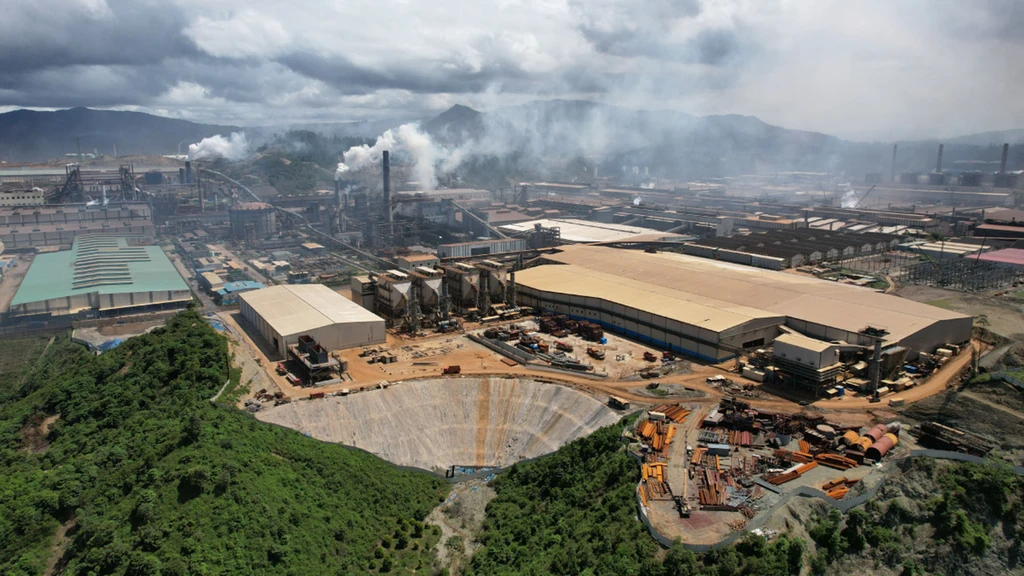
Chinese Firms Control Around 75% of Indonesian Nickel Refining Capacity, Report Finds

A report from C4ADS, a global security nonprofit based in Washington, has revealed that Chinese companies control approximately 75% of Indonesia’s nickel refining capacity, raising concerns about supply chain control and environmental risks. As of 2023, Indonesia’s refining capacity, which totals 8 million metric tons, is distributed across 33 companies. However, shareholder overlap shows that Chinese firms effectively control about three-quarters of the smelting capacity.

The report highlights that, while Indonesia aims to use its nickel industry as a key driver for economic growth, the substantial foreign influence could limit the country’s ability to fully control and shape the industry for its own benefit. The dominance of Chinese-controlled nickel production is also seen as a competitive disadvantage for U.S. and European automakers, especially in the growing electric vehicle (EV) market. Nickel, a key component in EV batteries, is crucial for the development of green technologies, but increasing restrictions on trade with China could affect access to this vital resource.

An Indonesian official noted last year that Chinese companies were seeking partnerships with Indonesian and South Korean firms to reduce their stakes in smelters, making their products more accessible to the U.S. market. To address these concerns, President Prabowo Subianto formed a task force to develop Indonesia’s downstream mineral industry with domestic financing, aiming to reduce the perception that foreigners benefit the most from the country’s resources.

The C4ADS report pointed out that two Chinese companies, Tsingshan Holding Group and Jiangsu Delong Nickel Industry Co Ltd, were responsible for over 70% of Indonesia’s refining capacity as of 2023. These companies were among the first investors in Indonesia’s push for domestic processing of nickel ore, a move that has helped make Indonesia the world’s dominant producer of nickel.

The report also mentions safety issues tied to Chinese-owned facilities. In December 2023, two workers at a Tsingshan Stainless Steel facility in Central Sulawesi were sentenced to jail for negligence related to a fire that caused fatalities. Additionally, in early 2023, two workers died in clashes at the PT Gunbuster Nickel Industry smelter in North Morowali, owned by Jiangsu Delong Nickel Industry.

Despite these concerns, Tsingshan has been selling stakes in some of its smelters. In October 2023, the company reached a deal with Indonesian state miner Aneka Tambang to sell 30% of PT Jiu Long Metal Industry.


Keppel’s Profit Boosted by Strong Data Centre Demand

Singapore’s Keppel Corporation reported a 5% rise in its full-year underlying profit, driven by robust performance in its connectivity segment, particularly in the data centre business. The company’s data centre operations saw an impressive 45% increase in annual net profit, reflecting the surging demand for digital infrastructure needed to support artificial intelligence services.

Keppel’s connectivity arm, which operates data centres that house servers and other computing equipment, has benefitted from the growing need for AI-driven digital infrastructure, particularly in the Asia Pacific region. As AI and other digital services expand, investments in data centres are expected to grow, further bolstering the company’s performance.

The firm, originally established over 56 years ago as a shipbuilding yard, has plans to more than double its data centre funds under management and increase its capacity, as announced in October. However, the highest-earning segment of Keppel’s infrastructure business saw a slight 4% decline in profit to S$673 million, largely due to lower fair value gains and reduced distributions from Keppel Infrastructure Trust.

Keppel’s net profit from continuing operations, excluding its offshore and marine assets, rose to S$1.06 billion ($784.20 million) in 2024, up from S$1.02 billion the previous year. The company, transitioning into an asset management firm, has set a target to manage S$200 billion in assets by 2030. As of December, its funds under management reached S$88 billion.

The company declared a final dividend of 19 Singapore cents per share, consistent with last year’s payout.


Bridgewater’s Pure Alpha Fund Surges 8.2% in January Amid Market Volatility

Bridgewater Associates’ flagship hedge fund, Pure Alpha, saw a notable gain of 8.2% in January, defying the broader market’s volatility, which included a downturn in AI-related stocks and geopolitical uncertainties. While the exact drivers behind the fund’s performance remain unclear, the surge marks a positive start for the year for the firm’s macro-focused strategy.

In comparison, last year, Pure Alpha experienced a more modest rise of 11.3%, driven by a mix of global economic events. In January, the tech sector faced a significant blow when Chinese AI startup DeepSeek claimed its model was either on par with or surpassed U.S. leaders like Nvidia at a fraction of the cost. This revelation caused Nvidia’s stock to plunge by 17%, contributing to broader sell-offs in the AI space.

Additionally, January saw market turbulence spurred by U.S. President Donald Trump’s tariff threats on Canada, Mexico, and China, which added to the uncertain economic backdrop. Although Trump later suspended tariffs on Mexico and Canada, the trade dispute with China remained unresolved, adding further pressure on global markets.

Despite these challenges, U.S. stock indices ended January in the positive, with the S&P 500 rising by 2.7%, the Nasdaq Composite up by 1.64%, and the Dow Jones Industrial Average gaining 4.7%. Bridgewater’s strong performance during this volatile period underscores the fund’s ability to navigate market challenges effectively.

Karen Karniol-Tambour, co-chief investment officer at Bridgewater, advised investors at a conference in Miami to diversify away from U.S. equities and increase their bond holdings to hedge against potential growth slowdowns. She highlighted that the bar for continued U.S. equity outperformance had risen significantly after a period of extraordinary gains.