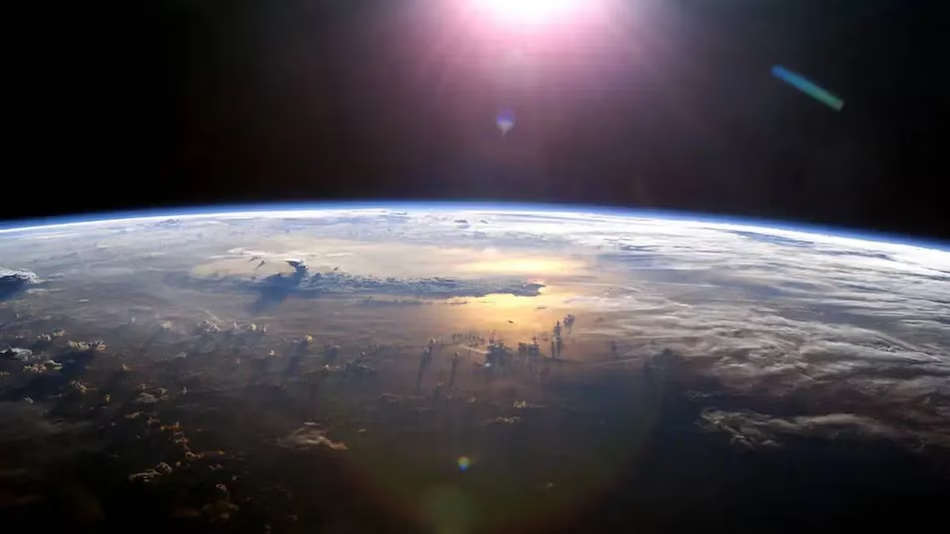
Researchers Warn Artificial Climate Cooling Could Disturb Monsoons and Global Weather Patterns

Injecting fine particles of sulphur into the stratosphere via aircraft has been proposed as a seemingly “cheap and fast” method to cool the planet. Known as stratospheric aerosol injection (SAI), this form of geoengineering could potentially slow the rise of global temperatures. However, recent research warns that such interventions may carry serious unintended consequences, including disruptions to crucial weather patterns like the monsoon and shifts in rainfall, which could also impact tropospheric ozone levels. Devamını Oku
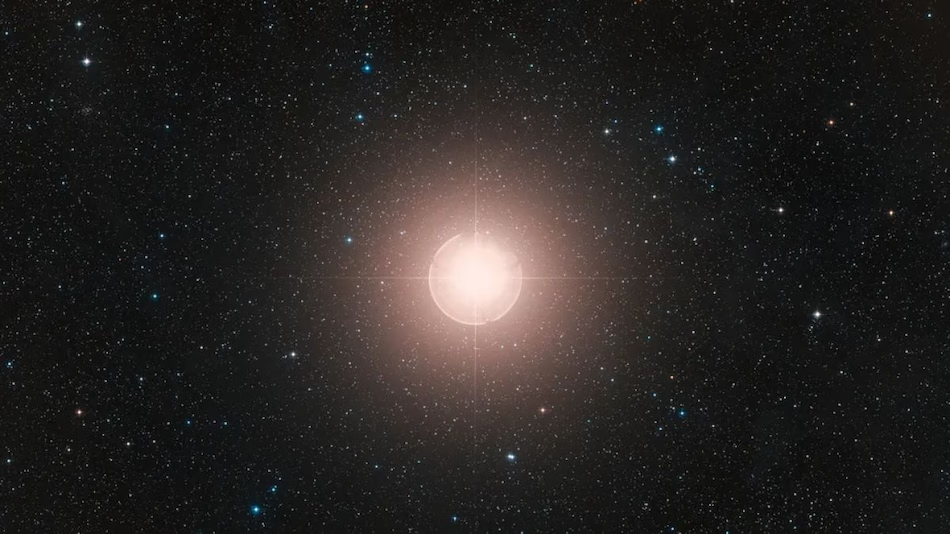
NASA Telescopes Spot First Known Companion Star Orbiting Red Supergiant Betelgeuse

Astronomers have for the first time directly observed a companion star orbiting the massive red supergiant Betelgeuse, shedding new light on the dynamics of such extreme binary systems. Using NASA’s Chandra X-ray Observatory and the Hubble Space Telescope, researchers from Carnegie Mellon University (CMU) captured the faint companion at its maximum distance from the bright giant. Betelgeuse itself is an enormous evolved star, over 700 times the size of the Sun and thousands of times more luminous, making this observation particularly challenging due to the glare of the primary star. Devamını Oku

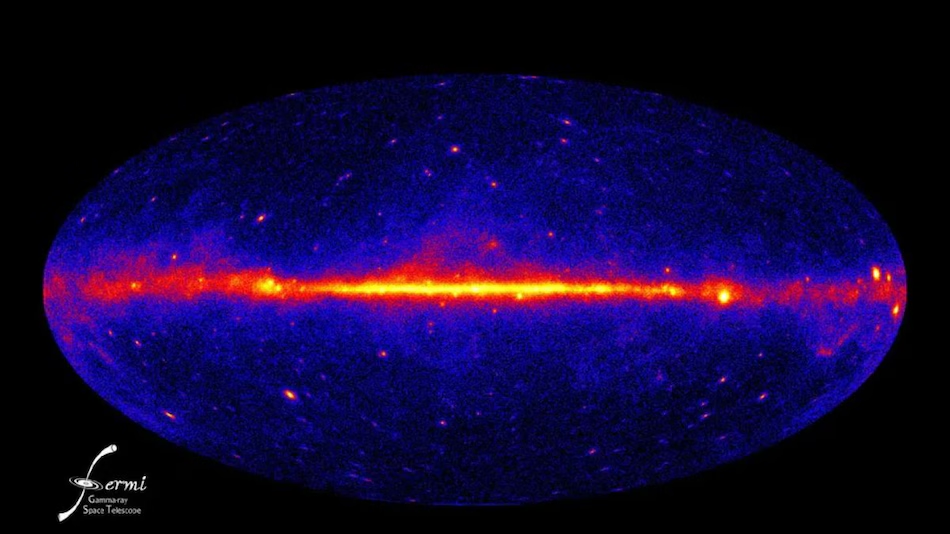
Study Suggests Flattened Dark Matter Could Be Behind Milky Way’s Central Gamma-Ray Glow

For over a decade, astronomers have been intrigued by a mysterious high-energy gamma-ray glow emanating from the center of the Milky Way. This excess radiation could not be explained by known sources, such as pulsars or supernova remnants. Recent computer simulations now suggest a potential solution: the dark matter surrounding galactic centers may not be spherical, as previously assumed, but rather flattened into a discoidal shape. This configuration could produce a radiation pattern closely matching the unexplained glow observed by NASA’s Fermi space telescope. Devamını Oku