Study Suggests Flattened Dark Matter Could Be Behind Milky Way’s Central Gamma-Ray Glow
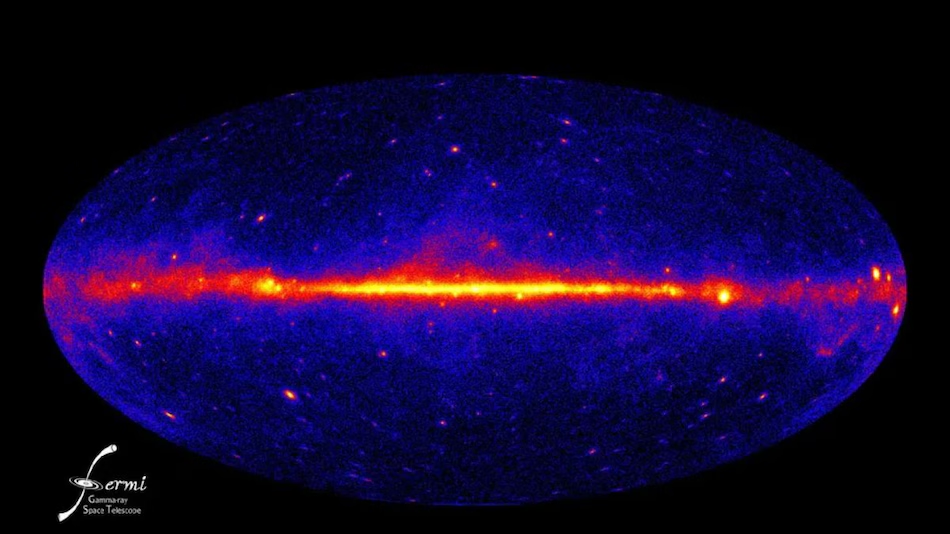
For over a decade, astronomers have been intrigued by a mysterious high-energy gamma-ray glow emanating from the center of the Milky Way. This excess radiation could not be explained by known sources, such as pulsars or supernova remnants. Recent computer simulations now suggest a potential solution: the dark matter surrounding galactic centers may not be spherical, as previously assumed, but rather flattened into a discoidal shape. This configuration could produce a radiation pattern closely matching the unexplained glow observed by NASA’s Fermi space telescope.
The study, published on 16 October in Physical Review Letters, was led by Moorits Mihkel Muru in collaboration with the University of Tartu in Estonia and the Leibniz Institute for Astrophysics Potsdam. Using advanced HESTIA simulations, the team modeled the behavior of dark matter under galactic forces, including gravitational interactions and past galactic mergers. These simulations suggest that such events could distort dark matter into a flattened shape, generating the gamma-ray emission pattern detected in the Milky Way’s core.
Previously, many scientists attributed the excess gamma rays to populations of millisecond pulsars. However, the new study challenges this explanation, proposing that the geometry of dark matter itself could account for the radiation. The flattened arrangement provides a natural mechanism for the central glow without requiring unseen populations of exotic stars, reviving the long-debated theory linking dark matter to the galaxy’s energetic heart.
The findings highlight that dark matter around our galaxy is likely dynamic and non-uniform, influenced by gravitational torques from structures like the stellar spheroid. By demonstrating that a flattened dark matter halo can produce the observed gamma-ray signature, the research opens new pathways for understanding the distribution of dark matter in galaxies and its role in shaping the radiation environment at their cores.