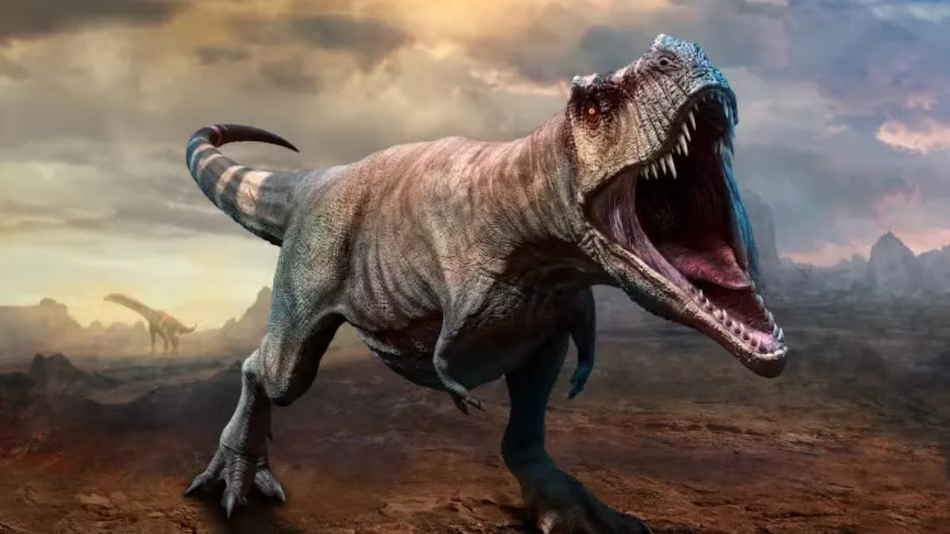
Fossil Discoveries Reveal Dinosaurs Thrived Right Up to Their Extinction
Recent fossil evidence suggests that dinosaurs were thriving right up until the catastrophic asteroid impact 66 million years ago, challenging previous assumptions that their populations were already in decline. A rich and diverse dinosaur community has been uncovered in New Mexico, indicating that these prehistoric creatures maintained robust ecosystems shortly before their sudden extinction. These findings paint a picture of dinosaurs as active and flourishing in their final days, rather than gradually fading from the planet.
Researchers re-examined the San Juan Basin’s Naashoibito Member in New Mexico using radiometric and magnetic dating methods. The new analysis revealed that the youngest dinosaur-bearing rock layers date to approximately 66.38 million years ago, roughly 350,000 years before the mass extinction event. This provides a more precise timeline than previous estimates, which suggested the area’s dinosaur fossils were closer to 70 million years old.
The updated dating shows that New Mexico’s dinosaurs lived nearly to the very end of the Cretaceous period, contemporaneous with species such as Triceratops in Montana. Among the fossils identified were hadrosaurs, or duck-billed dinosaurs, and the massive sauropod Alamosaurus, demonstrating that large herbivores and diverse dinosaur communities were still thriving just before the asteroid impact.
These discoveries offer new insights into the final days of dinosaur ecosystems, indicating that the mass extinction event was abrupt rather than a consequence of long-term decline. By revisiting rock layers and applying modern dating techniques, scientists are rewriting our understanding of the Late Cretaceous, revealing that dinosaurs were still flourishing and fully adapted to their environment right up to the moment when a cataclysmic asteroid abruptly ended their reign.