Google Begins Rolling Out Gemini Assistant for Android Auto

Gemini starts rolling out on Android Auto with Live support [Gallery]

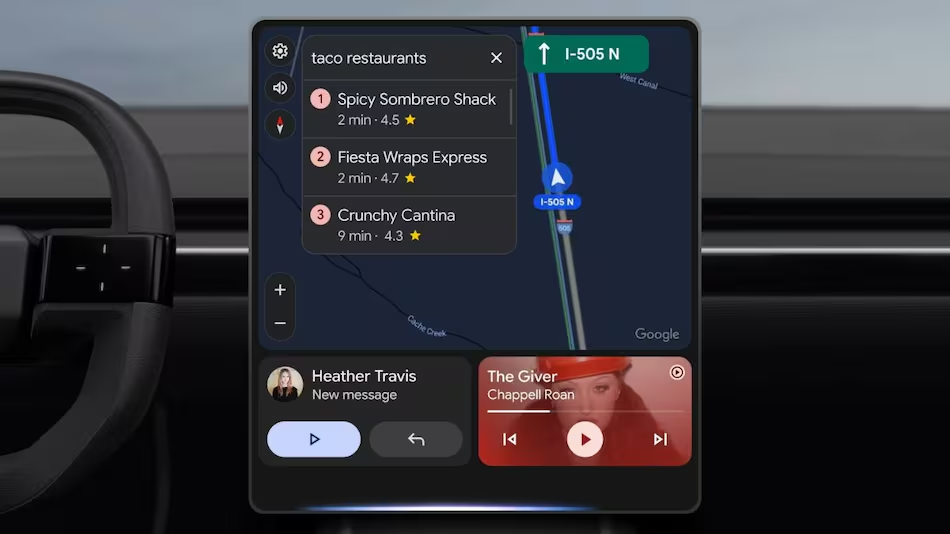
Google has reportedly begun rolling out its Gemini assistant to Android Auto, marking a significant step in integrating AI-driven functionality into the in-car experience. Over the past few days, several users have spotted Gemini appearing in their Android Auto interfaces, suggesting that the Mountain View-based company is gradually introducing the assistant. While it remains unclear whether this rollout is part of a beta program or intended for wider public access, the development follows Google’s initial announcement of the feature at Google I/O in May.

According to a 9to5Google report, Gemini has been observed on Android Auto 15.6 when connected to the Google Pixel 10 Pro XL, and on Android Auto 15.7 when paired with the Samsung Galaxy Z Fold 7. Both of these Android Auto versions are currently in beta, indicating that Google may be using the beta environment to test Gemini’s performance and compatibility before a full-scale launch.

At this stage, there is no official word from Google regarding whether the rollout is exclusively a beta test or the beginning of a broader deployment. Users encountering Gemini in Android Auto might simply be part of an initial controlled rollout, with more devices and regions expected to gain access gradually. This phased approach allows Google to monitor performance, gather user feedback, and make adjustments before releasing the feature globally.

Despite the uncertainty, the introduction of Gemini in Android Auto signals Google’s ongoing push to bring AI assistants deeper into everyday workflows, including in-car navigation and hands-free interaction. By leveraging Gemini’s capabilities, drivers could potentially access smarter route suggestions, contextual reminders, and natural language queries, enhancing both convenience and safety for Android Auto users in the near future.


Perplexity Teams Up With Snapchat to Bring AI-Powered Search to the App

Snapchat X Perplexity AI $400 Million Collaboration

Perplexity and Snap, the parent company of Snapchat, announced a strategic partnership on Wednesday to bring AI-powered search and chat capabilities directly into the social media app. Under the agreement, Perplexity’s AI chatbot will be integrated alongside Snapchat’s existing My AI feature, allowing users to ask a wide range of questions and receive intelligent responses in real time. The collaboration not only expands Snapchat’s AI offerings but also provides financial benefits to Snap through the partnership.

According to a Snap newsroom post, Perplexity’s AI chatbot will soon be accessible to more than 943 million monthly active users (MAUs) on Snapchat. The integration aims to make AI a more natural and interactive part of the app experience, enabling users to explore information, engage in dynamic conversations, and discover new content without leaving the platform.

Evan Spiegel, CEO of Snap Inc., emphasized the company’s vision for AI in social media, stating, “Our goal is to make AI more personal, social, and fun – woven into the fabric of your friendships, Snaps, and conversations. This partnership reflects our shared vision for the power of AI to enhance discovery and connection on Snapchat.” By embedding AI seamlessly into everyday interactions, Snapchat hopes to elevate user engagement and satisfaction.

The collaboration also signals Snap’s commitment to innovative AI partnerships that bring meaningful value to its community. By integrating Perplexity, the company strengthens its position in the rapidly evolving AI landscape, offering users smarter tools for learning, entertainment, and social interaction while providing developers with new opportunities to expand AI-driven experiences within the app.

Seated Salsa: The Simple Desk Exercise That Helps Ease Back Pain

If you’ve ever bent down to tie your shoes and felt that sudden, sharp pain in your lower back, you’re not alone. Around 619 million people worldwide suffer from lower back pain — now the leading cause of disability globally. But a simple exercise called “seated salsa” could help relieve that pain without you even having to stand up.

Developed by physiotherapists studying how movement affects the spine, seated salsa gently mobilizes the lower vertebrae — the stiffest part of the back, where most pain occurs. “The bottom of the spine is held tightly in place by ligaments, which makes it very stable but also difficult to move once pain sets in,” explains Chris McCarthy, associate professor of physiotherapy at Manchester Metropolitan University.

When the back becomes painful, muscles spasm and restrict motion, creating a vicious cycle of stiffness and pain. Seated salsa breaks that cycle by restoring small, rhythmic motion to the pelvis — mimicking the natural side-to-side movement that occurs when walking.

To perform it, sit upright with your feet flat on the floor and knees together. Keep your shoulders still, then push your right knee forward as you pull your left knee back, and switch. The motion causes your pelvis to tilt from side to side — just like a salsa dance. Repeat for one minute every 30 minutes.

Early trials by the Manchester Movement Unit found that even short sessions helped relax lower back muscles and reduce pain. “It’s easy to do while you’re working,” says McCarthy. “You don’t even need to leave your desk.”

Seated salsa can also help older adults or those with reduced mobility, offering a low-impact way to stay active. Experts agree that regular movement — no matter how small — is essential for long-term health. As geriatrician Jugdeep Dhesi puts it: “It’s about making movement a habit — whether it’s seated salsa at work or a few squats while the kettle boils.”