
India Begins Repatriation of Citizens Who Fled Myanmar Cybercrime Center

India has begun repatriating hundreds of its nationals who fled from a major cybercrime hub in Myanmar following a military raid on the facility last month. The operation marks the latest effort to rescue victims of human trafficking linked to Southeast Asia’s booming online scam industry.

An Indian Air Force transport plane departed Thailand on Thursday carrying 270 people, with another flight scheduled later in the day. A total of 465 Indians will be flown home from the Thai border town of Mae Sot, where they had taken refuge after escaping the notorious “KK Park” compound in Myawaddy, Myanmar, according to Thai army commander Maj. Gen. Maitree Chupreecha. The remaining group is expected to leave on Monday.

Myanmar’s military raided KK Park in mid-October, part of a wider crackdown on cyber scams and illegal gambling operations that have flourished along its borders. The compound reportedly hosted a large-scale scam network where foreign workers — many trafficked or deceived by false job offers — were forced to run fraudulent online schemes.

In total, more than 1,500 people from 28 countries fled the Myawaddy raid. Thai authorities temporarily housed nationals from India, China, the Philippines, Vietnam, Ethiopia, and Kenya while coordinating repatriation with their governments.

The United Nations estimates that cyber scam centers across Southeast Asia generate nearly $40 billion annually, often using trafficked labor. While Myanmar’s junta says it is dismantling such operations, independent media including The Irrawaddy report that scam networks continue to operate in Myawaddy despite the raids.

The issue has drawn global attention: the U.S. and U.K. recently sanctioned organizers of a Cambodian scam ring, while South Korea was shaken by the death of a young man believed to have been lured into one such operation.

Denmark Moves to Ban AI Deepfakes, Giving Citizens Copyright Over Their Own Likeness

Denmark is preparing to pass one of the world’s toughest laws against AI-generated deepfakes, aiming to give citizens new legal rights over their appearance, voice, and likeness online. The bill — expected to pass early next year — would make it illegal to share or distribute deepfake content without a person’s consent, extending copyright protections to individuals.

The proposed legislation follows growing concern about the rapid spread of deepfakes — hyper-realistic AI-generated videos, images, or audio that impersonate real people. Danish Culture Minister Jakob Engel-Schmidt said the move is essential to protect both private citizens and democracy itself, warning that political deepfakes could “undermine our democracy” by spreading falsehoods.

Under the new law, Danes would be able to demand takedowns of AI-generated content that misuses their likeness, while parody and satire would remain protected. Major tech platforms that fail to remove harmful deepfakes could face significant fines, although individuals are unlikely to face criminal penalties.

Experts have praised the move as a landmark step. “When people ask, ‘what can I do to protect myself from being deepfaked,’ the answer right now is basically nothing,” said Henry Ajder, a generative AI researcher and founder of Latent Space Advisory. “Denmark is one of the first governments to change that.”

The Danish proposal mirrors similar measures abroad. The United States recently criminalized the sharing of non-consensual intimate deepfakes, while South Korea introduced harsh penalties for deepfake pornography. Denmark’s initiative could now influence European Union policy, with France and Ireland reportedly showing interest in adopting similar laws.

For victims like Marie Watson, a Danish video game streamer whose photos were digitally altered and shared online, the legislation comes too late to undo the damage but offers hope for future protection. “When it’s online, you’re done. You can’t do anything,” she said. “It’s out of your control.”

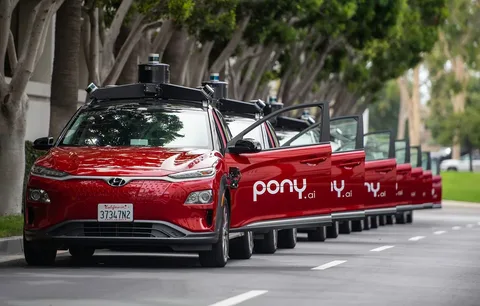
Pony.ai Shares Fall 12% in Hong Kong Debut as Autonomous Rivals WeRide Also Slide

China’s leading autonomous driving startup Pony.ai saw its shares drop more than 12% on Thursday in its Hong Kong debut, while rival WeRide fell nearly 13%, reflecting investor caution toward the fast-evolving self-driving sector.

Pony.ai raised HK$6.71 billion (about $860 million) and WeRide HK$2.39 billion through their initial public offerings, both of which come as Chinese tech firms increasingly seek dual listings in Hong Kong amid geopolitical uncertainty and stricter U.S. regulations.

Both Guangzhou-based firms are investing heavily in Level 4 autonomous driving — vehicles that can operate without human intervention under specific conditions. Pony.ai CEO James Peng said proceeds would help expand autonomous parking and charging infrastructure, while WeRide’s CEO Tony Xu Han said funds would support AI development and data center expansion.

The companies have already launched robotaxi services in several Chinese cities and plan to expand to new regions including the Middle East, Europe, and Singapore, though full regulatory approvals remain pending.

The listings come at a delicate time for Chinese tech firms facing mounting U.S. restrictions. A new rule effectively bans Chinese technology in connected vehicles, complicating Pony.ai and WeRide’s ambitions to partner with Uber for robotaxi operations in the U.S.

“The dual listings are about risk mitigation,” said Tu Le, managing director at Sino Auto Insights. “They acknowledge it will take significant capital — and a market outside the U.S. — for these firms to succeed.”

The weak debut mirrored declines in New York, where WeRide shares dropped 5.2% and Pony.ai fell 2% the previous day. Still, analysts said the Hong Kong listings will help both companies secure Asia-based funding and reinforce the city’s growing image as a tech hub.