Yazılar

Sergey Brin Breaks Silence at Google I/O 2025, Shares Why He Came Back

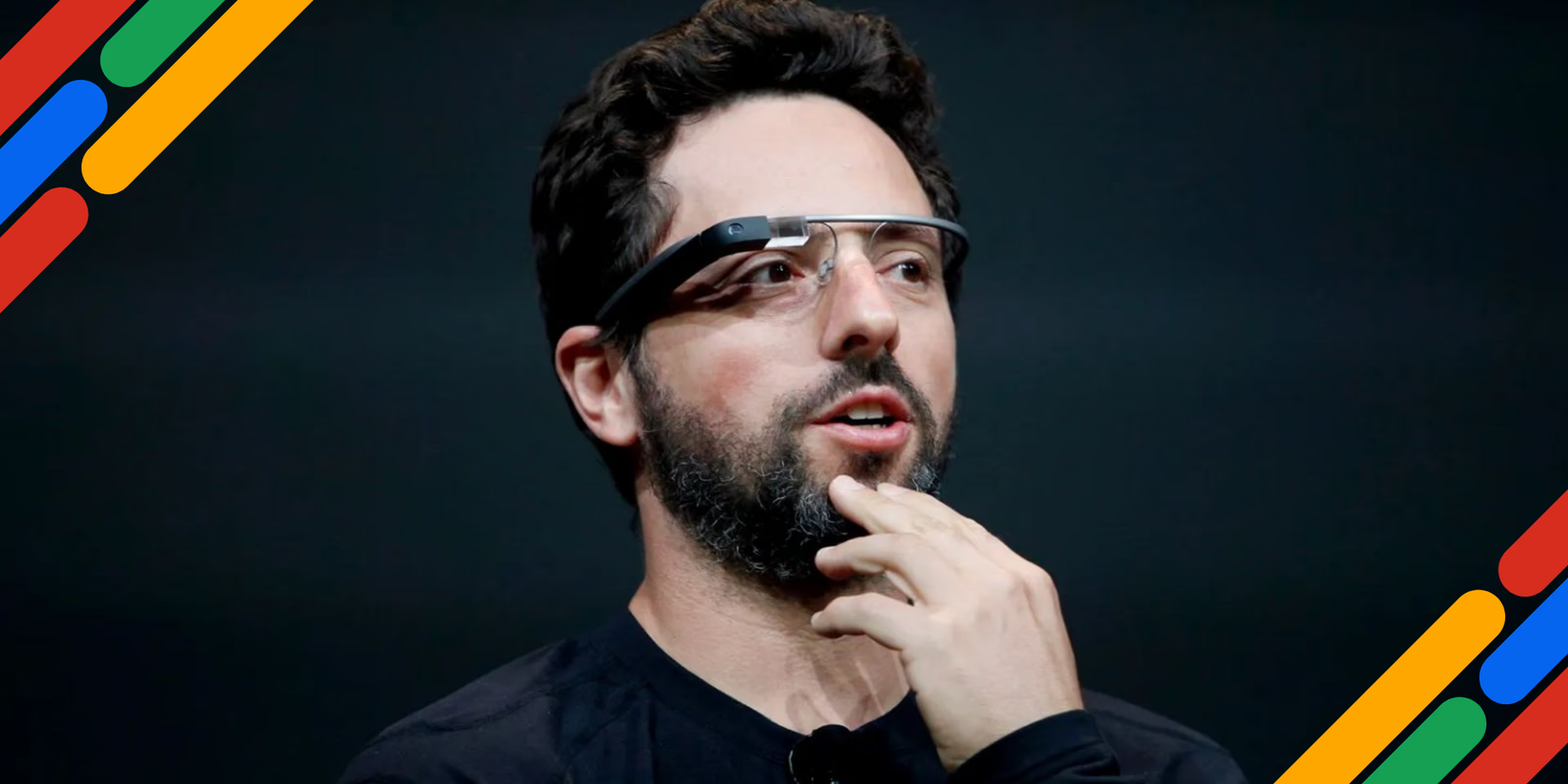
At the Google I/O 2025 developer conference, attendees were treated to a major surprise on day one: the unexpected appearance of Google Co-Founder Sergey Brin. Scheduled as a fireside chat between DeepMind CEO Demis Hassabis and moderator Alex Kantrowitz, the session quickly turned into something far more notable when Brin joined the stage. The conversation centered around artificial intelligence, highlighting Google’s latest Gemini tools, the capabilities of its newest AI models, and a bold look toward the future of artificial general intelligence (AGI). Brin also used the opportunity to share why he returned to Google after years of stepping away from day-to-day operations.

Brin’s reentry into the spotlight appeared to be driven by a renewed sense of purpose. He expressed his excitement about the progress in AI and the potential for meaningful breakthroughs that could reshape technology—and even society. Speaking candidly, Brin acknowledged that developments like Gemini represent a pivotal shift in computing, and he believes his presence can help steer Google toward achieving AGI responsibly and effectively. “This is the most interesting and important challenge I’ve seen in decades,” he remarked.

Throughout the discussion, Demis Hassabis emphasized the distinction between current AI models and true AGI. According to Hassabis, AGI is not just about performing tasks—it’s about replicating the broad cognitive flexibility of the human brain. He explained that while today’s models are capable of impressive feats, they still fall short of the consistency, reasoning, and creativity that define general intelligence. Hassabis pointed to the need for breakthroughs in world modeling and logical reasoning before AGI becomes a reality, though he remains optimistic that those breakthroughs are within reach.

When pressed on a timeline for AGI, the panelists offered slightly different forecasts. Brin confidently predicted that AGI would arrive before 2030, aligning with Google’s ambitions for its Gemini platform. Hassabis, slightly more cautious, estimated it might emerge just after that milestone. Regardless of the exact date, both leaders agreed that AGI is no longer a distant dream but a near-future goal—one that Brin is now personally invested in helping realize.

High-Flyer, the AI Quant Fund Behind China’s DeepSeek, Shifts Focus to Artificial General Intelligence

Key Highlights:

  • High-Flyer, a quantitative hedge fund, shifted its focus from managing a $13.79 billion portfolio to developing Artificial General Intelligence (AGI).
  • The fund, officially known as Hangzhou Huanfang Technology Ltd Co., is reorienting its resources to pursue AGI, which is a more advanced form of AI capable of surpassing human abilities in most economically valuable tasks.
  • The DeepSeek AI model, which has gained significant attention in the tech world, is part of this new direction under the leadership of Liang Wenfeng, High-Flyer’s founder and the leader of DeepSeek.
  • DeepSeek’s AI models have garnered praise from Silicon Valley and sparked concerns about the computational efficiency of U.S. firms’ AI models, given DeepSeek’s claims of utilizing far less computing power.

Background on High-Flyer’s AI Investment Strategy:

  • High-Flyer has heavily invested in supercomputing clusters, including those made up of Nvidia A100 chips, despite U.S. export controls. These clusters have been crucial for the development of its AI models.
  • The company has also spent millions on high-end Nvidia chips, setting up two AI supercomputing clusters with a combined investment of over $1.2 billion.
  • DeepSeek, which utilizes much less powerful chips (Nvidia’s H800 and H20), has nonetheless sparked debates on its computational capabilities, with some tech executives speculating it may have access to 50,000 Nvidia H100 chips, potentially bypassing U.S. export restrictions.

Future Prospects:

  • Liang Wenfeng has indicated that High-Flyer is not currently seeking external funding for DeepSeek and is more focused on overcoming challenges related to chip restrictions rather than financial concerns.
  • The company’s strategic shift towards AGI signals a long-term commitment to advancing AI technology for human benefit, even as it navigates international tensions over AI and technology exports.

Alibaba Unveils Qwen 2.5 AI Model, Claims Superiority Over DeepSeek

Chinese tech giant Alibaba (9988.HK) has launched Qwen 2.5-Max, its latest AI model, which it claims surpasses DeepSeek-V3, GPT-4o, and Llama-3.1-405B in performance.

Key Highlights:

  • Unexpected Timing:
    • Released on Lunar New Year’s first day, signaling urgency amid DeepSeek’s rapid rise.
  • DeepSeek’s Disruptive Impact:
    • DeepSeek-V3 & R1 models have shaken Silicon Valley and Chinese AI firms.
    • The low-cost model pricing has forced AI leaders to reassess spending strategies.
  • Domestic AI Rivalry Intensifies:
    • ByteDance quickly upgraded its AI model to challenge OpenAI.
    • Alibaba, Baidu, and Tencent are aggressively cutting prices to remain competitive.
  • DeepSeek’s Unique Approach:
    • Founder Liang Wenfeng prioritizes AGI (Artificial General Intelligence) over price wars.
    • The startup operates lean and research-focused, unlike hierarchical tech giants.

Alibaba’s latest move underscores the fierce AI competition in China as companies race toward dominance in next-gen AI models.