Yazılar

Google Cloud Integrates Chirp 3 Audio Generation Model into Vertex AI Platform

Google Cloud has expanded its AI offerings by bringing the Chirp 3 audio generation model to its Vertex AI platform, marking a significant step in enhancing the platform’s capabilities. Initially available in private preview, Chirp 3 is now accessible to all Vertex AI users. This cutting-edge model is designed to create human-like audio with a variety of custom voices, providing a more natural and expressive listening experience. The latest version of Chirp 3 introduces eight new voices and supports 31 different languages, further expanding its versatility and global reach.

The official announcement was made during the “Gemini for the United Kingdom” event held at Google DeepMind’s headquarters in London, where Google Cloud unveiled several notable updates and advancements related to artificial intelligence. Chirp 3’s integration into Vertex AI is poised to add significant value to the platform by enabling users to generate high-quality audio with nuanced and dynamic voice inflections, which can be useful across various applications, from virtual assistants to content creation.

Starting next week, Chirp 3 will be fully integrated into Vertex AI, joining other notable AI models such as Gemini, Imagen, and Veo. The addition of Chirp 3 will enhance the platform’s offerings, providing users with the ability to create realistic and expressive speech. With the introduction of its HD Voices feature, Chirp 3 will be available in 31 languages and offer 248 unique voices, including eight speaker options to cater to a wide range of preferences and needs.

One of the standout features of Chirp 3 is its ability to generate speech with human-like intonation and emotional depth, making it a powerful tool for creating immersive and lifelike audio experiences. Google Cloud’s continuous innovation in AI models like Chirp 3 signals the company’s commitment to advancing the field of artificial intelligence and empowering users with sophisticated tools for a wide range of applications.
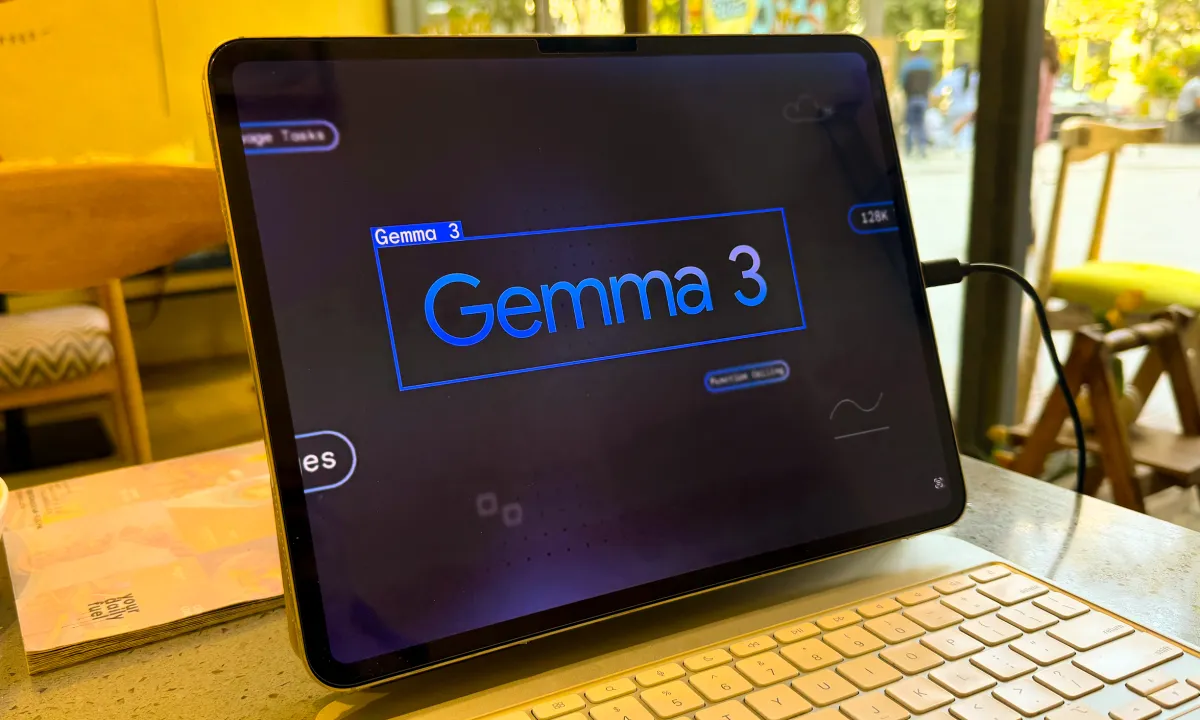
Google Unveils Gemma 3 Open-Source AI Models, Optimized to Run on a Single GPU

Google has officially launched the Gemma 3 family of open-source artificial intelligence (AI) models, marking a significant advancement over the previous Gemma 2 series introduced in August 2024. The new models come with enhanced text and visual reasoning capabilities, offering the ability to process and analyze images, text, and short videos. One of the key selling points of the Gemma 3 series is its support for over 35 languages, with the ability to be fine-tuned to support up to 140 languages. This makes it an incredibly versatile tool for developers and organizations looking to integrate AI into multilingual applications. Additionally, these models are optimized to run on a single GPU or Google’s custom Tensor Processing Unit (TPU), making them more accessible and easier to deploy.

The Gemma 3 models are part of Google’s broader initiative to provide small language models (SLMs) that maintain high performance while being resource-efficient. Built using the same underlying technology as Google’s Gemini 2.0 models, Gemma models have already seen impressive uptake, with over 100 million downloads and more than 60,000 variants created by developers. By making these models open-source, Google continues its push to democratize AI, allowing a wide range of developers to leverage the power of advanced AI models without needing extensive computational resources.

In terms of performance, the Gemma 3 series has proven itself to be competitive with other industry-leading models. According to Google, it outperforms Meta’s Llama-405B, DeepSeek-V3, and OpenAI’s o3-mini models on the LMArena’s leaderboard. Available in four sizes — 1B, 4B, 12B, and 27B parameters — these models can be tailored to meet different use cases, whether for text processing or image and video analysis. Furthermore, the Gemma 3 models come equipped with a context window of 128,000 tokens, enabling them to handle larger data inputs efficiently. They also support function calling, allowing developers to integrate agentic capabilities into their applications and software.

Google has emphasized that these models were developed with careful attention to safety and risk management. The company has incorporated internal safety protocols through fine-tuning and benchmark evaluations to ensure that the models function responsibly. Additionally, the Gemma 3 models underwent testing with more capable AI models to ensure that they performed reliably while maintaining a low risk profile. By focusing on both performance and safety, Google aims to provide powerful AI tools that are not only effective but also secure and responsible in their deployment.

China’s DeepSeek Releases V3 AI Model, Boosting Competition with OpenAI

Chinese AI startup DeepSeek has launched a major upgrade to its V3 large language model, DeepSeek-V3-0324, marking a significant step in its rivalry with U.S. tech giants such as OpenAI and Anthropic. The new model, available through the AI development platform Hugging Face, showcases notable improvements in reasoning and coding abilities, setting a new benchmark for performance in the AI space.

Benchmark tests indicate that the V3 model has outperformed its predecessor across multiple technical metrics, solidifying DeepSeek’s growing presence in the competitive AI market. DeepSeek, which has quickly become a key player in the global AI landscape, has been pushing forward with a series of model releases, including the V3 launch in December and the R1 model earlier in January.

The company’s rise is seen as part of a broader trend where Chinese AI firms are intensifying competition with Western companies, offering similar capabilities at lower operational costs. DeepSeek’s rapid development positions it as a formidable contender in the global AI race.