Yazılar

Snapdragon X Processors Unveiled for Budget PCs, Offering Up to 45 TOPS of NPU Performance at CES 2025

At CES 2025, Qualcomm unveiled its newest platform designed specifically for affordable PCs: the Snapdragon X. The new platform aims to challenge budget processors from Intel and AMD, offering a compelling option for cost-effective laptops. The Snapdragon X processors are equipped with an octa-core design and a dedicated neural processing unit (NPU) to enhance AI capabilities. With a focus on energy efficiency, these processors are designed to provide better battery life, making them an attractive choice for budget-conscious consumers. The Snapdragon X platform is expected to power computers priced under $600 (approximately Rs. 51,400), offering a more affordable solution for Arm-based Windows laptops.

The Snapdragon X platform, branded as the X1-26-100, features eight Oryon CPU cores, with a peak clock speed of up to 3GHz. While this is lower than the higher-end Snapdragon X Plus and X Elite variants, which can reach up to 3.4GHz and 3.8GHz, respectively, the X platform is still highly competitive for budget devices. Qualcomm’s decision to target the affordable PC segment with this chipset is part of a broader strategy to offer capable alternatives to traditional x86 processors in lower-priced laptops, particularly those running Windows 11.

In terms of memory and graphics, the Snapdragon X platform supports up to 64GB of LPDDR5x RAM and offers a substantial memory bandwidth of 135GB/s. This is paired with a Qualcomm Adreno GPU capable of driving up to three 4K displays at 60Hz, a feature typically found in higher-end laptops. With these specifications, the Snapdragon X ensures that affordable PCs can still offer excellent performance for everyday tasks, including media consumption and multitasking.

The Snapdragon X platform also supports Windows 11, bringing access to advanced features like Copilot+, which are typically reserved for more expensive PCs. This inclusion shows Qualcomm’s commitment to providing a premium user experience, even in the budget segment. By combining high performance, AI support, and improved power efficiency, the Snapdragon X platform is set to make a significant impact on the affordable PC market, making Arm-based laptops more accessible without compromising on essential features.
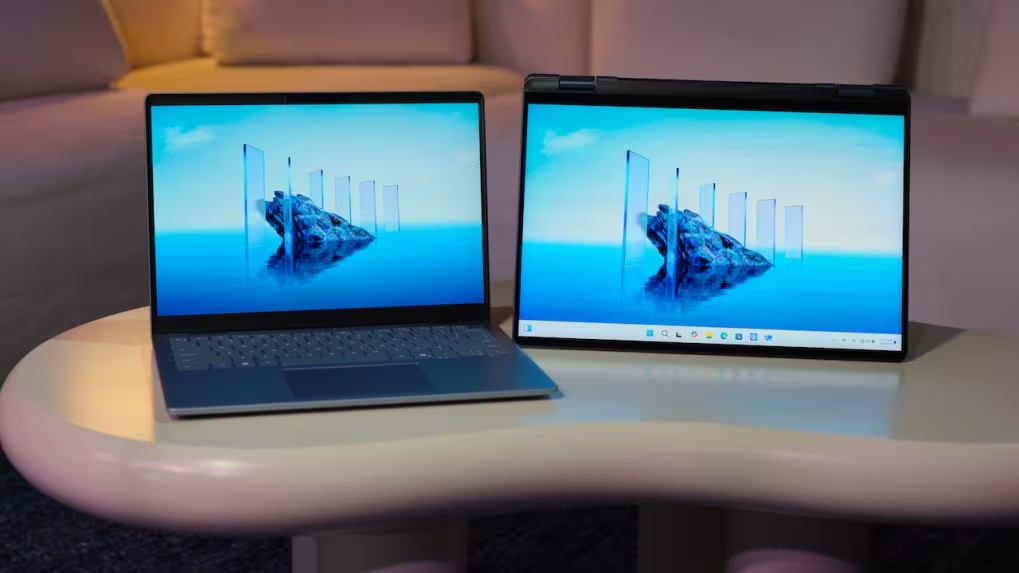
Dell Reveals Unified Branding and New AI Pro Studio at CES 2025, Launches 3-Category Product Lineup

Dell Unveils Unified Branding and AI-Powered Devices at CES 2025
At the Consumer Electronics Show (CES) 2025, Dell Technologies made a significant announcement regarding its new product lineup and branding strategy. The company revealed a simplified portfolio that integrates on-device artificial intelligence (AI) capabilities into its devices. In a bold move, Dell decided to retire the familiar Inspiron and XPS brands, choosing instead to consolidate its offerings under a unified Dell branding. The new lineup is divided into three distinct categories—Dell, Dell Pro, and Dell Pro Max—each catering to users with varying needs, from casual to professional.

A New Era for Dell: Streamlined Product Categories
Dell’s new branding strategy, which was detailed in a recent press release, marks a shift towards a more cohesive and simplified approach. The “Dell” category will target everyday users, offering devices ideal for play, school, and work. The “Dell Pro” line is designed for individuals looking to elevate their productivity to professional standards, with devices optimized for more demanding tasks. Meanwhile, the “Dell Pro Max” lineup is all about maximum performance, aimed at power users who require top-tier hardware and functionality. This reorganization allows customers to more easily identify the device that best suits their needs, whether for personal or professional use.

Expanding Beyond Laptops: A Comprehensive Dell Ecosystem
Dell’s new product lines go beyond just laptops and PCs. The Dell and Dell Pro categories will also include a wide range of peripherals, such as monitors, accessories, and various services, making it a comprehensive solution for both home and professional environments. This expansion reflects Dell’s commitment to offering an all-encompassing ecosystem of devices and tools designed to enhance the user experience. Whether users are working from home, collaborating in a professional setting, or enjoying entertainment, Dell’s new offerings are poised to meet a variety of needs.

AI Integration: The Future of Computing with Dell
At the heart of Dell’s 2025 product lineup is the integration of artificial intelligence. Dell is prioritizing AI to bring smarter and more efficient devices to the market, with on-device AI helping to optimize performance, enhance productivity, and deliver personalized experiences. From improving battery life and system efficiency to enabling advanced features like voice recognition and AI-driven software, Dell’s AI-powered devices promise to push the boundaries of what personal computing can achieve. This strategic emphasis on AI places Dell at the forefront of innovation in the tech industry, offering users an intelligent, adaptable computing experience.

Microsoft’s 2025 Vision: Expanding Data Centers, AI Training, and Global Accessibility

Microsoft Outlines Ambitious AI Vision for 2025
Microsoft has unveiled its strategic vision for artificial intelligence (AI) for the fiscal year 2025, emphasizing significant investments in AI infrastructure, workforce skilling, and global accessibility. Instead of solely focusing on its AI product roadmap, the company has detailed plans to advance its AI ecosystem, aiming to create broader adoption and impact across industries. This vision underscores Microsoft’s commitment to shaping a future where AI plays a pivotal role in empowering individuals and organizations worldwide.

One of the most substantial elements of Microsoft’s strategy is a planned investment of approximately $80 billion (roughly Rs. 6.86 lakh crore) in AI-enabled data centers. These advanced facilities will serve as the backbone for training and deploying cutting-edge AI models, ensuring that the technology can be scaled globally. Notably, Microsoft revealed that over half of this massive investment will be directed to infrastructure within the United States, reinforcing its commitment to domestic innovation while extending global reach.

In addition to infrastructure, Microsoft is taking bold steps to address the skills gap in the AI field. The company announced its development of AI-focused educational curriculums for colleges across the United States, aimed at preparing the next generation of AI professionals. These initiatives reflect Microsoft’s dedication to fostering a skilled workforce capable of leveraging AI technology to solve real-world challenges and drive innovation across sectors.

Microsoft also highlighted its commitment to making AI accessible on a global scale. By investing in tools and programs that democratize AI technology, the company aims to ensure that businesses of all sizes, educators, and individuals around the world can benefit from AI advancements. This holistic approach signals Microsoft’s broader goal of creating a sustainable and inclusive AI ecosystem for the future.