
Yazılar

Amazon Prime Video Introduces AI-Powered X-Ray Recaps for Spoiler-Free Show Summaries

Amazon Prime Video has announced an innovative new feature powered by artificial intelligence (AI) to enhance its streaming experience. Called X-Ray Recaps, this addition allows users to quickly catch up on the shows they’re watching without encountering spoilers. This new feature expands the existing X-Ray suite, which already provides viewers with trivia, cast details, soundtrack information, and more. According to Amazon, X-Ray Recaps offer spoiler-free text summaries that bring users up to speed on a show right from the point they last stopped watching.

In a newsroom post, Amazon explained the motivation behind introducing X-Ray Recaps. Many viewers face the common problem of needing a brief recap of past episodes, especially when revisiting a show after a break or starting a new season. The feature aims to address this challenge by offering precise, spoiler-free updates. With the help of AI, these summaries are crafted to ensure users can dive back into the content seamlessly.

The need for such a tool becomes evident when considering the alternatives. While third-party websites often provide episode recaps, they are rarely spoiler-free and can be difficult to navigate, especially for finding specific episodes. By integrating this feature directly into Prime Video, Amazon eliminates the hassle and risks associated with relying on external sources.

X-Ray Recaps is positioned as a thoughtful solution for viewers seeking a more streamlined experience. Whether catching up on a long-forgotten series or keeping up with a newly released season, users can now rely on this AI-driven feature to stay in the loop while maintaining the excitement of their favorite stories.

Walt Disney Creates New Business Unit to Oversee AI and Augmented Reality Integration

Walt Disney is taking significant steps to harness the power of emerging technologies by establishing a new division dedicated to artificial intelligence (AI) and augmented reality (AR), marking a strategic move to further innovate across its various business sectors. The newly formed Office of Technology Enablement will focus on coordinating the use of AI and mixed reality (XR) technologies within Disney’s film, television, and theme park operations. This group will centralize efforts to explore how these cutting-edge technologies can enhance both consumer experiences and creative processes across Disney’s expansive media empire.

The initiative will be led by Jamie Voris, Disney’s current Chief Technology Officer for the film studio, who has been instrumental in the development of Disney’s app for the Apple Vision Pro mixed reality headset. Voris’s leadership in this space highlights Disney’s commitment to integrating XR technologies into its content creation and consumer offerings. As part of this transition, Eddie Drake will take over as the new CTO of Disney’s film studio, continuing the company’s technological innovation in entertainment.

In an email shared by Reuters, Disney Entertainment Co-Chairman Alan Bergman emphasized the transformative potential of AI and XR, noting that the rapid advancements in these fields are already reshaping consumer interactions and creative endeavors. Bergman underscored the necessity of embracing these technologies, saying that they will play an increasingly vital role in both the future of entertainment and Disney’s business strategy. He also acknowledged the importance of carefully navigating the associated risks, ensuring that Disney remains at the forefront of these evolving technologies while safeguarding its core values.

The formation of the Office of Technology Enablement marks a critical step for Disney as it seeks to maintain its leadership in the ever-changing media landscape. By integrating AI and AR into its various platforms, Disney aims to not only create more immersive and engaging experiences for its audiences but also to streamline production and creative processes. The company’s forward-thinking approach will allow it to better compete in the highly dynamic entertainment industry, where technological innovation is becoming a key driver of success.

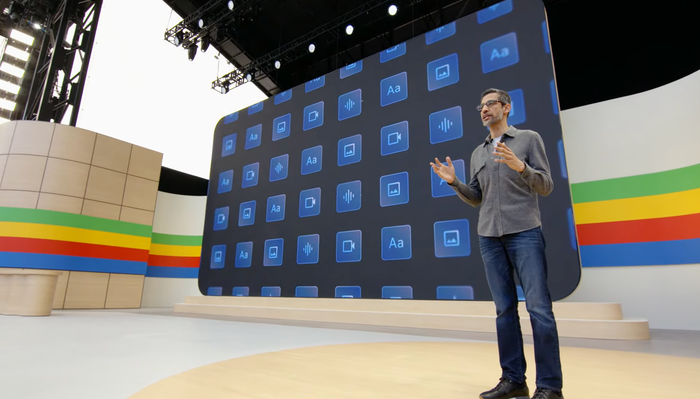
Google CEO Sundar Pichai Claims AI Now Creates Over a Quarter of All New Code

During Alphabet’s quarterly earnings call on Tuesday, CEO Sundar Pichai shared significant insights into how the company is optimizing its artificial intelligence (AI) infrastructure to drive efficiency and reduce costs. One of the key highlights was Pichai’s announcement that Google has now begun generating more than a quarter of all new code using generative AI. This shift has allowed the company to streamline its operations and become more cost-effective, leveraging AI not just for products but also for internal processes.

In a blog post summarizing the earnings call, Google emphasized the role AI is playing in improving operational efficiency. Pichai detailed how the company has overcome challenges in scaling its AI infrastructure, making it more accessible and efficient across all its products and services. Alphabet’s strong Q3 results, which saw a revenue of $88.3 billion (approximately Rs. 7.4 lakh crore), were largely driven by AI-based services that Google began offering earlier this year, marking a significant expansion in the company’s AI-focused business model.

The growth in revenue was not solely attributed to new AI services but also to Google’s careful management of expenditures. Pichai pointed out that part of the increase in revenue was the result of the company’s focus on becoming more agile and lean. By minimizing overhead and deploying smaller, more efficient teams, Google has been able to accelerate development and delivery. Pichai specifically mentioned the creation of Notebook LM, an AI tool developed by a small, dedicated team, as an example of how this new approach has allowed for quicker innovation.

Overall, the earnings call highlighted not only the financial success of Alphabet in the third quarter of 2024 but also the pivotal role AI is playing in reshaping Google’s operations. With generative AI now driving a significant portion of new code generation, the company is positioning itself as a leader in the integration of AI into business operations, aiming to stay competitive while optimizing both its product offerings and internal processes