
Yazılar

Google Reportedly Developing Reasoning AI in Response to OpenAI’s Advances

Google is reportedly developing artificial intelligence software aimed at emulating human reasoning capabilities, similar to OpenAI’s recent advancements. This marks a new phase in the ongoing competition between the tech titan and the rapidly emerging startup. According to sources familiar with the project, several teams within Alphabet Inc. have been making strides in creating AI reasoning software that excels at tackling complex, multistep problems, particularly in areas like mathematics and computer programming.

The drive towards creating reasoning models is seen as a crucial step forward in AI technology. Both Google and OpenAI are attempting to approximate human reasoning through a technique known as chain-of-thought prompting. This method, which Google originally pioneered, involves the AI pausing for a brief period before responding to a prompt. During this pause, the system evaluates a range of related queries behind the scenes, ultimately summarizing what it determines to be the most effective response. This approach aims to enhance the AI’s ability to provide coherent and logically sound answers to complex questions.

Despite the buzz surrounding this development, Google has chosen not to comment publicly on the ongoing efforts. This lack of information underscores the competitive nature of the AI landscape, where companies are keen to guard their innovations. The tech industry has seen an increasing focus on reasoning models as researchers aim to push the boundaries of what AI can accomplish, signaling a shift towards more sophisticated applications of the technology.

The rivalry between Google and OpenAI has intensified since the launch of ChatGPT, which has raised concerns among investors about the potential implications for Google Search. In response, Google has taken various steps to bolster its position in the AI arena, such as merging its research labs into the Google DeepMind unit and fostering closer collaboration between researchers and product teams. However, Google’s cautious approach to rolling out AI products reflects a broader consideration of ethical concerns, public trust, and the complexities of managing diverse AI initiatives within the organization. As both companies strive to lead the AI revolution, the quest for reasoning capabilities will be a pivotal battleground.

Samsung Reportedly Slashing Thousands of Jobs as AI Market Faces Challenges

Samsung Electronics Co. is reportedly initiating significant layoffs across its operations in Southeast Asia, Australia, and New Zealand as part of a broader strategy to cut its global workforce by thousands. Sources familiar with the situation indicated that the layoffs could impact around 10 percent of the employees in these regions, though the specific numbers may vary between subsidiaries. This move reflects the company’s response to ongoing challenges in the market, particularly in the competitive landscape of artificial intelligence (AI).

The decision to downsize is indicative of a shifting corporate strategy at Samsung, which currently employs approximately 147,000 workers abroad, representing over half of its total workforce of more than 267,800, as noted in its latest sustainability report. Despite the significant cuts planned for international markets, the company has clarified that it does not intend to implement layoffs in its home country of South Korea. This distinction may stem from the company’s commitment to maintaining its domestic workforce amidst global restructuring efforts.

Analysts suggest that the layoffs are largely driven by economic pressures and the need for Samsung to remain competitive in rapidly evolving technology sectors, particularly AI. As the demand for advanced technologies fluctuates, companies like Samsung must adapt by streamlining operations and reallocating resources. The layoffs could allow the company to focus on its core business areas and invest more heavily in future technologies, although they also signal a challenging environment for tech firms navigating market uncertainties.

While the specifics of the job cuts have yet to be officially announced, the potential impact on employees and local economies in affected regions cannot be overlooked. Many workers may face uncertainty about their job security and future prospects in the tech industry. As Samsung moves forward with its restructuring plans, the company will need to manage both the operational changes and the human elements of such significant workforce reductions. This situation highlights the broader trend within the tech industry, where companies are continuously adapting to new challenges while striving to remain at the forefront of innovation.

Google for India 2024: Gemini Live Expands with Hindi and Eight Additional Regional Language Support

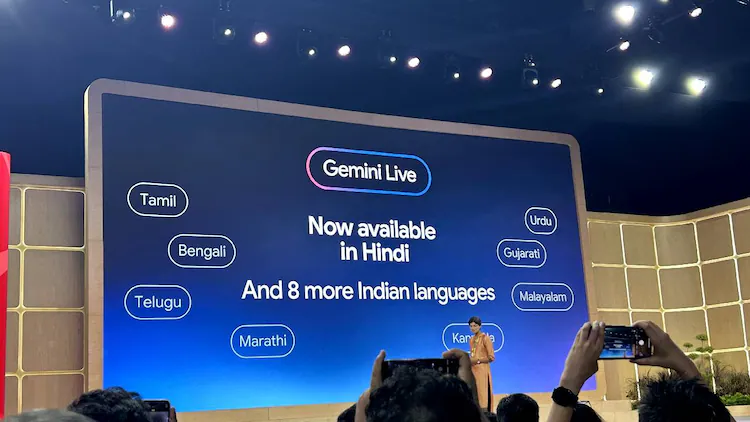
At the Google for India 2024 event in New Delhi, Google unveiled several India-centric features, including significant updates to its AI chatbot, Gemini. The tech giant introduced Gemini Live, a real-time verbal communication feature, last month, and it is now expanding its language capabilities to reach a broader audience. Previously available only in English, Gemini Live now supports Hindi and eight other regional Indian languages, underscoring Google’s commitment to making its technology accessible to India’s diverse linguistic population.

During the event, Hema Budaraju, Senior Director of Product Management at Google, emphasized the importance of this update. The new language support allows users to engage with Gemini Live in their native languages, making the AI experience more intuitive and natural. Users can now ask questions verbally in Hindi, Bengali, Gujarati, Kannada, Malayalam, Marathi, Telugu, Tamil, and Urdu, with the chatbot providing real-time spoken responses. This functionality aims to bridge the digital divide, especially for non-English speakers, offering an inclusive AI-driven interaction for millions of users in India.

Gemini Live was first introduced as part of the Gemini Advanced subscription in August, but Google later extended it to the free tier on Android devices. This move made the feature more accessible to a wider user base, enabling people to experience AI-powered communication without the need for a subscription. Until now, the feature had been limited to English, but with the addition of nine Indian languages, Google is making strides to cater to India’s multilingual user base. The inclusion of these regional languages reflects the growing demand for localized AI services in India, a country known for its linguistic diversity.

With these updates, users in India can now interact with the chatbot more naturally, asking questions and receiving answers in their preferred language. This expansion not only enhances the usability of Google’s AI services but also sets a precedent for more tech companies to adopt a multilingual approach. The rollout of Gemini Live’s language support marks another milestone in Google’s ongoing efforts to integrate AI into everyday experiences for users in India, reinforcing its position as a leader in the country’s digital transformation.