Yazılar

Anthropic, Google Discuss Cloud Deal Worth Tens of Billions, Bloomberg Reports

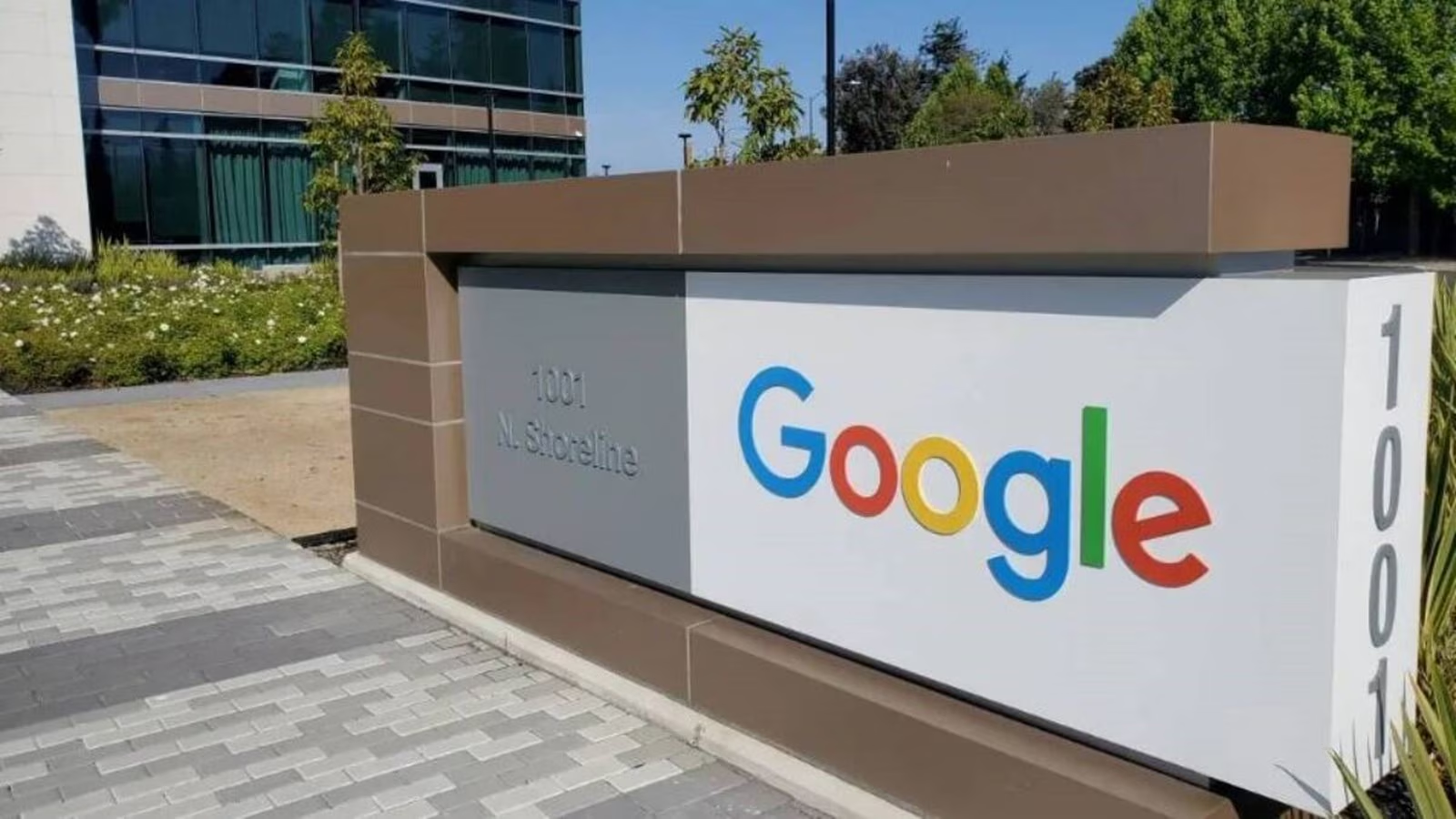
Anthropic, the AI startup behind the Claude chatbot, is in advanced discussions with Google (GOOGL.O) over a massive cloud computing deal valued in the high tens of billions of dollars, according to Bloomberg News, citing people familiar with the talks. The agreement, which is not yet finalized, would see Google provide cloud infrastructure and computing power to support Anthropic’s fast-growing AI operations.

The potential deal underscores the increasing cost and scale of AI development, as companies like Anthropic, OpenAI, and Microsoft-backed Mistral race to secure computing resources needed to train and deploy large language models.

Alphabet shares rose 2.3% after hours following the report, reflecting investor optimism over Google Cloud’s role as a major infrastructure provider for next-generation AI systems. Google declined to comment, while Anthropic did not immediately respond to requests for clarification.

Anthropic, which counts Google and Amazon (AMZN.O) among its biggest investors, has seen rapid adoption of its enterprise AI products and is reportedly on track to reach a $9 billion annual revenue run rate by the end of 2025, nearly tripling its current pace, according to a Reuters report last week.

The collaboration could deepen Google’s long-standing relationship with Anthropic, which already relies heavily on Google Cloud for model training. If completed, the deal would be among the largest cloud infrastructure partnerships ever in the AI sector, solidifying both firms’ positions in the escalating competition against OpenAI and Microsoft.

Amazon Restores AWS Cloud After Global Outage Disrupts Major Apps and Businesses

Amazon (AMZN.O) said its AWS cloud services had fully recovered by Monday afternoon following a massive outage that disrupted businesses and websites worldwide, including major platforms such as Snapchat, Reddit, Venmo, and Zoom. While all core systems were back online, Amazon noted that some AWS services still faced a backlog of messages expected to clear within hours.

The outage, which began earlier in the day, briefly knocked thousands of companies offline across Europe, Asia, and the Americas, halting digital payments, travel bookings, and business operations. It was the largest internet disruption since the CrowdStrike crash of 2024, underscoring the fragility of global cloud infrastructure.

According to Amazon, the failure originated in the US-EAST-1 region — AWS’s oldest and largest data center cluster in northern Virginia, which has suffered similar incidents in 2020 and 2021. The root cause was traced to a malfunction in the subsystem monitoring network health for its Elastic Load Balancers, which distribute web traffic across multiple servers.

AWS explained that the issue began within its EC2 internal network, disrupting the Domain Name System (DNS) used to connect services to their databases, including the DynamoDB API, which stores critical user data.

Experts said the incident exposes the world’s dependence on a few dominant cloud providers. “This outage once again highlights the dependency we have on relatively fragile infrastructures,” said Jake Moore, cybersecurity advisor at ESET. Nishanth Sastry, of the University of Surrey, added that the disruption showed “the risk of relying on just one service provider.”

The outage’s ripple effects hit a wide range of sectors. Financial institutions including Lloyds Bank, Bank of Scotland, and HMRC, as well as telecom firms BT and Vodafone, reported temporary downtime in the UK. In the U.S., Coinbase, Robinhood, Perplexity, and Lyft experienced interruptions, while gaming services like Fortnite, Roblox, and Clash Royale also went dark. Even Amazon’s own Prime Video, Alexa, and shopping platform were affected.

Despite the chaos, Wall Street shrugged off the disruption, sending Amazon shares up 1.6% to $216.48 by market close. Experts estimate that hours of cloud downtime can translate into millions of dollars in lost productivity for large companies, a reminder of the growing risks in the digital economy.

Anthropic aims to nearly triple annualized revenue in 2026 amid surging enterprise AI demand

Artificial intelligence startup Anthropic is targeting an ambitious leap in revenue, projecting to more than double—and potentially nearly triple—its annualized revenue run rate in 2026, according to sources familiar with the company’s internal forecasts.

The San Francisco-based firm expects to hit an annualized revenue run rate of $9 billion by the end of 2025, and has set 2026 goals ranging from $20 billion to $26 billion, driven by rapid adoption of its enterprise-focused AI products. Anthropic confirmed to Reuters that its current revenue run rate is approaching $7 billion, up from $5 billion in August, though it declined to comment on future projections.

The growth underscores the accelerating demand for generative AI tools across industries, even as questions arise over the sustainability of massive AI infrastructure investments. About 80% of Anthropic’s revenue now comes from its 300,000 enterprise customers, who use its Claude models for software integration, data analysis, and automation.

One major contributor has been Claude Code, Anthropic’s AI-powered programming assistant, which has already reached a $1 billion annualized run rate since launching earlier this year. The company also recently introduced its Haiku 4.5 model — a low-cost AI system aimed at making enterprise AI more accessible.

Anthropic’s growth trajectory puts it in direct competition with OpenAI, whose revenue surpassed $13 billion in August and is expected to exceed $20 billion by year’s end. Founded in 2021 by former OpenAI employees, Anthropic has been valued at $183 billion following a $13 billion funding round led by ICONIQ.

Backed by Amazon and Google, the company plans to open its first India office in Bengaluru in 2026 and significantly expand its workforce to meet surging global demand for enterprise AI solutions.