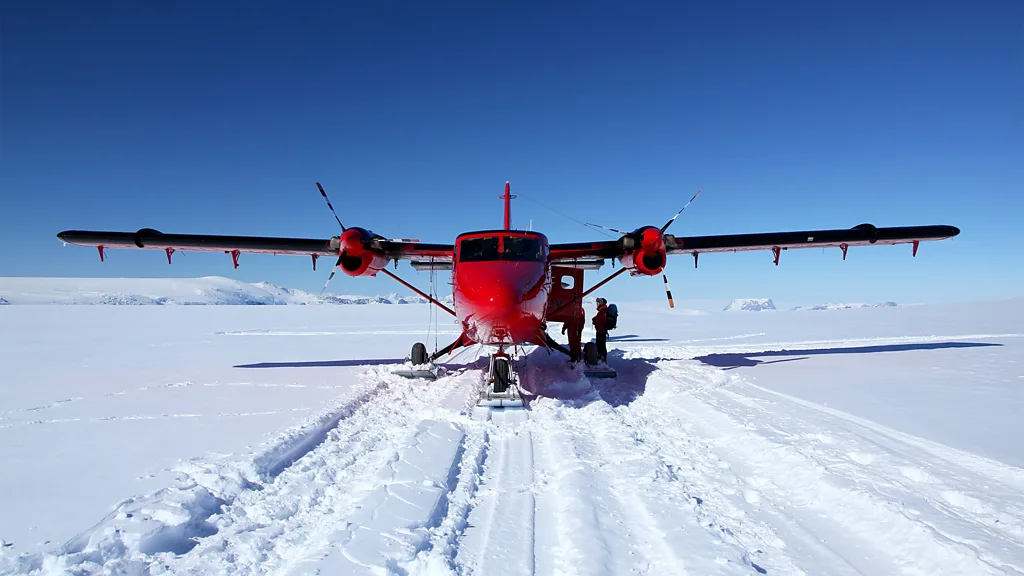
Flying to Antarctica is no easy task, but for the British Antarctic Survey (BAS), a 60-year-old Canadian-built plane has proven to be the perfect aircraft for the job. Every year, BAS undertakes an epic 12-day, 55-hour flight from Canada to Antarctica, covering 13,700 km (8,500 miles) with their fleet of de Havilland aircraft, including the 40-year-old Twin Otters. These planes, known for their rugged design and versatility, are equipped to handle some of the toughest flying conditions on the planet.
Vicky Auld, deputy chief pilot for BAS, describes the annual ferry flight to Antarctica as “a massive adventure.” This year, she’ll be piloting a more spacious Dash-7, but most of her colleagues will be flying in Twin Otters, planes that have been dubbed the “Land Rover of the skies.” These twin-engine aircraft, which have been in production since the 1960s, can land in remote and challenging locations, making them ideal for scientific research and supply runs in Antarctica.
Despite their vintage appearance, with visible struts, wires, and rivets, the Twin Otters are fitted with modern engines and electronic equipment. However, these flights are far from comfortable. With no air conditioning, a simple tube for a toilet, and unpressurised cabins, pilots and crew endure long, physically demanding journeys. For Auld and her team, the trip is further complicated by changing weather conditions, difficult airport approaches, and even the threat of political instability in some regions.
The journey to Antarctica involves multiple stops, with the Twin Otters flying at 150 knots (170 mph) and navigating through diverse weather systems from snowstorms to tropical hurricanes. One of the riskiest stretches is the final 600-mile (966 km) flight across the Southern Ocean, where the crew wears immersion suits in case they have to ditch in the rough waters.
Despite these challenges, the Twin Otters have proven to be an indispensable tool for BAS, supporting research missions not only in Antarctica but also in remote regions of the world like Greenland, Bolivia, and Brazil. Maintaining the aircraft in Antarctica during winter isn’t possible due to limited facilities at BAS’s Rothera research station. Therefore, the fleet is serviced annually in Canada, which offers a robust infrastructure for these specialized planes.
For Auld, the thrill of landing in one of the most remote parts of the world never fades. “It’s just the best and most challenging flying you can do,” she says. Yet, even after the successful landing, more challenges await in the harsh, icy environment of Antarctica.