

Supernovas in Early Universe May Have Created Water, Setting the Stage for Life 100 Million Years After the Big Bang
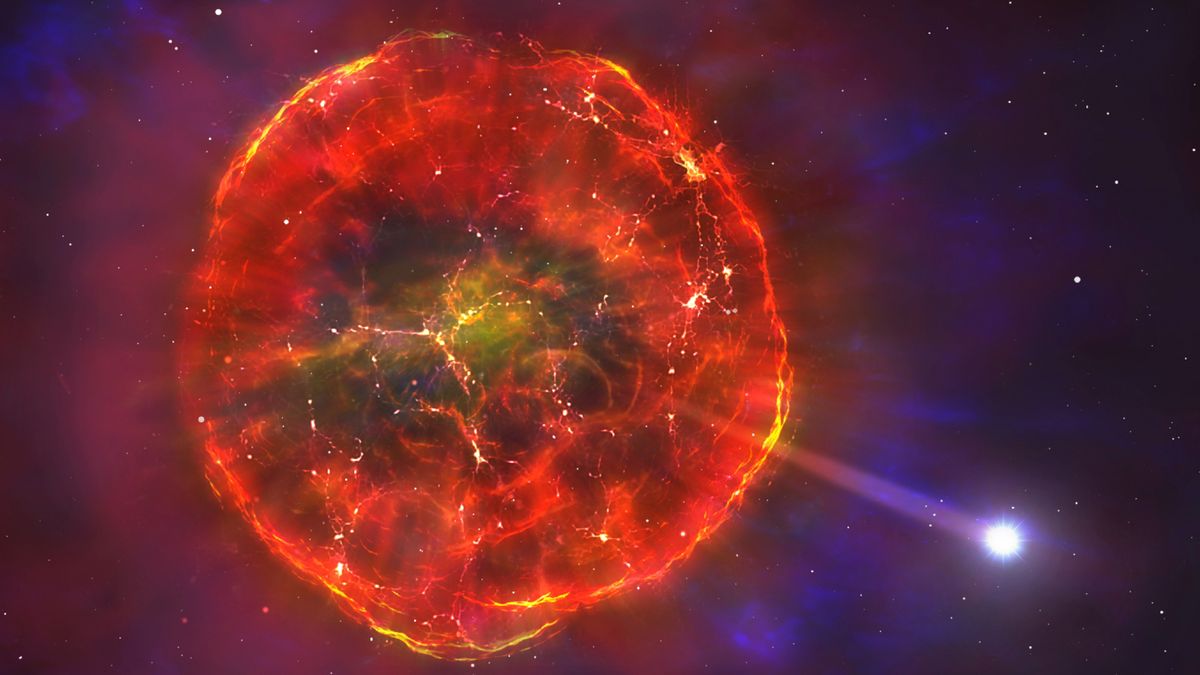
New research suggests that the explosive deaths of the first stars in the universe, known as supernovas, could have been responsible for the creation of water, potentially enabling life to emerge as early as 100 million years after the Big Bang. These findings challenge current theories about the origins of water in the cosmos and highlight the significant role supernovae played in the early universe. The study, based on simulations of short-lived, massive stars, proposes that supernovae triggered the formation of water in dense clouds of hydrogen and oxygen left behind by these stellar explosions.
Water Formation in Early Stellar Explosions
The study, which was uploaded to arXiv on January 9, focused on the first generation of stars, known as population III stars. These stars were much more massive than those seen in the present universe, with masses estimated to be around 200 times that of the Sun. The researchers found that the dense material expelled during these supernovas could have created conditions ripe for water molecules to form. The process likely occurred in the aftermath of the explosion, where hydrogen and oxygen, elements essential for water, were abundant.
High Concentrations of Water in Early Universe
According to the simulations, the concentrations of water formed in the aftermath of early supernovas could have been up to 30 times higher than those observed in the interstellar gas clouds of our own Milky Way galaxy. This significant presence of water in the early universe could have provided essential conditions for the formation of galaxies, stars, and potentially even life. The research opens up new possibilities regarding the timeline and conditions under which life-supporting water could have existed, significantly altering our understanding of the universe’s early history.
Implications for the Origins of Life and Galaxy Formation
The discovery has profound implications for our understanding of both the origins of water and the formation of life in the universe. If water existed so early in the universe’s history, it could have acted as a crucial ingredient for the formation of complex molecules, setting the stage for the emergence of life. Additionally, the presence of water in the dense regions created by early supernovas could have played a role in the formation of early galaxies, providing further insight into how the universe evolved in its infancy. This new research suggests that the universe’s first stars didn’t just shape the cosmos with their explosive ends—they may have created the very building blocks for life.

Unlocking the Mysteries of Hypernuclei: A Breakthrough in Subatomic Research
In a significant leap forward for particle physics, scientists have made a breakthrough in understanding hypernuclei—unusual atomic systems that incorporate hyperons, particles that contain at least one “strange” quark. Unlike conventional atomic nuclei, which are made up of protons and neutrons, hypernuclei exhibit distinct properties due to the inclusion of these exotic particles. The study of these rare structures promises to unlock crucial insights into subatomic forces, offering a deeper understanding of the extreme conditions that exist in environments such as neutron stars.
Cutting-Edge Research Methods
A new study published in The European Physical Journal A has advanced the study of hypernuclei through the application of nuclear lattice effective field theory. Led by Ulf-G. Meißner from the Institute for Advanced Simulation in Jülich and the University of Bonn, this research focuses on simplifying the complex interactions within atomic nuclei by concentrating on protons, neutrons, and hyperons. By employing a lattice-based approach, where particles are represented on a discrete grid, the researchers have managed to reduce the computational challenges that arise from modeling quarks and gluons at the core of atomic nuclei.
Focus on Λ-Hyperons and Their Role in Hypernuclei
The team’s research centered on Λ-hyperons, which are among the lightest types of hyperons. These particles, when incorporated into hypernuclei, interact in ways that differ from the interactions seen in traditional nuclei. Using the lattice model, the researchers were able to calculate the forces that govern the structure of these hypernuclei, achieving a remarkable level of accuracy. Their results showed that the theoretical calculations aligned with experimental data within a 5 percent margin of error. This breakthrough opens the door to studying more complex hypernuclei with up to 16 constituent particles, significantly extending the capabilities of earlier models.
Implications for Astrophysics and Nuclear Physics
The study of hypernuclei is crucial not only for nuclear physics but also for understanding astrophysical phenomena, particularly the behavior of matter in neutron stars. Neutron stars, which are incredibly dense and possess extreme gravitational forces, could contain hypernuclei formed under the intense conditions found in such environments. By improving the understanding of hyperon interactions within hypernuclei, scientists can gain deeper insights into the fundamental forces at play in neutron stars and other high-energy astrophysical objects. This research has the potential to reshape how we understand both the microcosm of subatomic particles and the macrocosm of celestial bodies.