Yazılar

Dassault Systèmes Forecasts Higher Sales and Earnings in 2025

Dassault Systèmes has projected revenue growth of 6% to 8% for 2025, an improvement from 5% in the previous year, driven by stronger software sales in late 2024. The French software firm, which serves the automotive, aerospace, and industrial sectors, also expects diluted earnings per share to rise to between 1.36 and 1.39 euros, up from 1.20 euros in 2024. Additionally, its operating margin is forecasted to increase to a range of 32.6%–32.9%, compared to 31.9% last year.

The positive outlook follows improved performance in Dassault’s software division, where revenue grew 9% in Q4 to 1.60 billion euros, supported by strong demand in the aerospace and defense sectors. The company’s flagship 3DEXPERIENCE platform, which offers 3D modeling, data management, and project management tools, saw sales growth of 22% in Q4—up from 21% in the same quarter of 2023 and recovering from a 10% decline in Q3 2024.

Dassault also announced a long-term partnership with Volkswagen to optimize the automaker’s engineering and manufacturing processes, though financial details were not disclosed.

Meanwhile, revenue at Medidata, Dassault’s clinical trial data analytics unit, increased by just 1% in Q4, an area closely monitored by investors.

Analysts at Stifel described the results as solid despite macroeconomic challenges but noted that the company’s 2025 guidance remains cautious. Dassault’s shares rose up to 2.5% at market open before stabilizing.


NXP Plans to Generate 8-10% of Revenue from India by 2030

NXP Semiconductors is poised to generate between 8% and 10% of its revenue from India by 2030, driven by the growing demand in the country’s automotive and industrial sectors. Hitesh Garg, head of NXP India, shared this projection at an industry event in Bengaluru, emphasizing that the next three to five years will be crucial for the company as it targets significant revenue growth in the region.

While NXP currently does not disclose its revenue from India, the company views the country as an increasingly important market. India’s expanding automotive industry and the rise of industrial applications for chips are expected to fuel this growth. As a result, NXP is positioning itself to capture market share in the region, which is still a small but fast-growing segment for many global chip manufacturers.

This strategic focus on India comes at a time when NXP’s sales in China have faced uncertainty due to geopolitical tensions, including the expansion of Chinese production in older chip technologies and European tariffs on Chinese electric vehicles. In 2023, China represented nearly a third of NXP’s $13.28 billion in sales, with the rest of the Asia-Pacific region accounting for nearly 30%. Garg indicated that any missed opportunities in one market could be offset by expanding in others, like India.

India’s semiconductor industry is still in its early stages, but the government has been working to establish a robust ecosystem, with initiatives like a $10 billion incentive package aimed at growing the local chip market. The country expects its semiconductor market to reach $63 billion by 2026, despite not yet producing its own chips. In September, NXP announced a $1 billion investment in India, which includes a major boost to its research and development efforts. Other companies like Micron are also making investments in the Indian market, signaling growing confidence in the region’s potential.


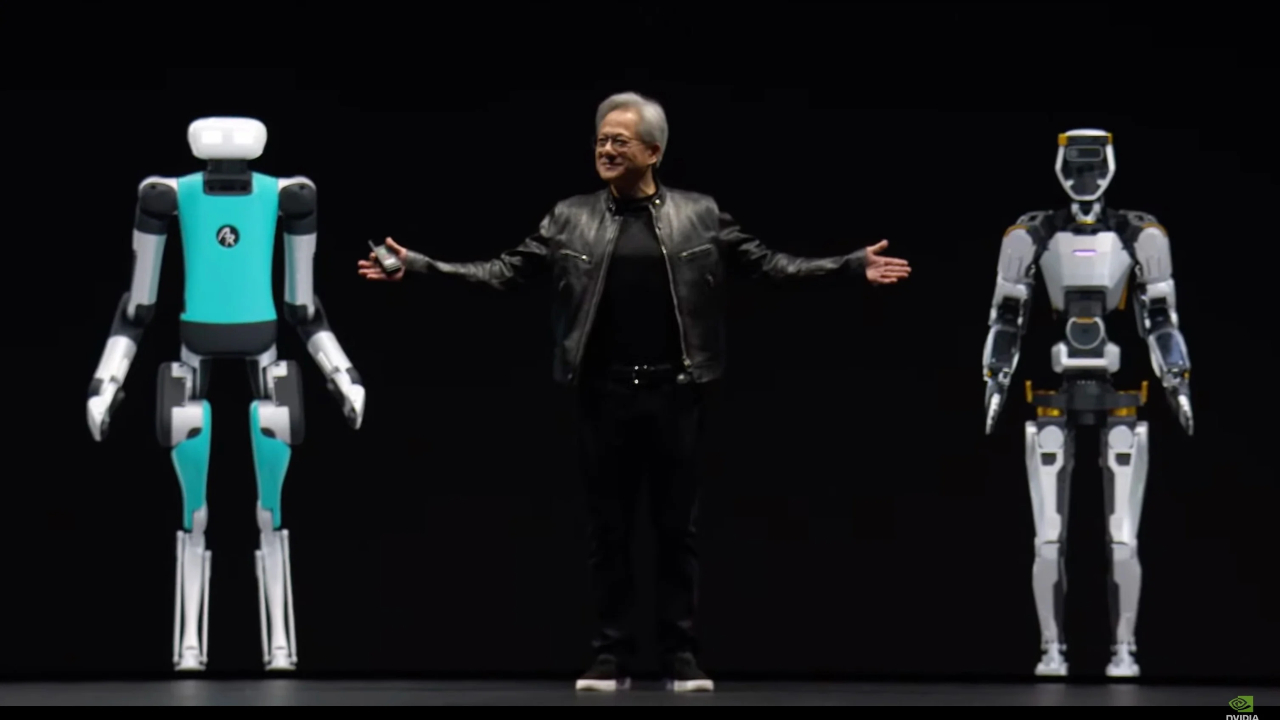
Nvidia Unveils New Robotics, Gaming Chips, and Toyota Deal at CES 2025

At CES 2025, Nvidia CEO Jensen Huang revealed several groundbreaking products, showcasing the company’s ambitions to expand its business across robotics, gaming, and automotive technology. The announcements highlighted innovations in AI, gaming chips, and collaborations, including a new deal with Toyota.

One of the key highlights was the introduction of Nvidia’s Cosmos foundation models, which use artificial intelligence to generate photo-realistic video for robot and self-driving car training. By creating “synthetic” training data, these models simulate physical environments much more affordably than traditional data collection methods. Unlike the typical approach of placing cars on the road or having humans demonstrate tasks, Cosmos can generate videos based on a text description, adhering to the laws of physics. The models will be made available on an “open license,” much like Meta Platforms’ Llama 3 language models, which have seen widespread use in the tech industry. Huang expressed hopes that Cosmos could revolutionize robotics and industrial AI similarly to the impact Llama 3 has had on enterprise AI.

Despite the excitement, analysts, including Vivek Arya from Bank of America, raised concerns about whether the new robotics technology would substantially boost Nvidia’s sales. Arya questioned the challenge of making the products both reliable and affordable enough to create viable business models, similar to the niche opportunities of autonomous vehicles or the metaverse.

In addition to robotics, Nvidia unveiled new gaming chips, part of the RTX 50 series, that use Nvidia’s Blackwell AI technology. These chips aim to enhance gaming graphics, particularly through ‘shaders’ that add realistic imperfections to objects in video games, such as fingerprint smudges on surfaces. The new chips are also designed to improve the realism of human faces, which is a critical area of focus for developers. Prices for the chips range from $549 to $1,999, with the high-end models set to launch on January 30, followed by lower-tier models in February. Analysts, including Ben Bajarin of Creative Strategies, expect these chips to drive short-term sales growth for Nvidia.

Nvidia also debuted its first desktop computer, Project DIGITS, which is designed for software developers rather than regular consumers. Priced at $3,000, the computer runs on Nvidia’s Linux-based operating system and includes the same AI chip used in the company’s data center products. The desktop, which features a central processor co-designed with Taiwan’s MediaTek, is expected to help individual developers quickly test their AI systems. Project DIGITS will be available in March.

Additionally, Huang announced that Toyota Motor will integrate Nvidia’s Orin chips and automotive operating system into several of its models to power advanced driver assistance features. Although the company did not specify which models would feature the technology, the partnership signifies a growing presence in the automotive sector. Nvidia projects automotive hardware and software revenue will reach $5 billion by fiscal 2026, up from an expected $4 billion in the current year.

Nvidia’s stock surged to a record high of $149.43, increasing its market valuation to $3.66 trillion, making it the second-most valuable listed company in the world, behind Apple.