Yazılar

Revolutionary Dual-Reactor System Converts CO₂ into Sustainable Protein

Transforming CO₂ into Food: A Breakthrough in Sustainable Protein

A team of engineers in China has pioneered a groundbreaking dual-reactor system capable of converting carbon dioxide into edible protein. This innovation addresses two major global challenges: reducing atmospheric CO₂ levels and developing sustainable food sources. By leveraging advanced microbial processes, this technology not only mitigates greenhouse gas emissions but also offers a potential solution to feeding a growing global population without relying on traditional agriculture.

How the Technology Works

The system operates in two critical stages, as outlined in a study published in Environmental Science and Ecotechnology. In the first stage, a process called microbial electrosynthesis transforms CO₂ into acetate, an essential intermediate compound. This acetate is then introduced into a second reactor, where specialized aerobic bacteria consume it to produce single-cell protein. This approach mimics natural biochemical processes but at an accelerated and controlled rate, ensuring efficient protein production.

Efficiency and Nutritional Advantages

The researchers reported a protein yield of 17.4 grams per liter of dry cell weight, with an impressive protein content of 74 percent—exceeding the protein concentrations found in traditional sources like soybeans and fish meal. The resulting protein is rich in essential amino acids, making it a highly nutritious and sustainable alternative for both human consumption and animal feed. Such efficiency in production could significantly reduce the environmental footprint of protein farming, making it an attractive option for future food security.

Implications for a Sustainable Future

Beyond its potential to revolutionize food production, this technology represents a significant step toward a circular carbon economy. By capturing and repurposing CO₂, the dual-reactor system could help industries offset emissions while simultaneously producing valuable food resources. As research continues, scaling up this technology for commercial use could pave the way for a more sustainable and resilient global food system, reducing dependence on land-intensive farming and mitigating climate change in the process.

Cyborg Cockroaches: The Future of Search and Rescue Robots

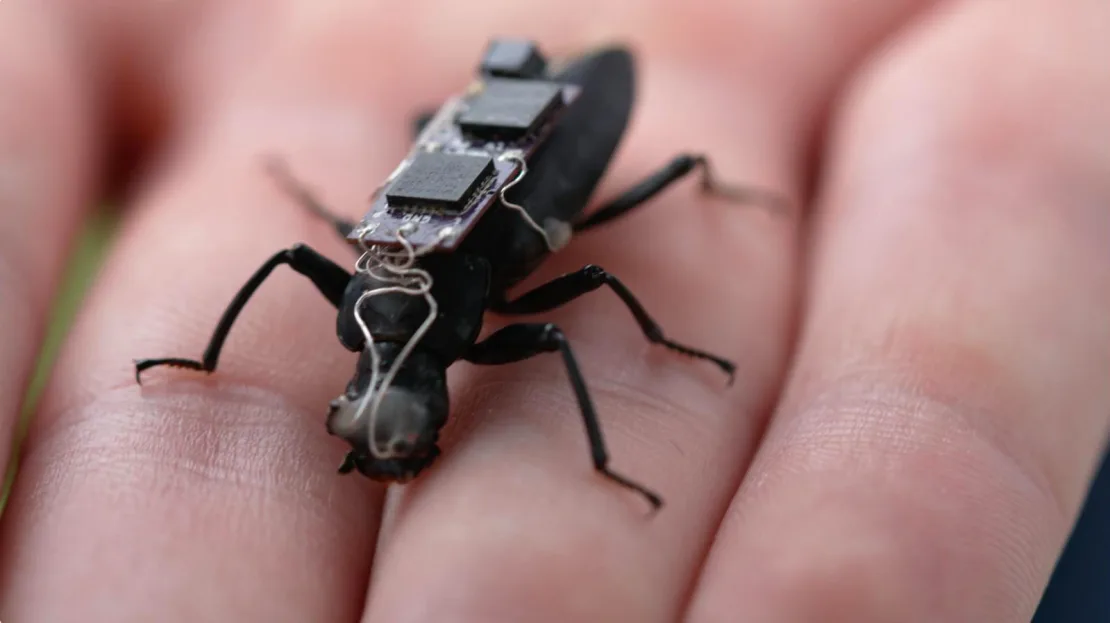
Researchers at the University of Queensland are creating cyborg insects that could revolutionize search and rescue operations. By implanting tiny circuits into the backs of beetles, they are crafting biohybrids—part-living, part-machine robots that could help in situations where human access is impossible, such as after natural disasters like earthquakes or bombings.

Lachlan Fitzgerald, a student studying mathematics and engineering, is leading the project. The beetles are outfitted with backpack-like devices that send electrical pulses to their antennae, allowing Fitzgerald to control their movements. This technology harnesses the insects’ natural agility, enabling them to navigate tight and hazardous environments with ease. Fitzgerald envisions a future where swarms of cyborg beetles could be deployed in disaster zones to find survivors or deliver life-saving drugs before human rescuers can safely enter.

The project also involves implanting control backpacks on giant Australian burrowing cockroaches and darkling beetles. These species are chosen for their adaptability and ability to navigate complex environments, making them ideal candidates for disaster response. Unlike traditional robots, insects can navigate with little computational effort, making them more efficient in unpredictable, real-world situations.

Despite their small size, cyborg insects could play a significant role in saving lives by quickly locating survivors in disaster zones and delivering essential aid. However, Fitzgerald acknowledges that there are still challenges to mastering the control of these insects, and it may take years before this technology is fully operational.

Fitzgerald is not the only researcher experimenting with biohybrid robots. At the California Institute of Technology (Caltech), researchers have implanted pacemakers into jellyfish to control their swimming and gather data from the deep ocean. Meanwhile, researchers at Cornell University have used king oyster mushrooms to control robots, which could be used for environmental sensing, like detecting soil chemistry for crop management.

While the rise of biohybrid robots sparks debates about ethical concerns, Fitzgerald and his team argue that the potential benefits, such as saving lives in urban disaster zones, outweigh the risks. He also assures that the beetles used in the project have normal life expectancies and aren’t harmed by the technology. However, he acknowledges the need for ongoing ethical discussions and proper regulation in this emerging field.


Scientists Engineer Solar-Powered Animal Cells by Merging Algae Chloroplasts with Hamster Cells

Scientists at the University of Tokyo have successfully created hybrid animal cells capable of harnessing sunlight for energy, a breakthrough that blends the mechanics of photosynthesis with cellular biology. By embedding chloroplasts, the photosynthetic structures found in algae, into animal cells, researchers have achieved something long deemed improbable. This innovation is poised to revolutionize artificial tissue engineering, particularly in environments with limited oxygen availability, as these cells can generate energy independently under light exposure.

A Novel Experimental Approach

The researchers chose the CHO-K1 cell line, derived from Chinese hamster ovary cells, as the animal host for this experiment. Known for its adaptability and tolerance to foreign material, the CHO-K1 line provided an ideal environment for the integration of chloroplasts. To address the thermal limitations of photosynthetic organelles, the team used chloroplasts from Cyanidioschyzon merolae, a species of red algae that thrives in warmer conditions. Unlike most chloroplasts that degrade or lose efficiency at body temperatures, these algae-derived chloroplasts remain functional at 37°C, aligning with the physiological environment of animal cells.

Overcoming Long-Standing Barriers

In the past, integrating chloroplasts into animal cells faced a significant hurdle: the organelles were quickly degraded by the host cells’ defense mechanisms. However, the Tokyo team developed methods to preserve these chloroplasts, allowing them to remain photosynthetically active within the hamster cells for up to 48 hours. By employing advanced imaging technologies, they confirmed that the chloroplasts continued to generate energy when exposed to light, demonstrating sustained photosynthetic activity—a crucial step forward in merging plant and animal cellular functions.

Future Implications

This achievement holds tremendous potential for bioengineering and medical research. Hybrid cells capable of photosynthesis could be used to develop artificial tissues that are less dependent on oxygen or external energy sources, making them invaluable in scenarios such as wound healing or space travel. While still in its early stages, this breakthrough paves the way for a deeper understanding of cellular integration and the creation of innovative solutions to global challenges in health and sustainability.