Yazılar

Singapore Charges Three Men in Connection with Fraud Against Dell and Super Micro

Singaporean authorities have added additional charges against three men involved in a larger investigation into server fraud, which may involve AI chips. The charges are related to fraudulent activities committed against tech companies Dell and Super Micro. According to court documents, the men allegedly misrepresented the destinations of the servers they purchased, falsely claiming that the servers would not be transferred to unauthorized third parties.

The police charge sheets indicated that the defendants made false representations regarding the ultimate consignee of the items, suggesting that they would not be diverted. Investigations revealed that the servers may contain Nvidia chips, though authorities have not confirmed if these chips are subject to U.S. export controls.

This case is part of an ongoing investigation in Singapore, which involves 22 individuals and companies accused of making false representations. Additionally, the United States is investigating whether DeepSeek, a Chinese company behind a highly publicized AI model, has been using U.S. chips prohibited from being sold to China.

The investigation also covers Malaysia, where the servers allegedly ended up, and authorities there are exploring whether any local laws were violated. Singapore has so far charged two suspects, Aaron Woon, 41, and Alan Wei, 49, with conspiring to defraud Super Micro in 2024. Their charges have been amended to include fraud against Dell. A third suspect, Chinese national Li Ming, 51, was also charged with defrauding Super Micro in 2023.

Authorities seized 42 devices, including phones, computers, and laptops, which are being analyzed by forensic experts. The investigation is still in its early stages, with prosecutors seeking bank statements to trace the movement of funds and planning to work with international law enforcement.
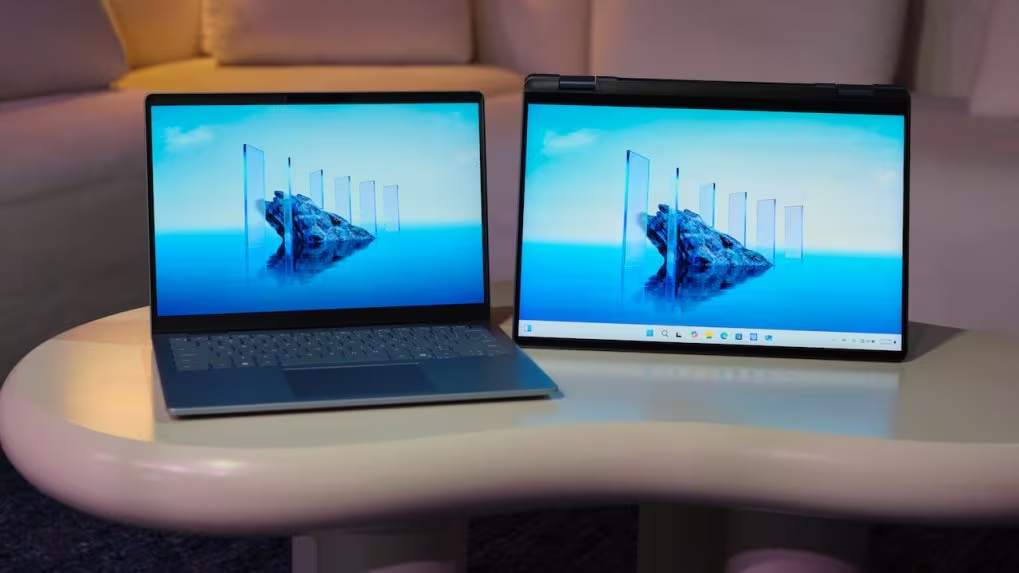
Dell Reveals Unified Branding and New AI Pro Studio at CES 2025, Launches 3-Category Product Lineup

Dell Unveils Unified Branding and AI-Powered Devices at CES 2025
At the Consumer Electronics Show (CES) 2025, Dell Technologies made a significant announcement regarding its new product lineup and branding strategy. The company revealed a simplified portfolio that integrates on-device artificial intelligence (AI) capabilities into its devices. In a bold move, Dell decided to retire the familiar Inspiron and XPS brands, choosing instead to consolidate its offerings under a unified Dell branding. The new lineup is divided into three distinct categories—Dell, Dell Pro, and Dell Pro Max—each catering to users with varying needs, from casual to professional.

A New Era for Dell: Streamlined Product Categories
Dell’s new branding strategy, which was detailed in a recent press release, marks a shift towards a more cohesive and simplified approach. The “Dell” category will target everyday users, offering devices ideal for play, school, and work. The “Dell Pro” line is designed for individuals looking to elevate their productivity to professional standards, with devices optimized for more demanding tasks. Meanwhile, the “Dell Pro Max” lineup is all about maximum performance, aimed at power users who require top-tier hardware and functionality. This reorganization allows customers to more easily identify the device that best suits their needs, whether for personal or professional use.

Expanding Beyond Laptops: A Comprehensive Dell Ecosystem
Dell’s new product lines go beyond just laptops and PCs. The Dell and Dell Pro categories will also include a wide range of peripherals, such as monitors, accessories, and various services, making it a comprehensive solution for both home and professional environments. This expansion reflects Dell’s commitment to offering an all-encompassing ecosystem of devices and tools designed to enhance the user experience. Whether users are working from home, collaborating in a professional setting, or enjoying entertainment, Dell’s new offerings are poised to meet a variety of needs.

AI Integration: The Future of Computing with Dell
At the heart of Dell’s 2025 product lineup is the integration of artificial intelligence. Dell is prioritizing AI to bring smarter and more efficient devices to the market, with on-device AI helping to optimize performance, enhance productivity, and deliver personalized experiences. From improving battery life and system efficiency to enabling advanced features like voice recognition and AI-driven software, Dell’s AI-powered devices promise to push the boundaries of what personal computing can achieve. This strategic emphasis on AI places Dell at the forefront of innovation in the tech industry, offering users an intelligent, adaptable computing experience.

Jim Cramer Says AI-Driven PC Upgrade Cycle Is “On Hold” Despite Industry Expectations

INTRODUCTION

CNBC’s Jim Cramer shared his thoughts on the state of the PC market, noting that the much-anticipated AI-driven PC upgrade cycle has yet to materialize. Despite being four years since the last refresh phase, Cramer suggested that current trends indicate a slower-than-expected pace of technological adoption.


KEY POINTS

AI-Driven PC Upgrade Cycle Not Yet in Full Swing

  • Cramer’s Analysis:
    Cramer pointed out that while there’s widespread confidence in an AI-driven PC upgrade cycle, the industry is still seeing a “normal” refresh cycle rather than the revolutionary shift many had hoped for.

    • Slow Pace: Cramer expressed concern that the expected AI-driven upgrade cycle appears to be stalled for now, with no substantial acceleration in demand for AI-enhanced PCs.

Earnings Reports and Stock Reactions

  • Disappointing Results:
    • Dell, HP, and Best Buy all experienced declines in their stock prices after reporting earnings that failed to meet Wall Street’s expectations.
    • Best Buy’s Outlook: Best Buy did show some positive signs, especially in PC sales, which were fueled by demand for new models replacing older ones. However, the sales weren’t driven by AI capabilities, with the company noting that AI integration is being phased in gradually.
    • PC Sales and AI: While Best Buy management expressed optimism for AI in the future, the sales figures were more tied to standard PC upgrades rather than any significant push for AI-driven tech.

Dell and HP Sales Trends

  • Enterprise vs. Consumer Sales:
    • Both HP and Dell showed stronger sales in enterprise PCs than consumer units, signaling that businesses are upgrading their PCs at a faster rate than individual consumers.
    • Dell’s Transparency: Cramer praised Dell for its transparency regarding its challenges and its view that a full PC refresh cycle is nearing, especially with the end of Windows 10 support in 2025.

Cramer’s Conclusion

  • No Cause for Panic:
    Despite the slower-than-expected pace of the PC upgrade cycle, Cramer believes it’s too early to dismiss the idea of a major refresh. He noted that, even if the AI-driven aspect is delayed, the traditional cycle is still likely to pick up speed soon.

CONCLUSION

While the industry eagerly anticipates an AI-driven shift in the PC market, the reality appears to be a more gradual upgrade cycle. With continued uncertainty over the role of AI and upcoming software changes like Windows 10’s end of support, the PC refresh may take longer to materialize than previously expected, though Cramer remains optimistic about its eventual occurrence.