Yazılar

How Nvidia’s $5B Intel stake could bolster Intel’s next-gen chipmaking

Nvidia’s (NVDA.O) $5 billion investment in Intel (INTC.O) may give the struggling chipmaker crucial momentum for its next-generation manufacturing efforts, even though Nvidia has not committed to using Intel’s factories for its own chips, analysts said.

The deal, announced Thursday, gives Nvidia a roughly 4% stake in Intel and creates a partnership to develop “multiple generations” of joint products. These products will link Intel’s central processors with Nvidia’s AI and graphics chips via NVLink, Nvidia’s high-speed proprietary interconnect.

Analysts say the collaboration could indirectly strengthen Intel’s 14A manufacturing process, set for 2027, which the company has warned may not move forward without sufficient customer demand. By tying its CPUs to Nvidia’s flagship products in ways unmatched by rivals, Intel could secure the production volumes needed to justify its costly investments.

“Any relationship with Nvidia at this point, while not explicitly talking about the foundry services, should be seen as a possible extension of the partnership in the future,” said Jack Gold, principal analyst at J.Gold Associates.

Under the agreement, Intel Foundry will supply CPUs for the joint products and package Nvidia chips for some of them. Engineers from both firms will collaborate to translate Nvidia’s designs into physical chips manufactured by Intel. This is notable given both companies often rely on Taiwan’s TSMC (2330.TW) for production.

“If these joint products prove popular, it gives me a higher degree of confidence that 14A continues, at which point Intel should have very good returns,” said Ben Bajarin, CEO of Creative Strategies.

For Nvidia, the deal offers better access to government and enterprise customers that run decades of Intel-compatible software. The main loser could be Advanced Micro Devices (AMD.O), which competes directly with both companies in CPUs and GPUs. “Having two major competitors combining their efforts is not exactly a positive outcome for AMD,” Gold noted.

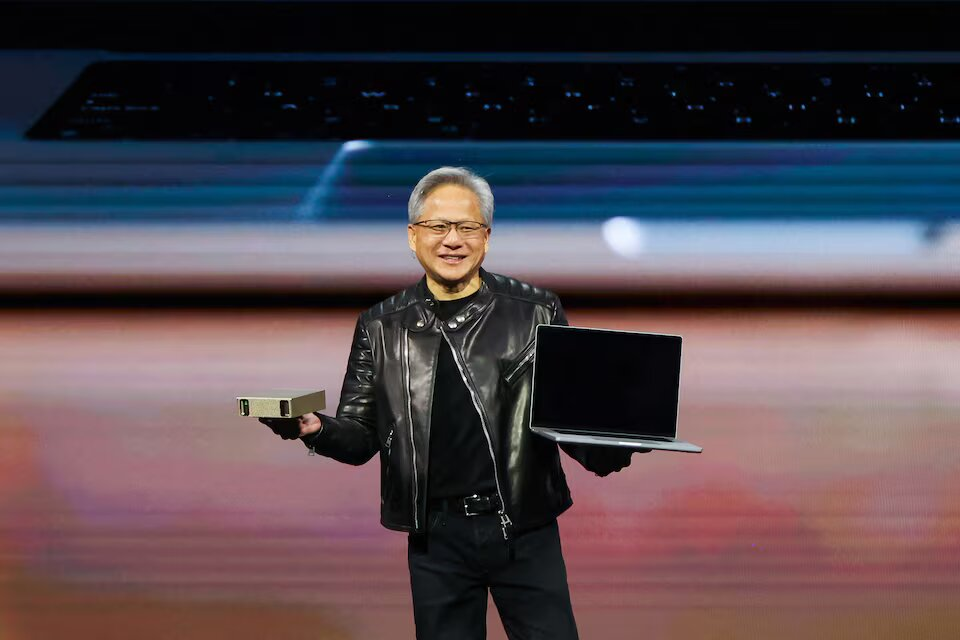
Deutsche Telekom and Nvidia Team Up to Build AI Cloud for European Manufacturers in Germany

Deutsche Telekom and Nvidia announced a strategic partnership on Friday to create an artificial intelligence cloud tailored for European manufacturers, based in Germany. Nvidia will provide 10,000 graphics processing units (GPUs) to be integrated into Deutsche Telekom’s existing data centers as part of this initiative.

The project aims for implementation by 2026 and represents a critical step toward building large-scale data centers, which are key to Germany’s push to modernize its industrial sector. This move also aligns with the European Union’s broader goal to close the AI infrastructure gap with global competitors like the U.S. and China.

Nvidia CEO Jensen Huang revealed plans for the AI cloud platform in Germany earlier this week and announced Deutsche Telekom’s participation during a meeting with German Chancellor Friedrich Merz.

Merz emphasized the significance of investments in AI infrastructure for Germany’s innovation and economic future, praising Nvidia and its partners’ commitment. He described the partnership as a vital step for strengthening Germany’s digital sovereignty.

GPUs have become essential for advancing AI capabilities. Under Chancellor Merz’s leadership, Germany plans to develop large data centers supported by state subsidies covering 35% of costs, while the industry is expected to cover the remaining 65%. The government aims to secure up to 100,000 GPUs to meet growing AI demands.

Earlier this year, the European Commission unveiled a $20 billion funding plan to accelerate AI data center construction across Europe.

Deutsche Telekom recently announced collaborations with companies like SAP, web hosting firm Ionos, and retailer Schwarz to seek EU support for building large data centers in Germany.

Nvidia is also working with European AI company Mistral to develop AI computing platforms powered by 18,000 Nvidia GPUs to serve European businesses.

Nvidia to Launch Quantum Computing Lab in Boston in Partnership with Top Universities

Nvidia has announced plans to open a quantum computing research lab in Boston, aiming to collaborate with leading academic institutions such as Harvard University and the Massachusetts Institute of Technology (MIT). CEO Jensen Huang revealed the initiative during Nvidia’s annual software developer conference in San Jose, California, where the company held a dedicated day for quantum computing discussions.

The new lab, named the Nvidia Accelerated Quantum Research Center (NVAQC), will foster partnerships with prominent quantum computing firms, including Quantinuum, Quantum Machines, and QuEra Computing. The center is set to begin operations later this year. Huang’s announcement followed his earlier statement in January, where he suggested that practical quantum computers could still be two decades away—comments he sought to clarify during the event.

The quantum computing industry, which is still in its early stages, sees companies like Quantinuum and IonQ exploring commercial applications of quantum technology. Even though some quantum machines may eventually outperform Nvidia’s renowned graphics processing units (GPUs) in tasks like simulating atomic interactions, industry leaders emphasized that quantum computers are unlikely to replace classical systems. Instead, quantum and classical computing will likely work in tandem.

Huang highlighted the continued importance of Nvidia’s GPUs in current computational tasks, with quantum machines complementing traditional systems, not replacing them. He expressed optimism about the future of quantum computing, indicating that Nvidia’s involvement would further accelerate the industry’s growth.