
Yazılar

Japan’s Renesas weighs $2 billion sale of timing unit amid semiconductor reshuffle

Renesas Electronics Corp., one of Japan’s largest semiconductor makers, is considering a sale of its timing division in a deal that could value the business at nearly $2 billion, according to people familiar with the matter.

The company has hired JPMorgan to advise on the potential divestment, which remains in its early stages. Sources said the process is expected to attract bids from major chipmakers, including Texas Instruments in the United States and Germany’s Infineon Technologies. None of the companies involved have commented publicly on the talks.

Renesas’ timing division produces specialized integrated circuits (ICs) that handle clock, timing, and synchronization functions — essential components for data centers, telecommunications systems, and 5G network infrastructure. These chips act as the “metronome” for electronic systems, ensuring precise coordination of data flow in high-speed environments.

The move comes as global demand for chips powering AI-driven data centers and networking infrastructure continues to soar. Selling the unit could allow Renesas to raise capital and sharpen its focus on core markets, particularly automotive and industrial semiconductors — areas where it is a major global supplier.

Renesas has expanded aggressively in recent years through acquisitions to build a broader portfolio of analog and power management chips. The possible divestment reflects a wider industry trend of portfolio consolidation, as chipmakers seek to streamline operations and concentrate on growth areas.

Alibaba’s Amap Hits Record 360 Million Users on First Day of China’s Extended Holiday

Alibaba Group’s mapping app Amap reached an all-time record of over 360 million daily active users on the first day of China’s eight-day National Day holiday, the company announced on Wednesday.

The surge highlights Amap’s growing dominance in the travel and lifestyle app ecosystem and marks a significant milestone in its ongoing rivalry with Meituan, another major player in China’s digital services market.

AMAP’S STRATEGIC SHIFT AND AI FEATURES

Traditionally known for navigation, Amap has been expanding into lifestyle and local services, directly challenging Meituan’s Dazhong Dianping platform. It now offers AI-powered rankings of restaurants, hotels and tourist destinations through its new feature called “Street Stars”, which leverages artificial intelligence algorithms to generate destination lists for users.

As part of the launch campaign, Amap rolled out 1 billion yuan ($140.43 million) worth of subsidies, including ride-hailing discounts and in-store coupons, to boost engagement during the peak holiday period.

MARKET REACTION AND HOLIDAY BOOST

The announcement sent Alibaba’s shares up 4% in Hong Kong trading on Thursday after JPMorgan raised its price target on the stock to HK$240 ($30.85) from HK$165, citing stronger-than-expected user activity and positive outlooks in the company’s digital services ecosystem.

The record usage coincided with China’s National Day and Mid-Autumn Festival, which this year were combined into an eight-day “super holiday”, one of the country’s busiest travel periods.

According to state broadcaster CCTV, China’s national railway handled 23.13 million passenger trips on the first day alone — an 8% increase year-on-year and a new single-day record, underscoring the nationwide travel boom.

ALIBABA VS. MEITUAN: A DIGITAL LIFESTYLE BATTLE

Amap’s evolution reflects Alibaba’s broader effort to capture local-lifestyle market share from Meituan by transforming a simple mapping tool into a comprehensive travel and experience platform.
Chinese consumers, who traditionally turned to Meituan’s Dazhong Dianping for restaurant reviews and bookings, are increasingly finding similar services integrated directly within Amap’s app — backed by AI personalization and user subsidies.

As China’s consumer and tourism sectors rebound post-pandemic, the battle for digital lifestyle dominance between Alibaba and Meituan is set to intensify — with Amap’s record user engagement during the National Day holiday offering Alibaba a strong start.

Trump slaps $100K annual fee on H-1B visas, rattling U.S. tech sector

The Trump administration on Friday announced a sweeping change to the H-1B visa program, saying companies will now have to pay $100,000 per year per visa—a move critics warn could devastate the U.S. tech industry’s access to global talent.

Commerce Secretary Howard Lutnick framed the move as part of Trump’s broader immigration crackdown, urging firms to “train Americans” instead of hiring foreign workers. But tech giants including Microsoft, Amazon, and JPMorgan quickly advised employees on H-1B visas to remain in the U.S. or return before the new fees take effect at midnight Saturday.

The H-1B program, which provides 85,000 visas annually for specialized workers, has long been dominated by Indian nationals (71% of approvals in 2024) and Chinese professionals (11.7%). In the first half of 2025 alone, Amazon received approval for more than 12,000 H-1B visas, with Microsoft and Meta securing over 5,000 each.

Under the new rules, the cost of a three-year H-1B stint would balloon to $300,000 per worker, compared with just a few thousand dollars under the current system. Analysts say this could force smaller firms and startups to offshore high-value work, weakening the U.S. in the global AI and tech race against China.

Industry figures voiced alarm. Venture capitalist Deedy Das warned the change “creates disincentive to attract the world’s smartest talent,” while eMarketer analyst Jeremy Goldman said Washington risks “taxing away its innovation edge, trading dynamism for short-sighted protectionism.”

The announcement sparked immediate financial fallout: shares of Cognizant sank nearly 5%, while Infosys and Wipro slipped 2–5% in U.S. trading.

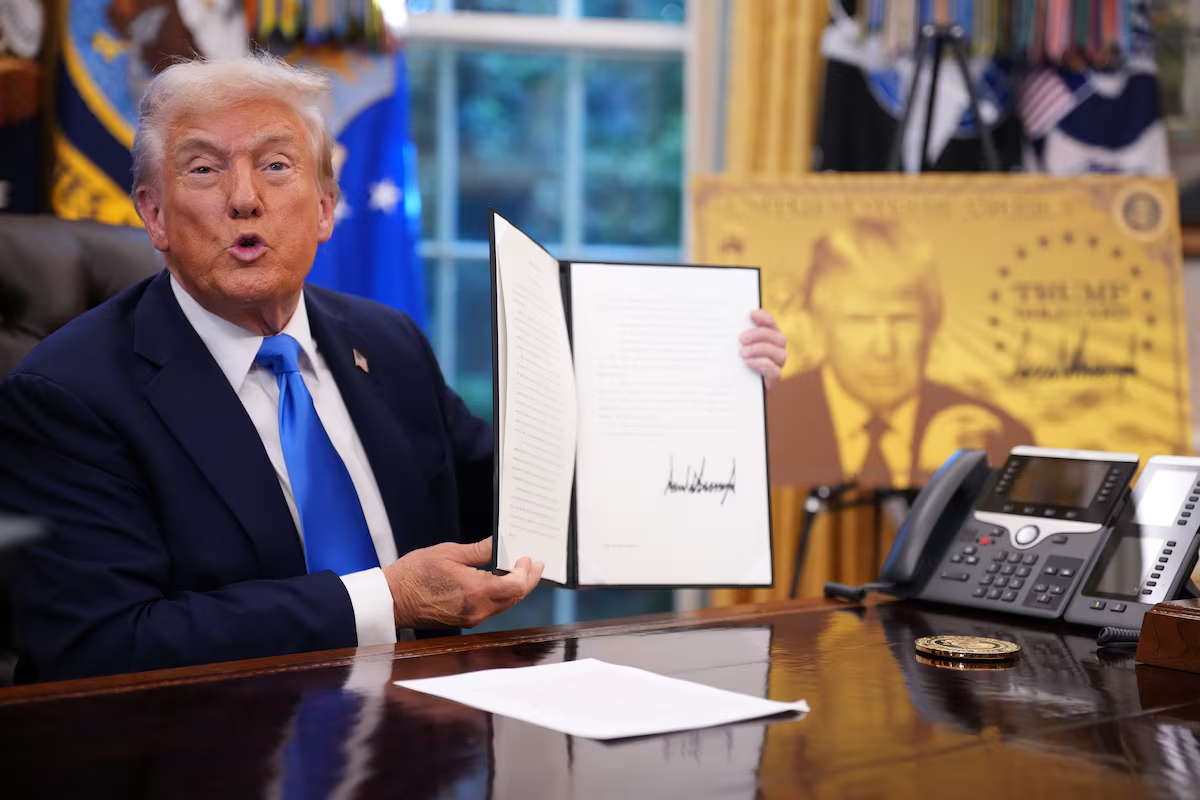
Meanwhile, Trump also signed an executive order creating a “gold card” residency program, offering permanent U.S. residency for those who can pay $1 million upfront.

Legal experts questioned the fee’s validity, noting Congress only authorizes visa fees to cover administrative costs, not as a revenue generator. Still, the administration insists “all the big companies are on board.”