Yazılar

Nvidia to invest up to $100B in OpenAI, fueling AI dominance — and antitrust worries

Nvidia will invest up to $100 billion in OpenAI and supply it with advanced data center chips, the companies confirmed Monday, marking one of the largest-ever deals in artificial intelligence. The pact ties together the world’s leading AI chipmaker and the sector’s most high-profile model developer, deepening concerns about market concentration.

Deal structure

  • Nvidia will acquire non-voting shares in OpenAI.

  • OpenAI will use the cash to purchase Nvidia chips, creating what analysts called a “circular” arrangement.

  • The two companies signed a letter of intent to deploy at least 10 gigawatts of Nvidia systems — equivalent to powering 8 million U.S. homes.

  • Nvidia will begin deliveries in late 2026 via its new Vera Rubin platform, starting with 1 GW of compute.

  • Initial investment: $10B, with further tranches scaling toward $100B.

OpenAI CEO Sam Altman said: “Compute infrastructure will be the basis for the economy of the future, and we will utilize what we’re building with Nvidia to both create new AI breakthroughs and empower people and businesses with them at scale.”

Market reaction

  • Nvidia shares hit a record intraday high (+4.4%).

  • Oracle gained 6% amid its own collaboration with OpenAI, Microsoft, and SoftBank on the $500B Stargate data center project.

  • Broadcom fell 0.8% on concerns the deal could complicate its custom-chip work with OpenAI.

Industry context

The pact follows:

  • Microsoft’s multibillion-dollar investments in OpenAI since 2019.

  • Nvidia’s $5B investment in Intel and its $6.6B backing of OpenAI in 2024.

  • Ongoing OpenAI efforts to design its own AI chips with Broadcom and TSMC, which reportedly remain unchanged.

Antitrust spotlight

The DOJ and FTC reached an agreement in 2024 enabling potential probes into the roles of Microsoft, Nvidia, and OpenAI in AI. Analysts warn this deal could intensify scrutiny:

  • Andre Barlow, antitrust lawyer: “It could potentially lock in Nvidia’s chip monopoly with OpenAI’s software lead, making it more difficult for rivals like AMD or competing AI labs to scale.”

  • Stacy Rasgon (Bernstein): The structure raises concerns about Nvidia’s investment dollars coming back as chip purchases.

The Trump administration has so far taken a lighter regulatory approach than Biden’s, emphasizing growth over enforcement — though officials say protecting competition in AI infrastructure remains a long-term priority.
Global companies pour billions into AI infrastructure with mega-deals

A wave of multi-billion dollar investments is reshaping the AI landscape as chipmakers, cloud providers, and tech giants race to secure computing power for next-generation artificial intelligence. The surge follows OpenAI’s launch of ChatGPT in 2022, which sparked unprecedented demand for GPUs, cloud infrastructure, and data centers.

Key deals fueling the AI boom:

  • Nvidia & OpenAI – Nvidia to invest up to $100B in OpenAI and supply advanced AI chips, cementing its dominance in the AI ecosystem.

  • Nvidia & Intel – Nvidia invests $5B for a ~4% stake in Intel.

  • Oracle & Meta – In talks on a $20B cloud deal to boost Meta’s AI compute.

  • Oracle & OpenAI – Landmark deal worth $300B over five years for OpenAI to buy Oracle cloud capacity.

  • CoreWeave & Nvidia$6.3B order ensuring Nvidia-backed startup CoreWeave absorbs unused cloud demand.

  • Nebius Group & Microsoft$17.4B, five-year GPU deal to bolster Microsoft’s infrastructure.

  • Meta & Google – Six-year, $10B cloud agreement signed in August.

  • Intel & SoftBank – SoftBank injects $2B into Intel, becoming a top-10 shareholder.

  • Tesla & Samsung$16.5B chip supply deal for Tesla’s next-gen AI6 chip, produced in Texas.

  • Meta & Scale AI – Meta takes 49% stake ($14.3B) in Scale AI, elevating CEO Alexandr Wang’s role in Meta’s AI strategy.

  • Google & Windsurf$2.4B licensing deal for AI code generation tech.

  • CoreWeave & OpenAI$11.9B, five-year contract signed before CoreWeave’s IPO.

  • Stargate Datacenter Project – Joint venture by SoftBank, OpenAI, Oracle, backed by U.S. President Donald Trump, with up to $500B in AI infrastructure funding.

  • Amazon & Anthropic – Amazon doubles down with a total $4B investment in Anthropic, developer of the Claude chatbot.

Why it matters:

  • Capital intensity: AI development is now measured in hundreds of billions, with infrastructure demands rivaling traditional energy projects.

  • Strategic alliances: Tech giants are securing long-term chip and cloud capacity to avoid bottlenecks.

  • Geopolitical edge: Governments, particularly the U.S., are encouraging private-public mega-projects like Stargate to keep ahead in the AI race.

The investment frenzy highlights a simple truth: the future of AI hinges not just on algorithms, but on who controls the world’s computing power.

Trump slaps $100K annual fee on H-1B visas, rattling U.S. tech sector

The Trump administration on Friday announced a sweeping change to the H-1B visa program, saying companies will now have to pay $100,000 per year per visa—a move critics warn could devastate the U.S. tech industry’s access to global talent.

Commerce Secretary Howard Lutnick framed the move as part of Trump’s broader immigration crackdown, urging firms to “train Americans” instead of hiring foreign workers. But tech giants including Microsoft, Amazon, and JPMorgan quickly advised employees on H-1B visas to remain in the U.S. or return before the new fees take effect at midnight Saturday.

The H-1B program, which provides 85,000 visas annually for specialized workers, has long been dominated by Indian nationals (71% of approvals in 2024) and Chinese professionals (11.7%). In the first half of 2025 alone, Amazon received approval for more than 12,000 H-1B visas, with Microsoft and Meta securing over 5,000 each.

Under the new rules, the cost of a three-year H-1B stint would balloon to $300,000 per worker, compared with just a few thousand dollars under the current system. Analysts say this could force smaller firms and startups to offshore high-value work, weakening the U.S. in the global AI and tech race against China.

Industry figures voiced alarm. Venture capitalist Deedy Das warned the change “creates disincentive to attract the world’s smartest talent,” while eMarketer analyst Jeremy Goldman said Washington risks “taxing away its innovation edge, trading dynamism for short-sighted protectionism.”

The announcement sparked immediate financial fallout: shares of Cognizant sank nearly 5%, while Infosys and Wipro slipped 2–5% in U.S. trading.

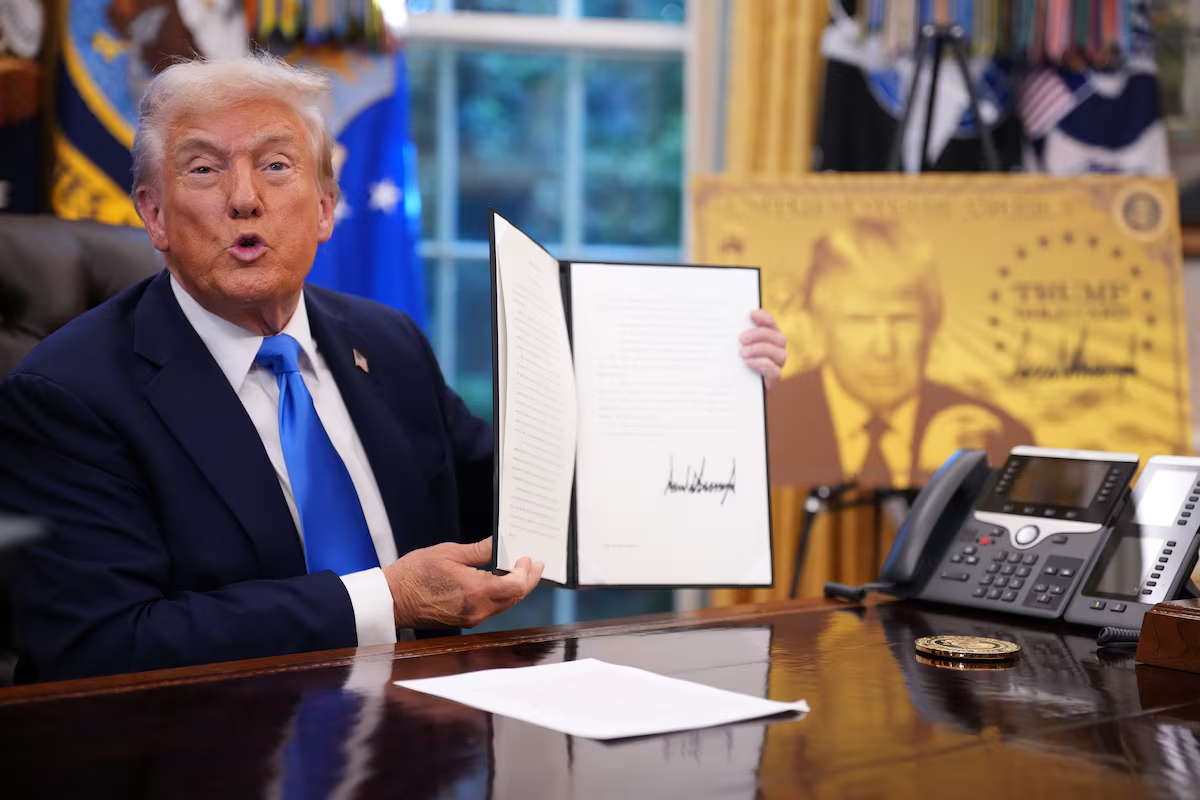
Meanwhile, Trump also signed an executive order creating a “gold card” residency program, offering permanent U.S. residency for those who can pay $1 million upfront.

Legal experts questioned the fee’s validity, noting Congress only authorizes visa fees to cover administrative costs, not as a revenue generator. Still, the administration insists “all the big companies are on board.”