Yazılar

NASA Launches Twin Mars Probes to Uncover How the Red Planet Lost Its Atmosphere

NASA is preparing to send two identical probes to Mars in a groundbreaking effort to uncover how the Red Planet lost its atmosphere — and what that might mean for Earth’s future.

Billions of years ago, Mars had a thick atmosphere, liquid water, and Earth-like chemistry. But today, it’s a frozen, airless desert. The question scientists are asking is simple yet profound: what went wrong?

The ESCAPADE mission — short for Escape and Plasma Acceleration and Dynamics Explorers — will send twin satellites, nicknamed Gold and Blue, to orbit Mars in formation, offering the first-ever 3D view of its magnetic and atmospheric interactions.

The probes, each about the size of a mini-fridge, are scheduled to launch Sunday from Kennedy Space Center aboard Blue Origin’s New Glenn rocket, which will make only its second flight. Instead of the usual direct trajectory, ESCAPADE will take a unique route — looping around a Lagrange point for a year before slingshotting toward Mars, a maneuver that could revolutionize future interplanetary mission planning.

NASA and the University of California, Berkeley’s Space Sciences Laboratory designed the mission to explore how solar wind — the stream of charged particles from the Sun — has stripped away Mars’ atmosphere over time. Without a strong magnetic field like Earth’s, Mars was left vulnerable to this cosmic erosion.

By 2027, the orbiters will study how solar storms affect Mars’ magnetosphere in real time, helping researchers understand both planetary climate loss and how to protect future astronauts from harmful space radiation.

“This is a low-cost mission — about $70 to $80 million — but with enormous scientific value,” said Casey Dreier of the Planetary Society. “Understanding Mars’ atmospheric loss helps us grasp how delicate Earth’s own system really is.”

As NASA faces tightening budgets, ESCAPADE represents a new model: small, efficient missions tackling big scientific questions — and a reminder that studying Mars may teach us more about saving Earth than we expect.

Intuitive Machines to Expand Beyond Lunar Missions with $800 Million Acquisition of Lanteris Space Systems

Intuitive Machines announced on Tuesday that it will acquire Lanteris Space Systems — formerly Maxar Space Systems — from private equity firm Advent International in an $800 million deal aimed at transforming the company into a full-spectrum space services provider. The acquisition marks a major strategic shift for the Houston-based lunar lander manufacturer, broadening its scope well beyond the Moon.

The transaction, comprising $450 million in cash and $350 million in stock, is expected to close in the first quarter of next year pending regulatory approval. Following the news, Intuitive Machines’ shares fell about 5% in premarket trading.

CEO Steve Altemus said the acquisition “moves Intuitive Machines beyond the Moon and into a wider range of space projects.” The combined company will generate an estimated $850 million in annual revenue and hold about $920 million in future contracts as of September 30.

Lanteris builds satellites and spacecraft used for defense, communications, and scientific missions. It was previously the satellite manufacturing arm of Maxar Technologies, which Advent took private in 2023 for $4 billion. Advent will retain a minority stake in the merged entity.

The deal follows Intuitive Machines’ recent acquisition of deep-space navigation firm KinetX and several new U.S. government contracts, as the company positions itself as a key player in both lunar and orbital missions.

Separately, the company reported third-quarter revenue of $52.4 million, below analyst expectations of $68.1 million, and a net loss of $10 million, according to LSEG data.

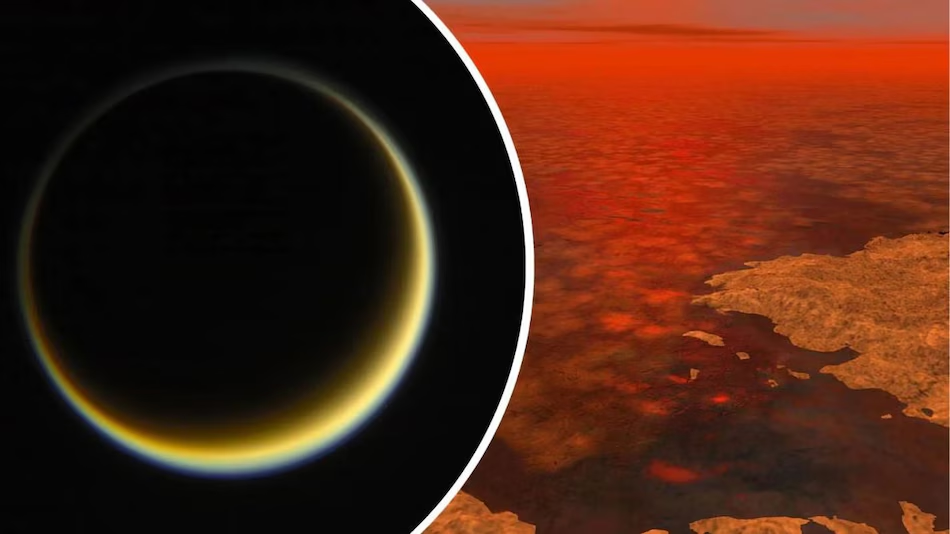
NASA Finds Titan Violating a Core Principle of Chemistry

Saturn’s largest moon, Titan, continues to challenge our understanding of chemistry and the potential for life beyond Earth. In a groundbreaking study, researchers from Chalmers University of Technology in Sweden, working with NASA, have uncovered evidence that Titan’s extreme cold allows chemicals to interact in ways long thought impossible. The study reveals that in Titan’s frigid environment—where temperatures plunge to nearly -179°C—substances that normally resist mixing can in fact combine. This remarkable behavior overturns one of chemistry’s most fundamental ideas: the rule that “like dissolves like.” Devamını Oku