Yazılar

Neptunian Ridge Discovery: Scientists Unveil New Planetary Zone in the Cosmos

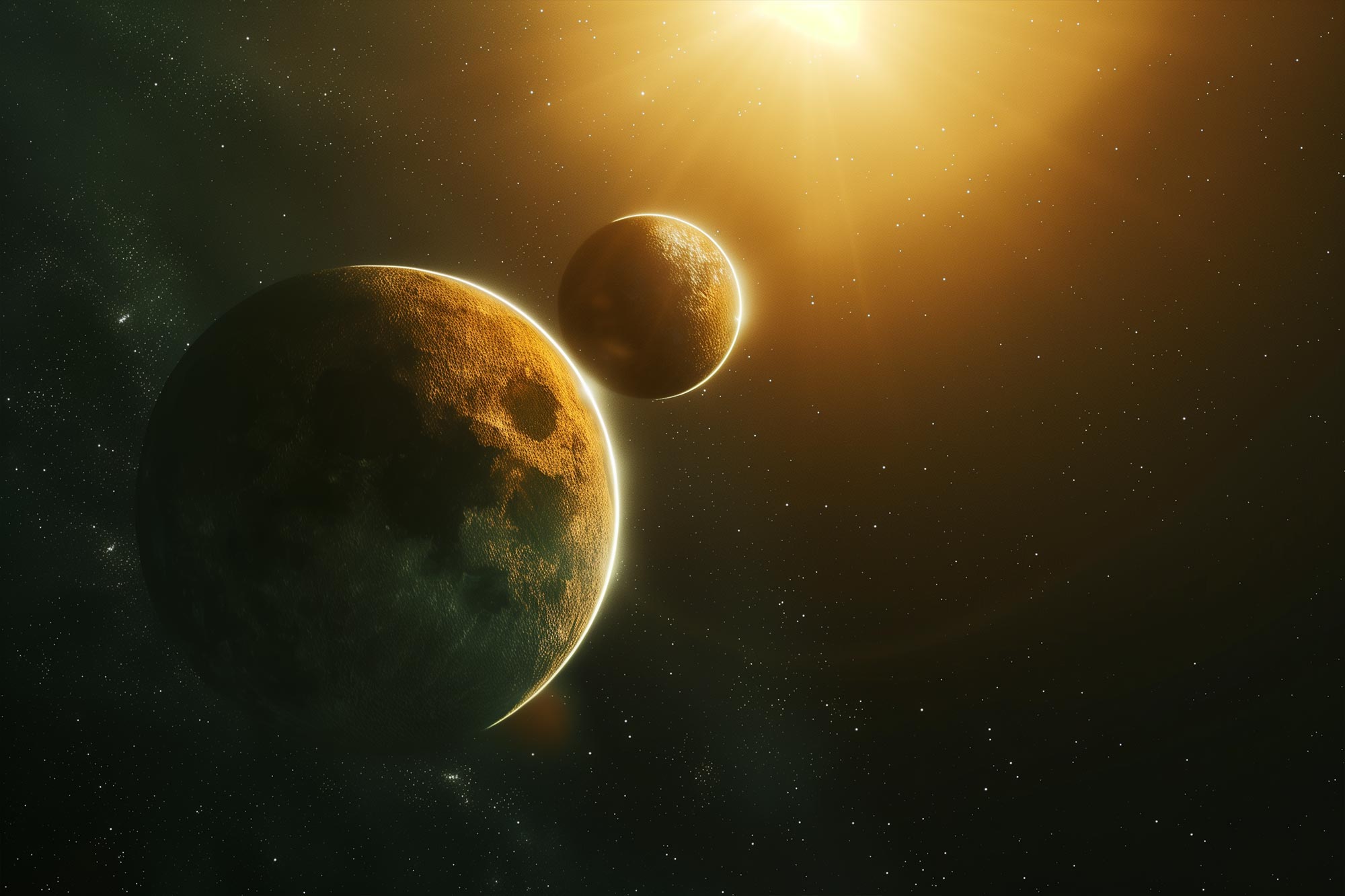
British scientists have made a groundbreaking discovery in the vast expanse of space: a densely packed ridge of planets previously unknown to the scientific community. A team from the University of Warwick stumbled upon this remarkable feature while investigating Neptune-like planets located far beyond our solar system. Their observations revealed a distinct pattern—a crowded band of planets lying between two starkly contrasting regions: a “desert,” where few planets can survive, and a “savannah,” where planets exist in abundance. This discovery provides new insights into how planets are distributed in space, akin to the revelation of an uncharted mountain range that reshapes our understanding of Earth’s landscape.

Life in the Cosmic Desert
Imagine a hostile environment where intense stellar radiation continuously bombards planets, eroding their atmospheres and leaving behind only barren rocky cores. This desolate region, now known as the Neptunian Desert, is inhospitable to most planetary bodies. Only the toughest planets, resistant to the relentless onslaught of their nearby stars, manage to endure. These rare survivors are comparable to the few resilient species that manage to eke out a living in Earth’s most unforgiving deserts.

A Planetary Savannah
Beyond this harsh desert lies a more forgiving region dubbed the “Neptunian Savannah,” where planets are far more likely to thrive. Here, conditions are relatively stable, and planets are better able to retain their atmospheres, sustaining a more favorable environment. This area teems with diverse planetary types, protected from the extreme radiation that characterizes the desert zone. The contrast between the two regions highlights the varied fates of exoplanets as they struggle to maintain their atmospheres and stability in the face of intense cosmic forces.

The Safe Haven: The Ridge of Survival
What makes this discovery so compelling is the dense ridge of planets that lies between the desert and the savannah. This newly identified zone acts as a safe haven, where planets somehow manage to retain their gaseous envelopes while avoiding complete atmospheric erosion. Scientists believe these planets arrived in this region through various mechanisms, such as migrating from farther out in their star systems or forming in place under unique conditions. This ridge represents a delicate balance, a transitional area where planets achieve a rare equilibrium, providing an invaluable opportunity to understand planetary evolution in extreme environments.
NASA’s Europa Clipper Mission Ready to Explore Potentially Habitable Ocean World

NASA’s Europa Clipper spacecraft is poised for launch, set to embark on a mission to explore Jupiter’s moon Europa, one of the most promising candidates in the solar system for supporting life. The spacecraft is scheduled to lift off on Monday at 12:06 p.m. ET from NASA’s Kennedy Space Center in Florida aboard a SpaceX Falcon Heavy rocket. This marks the start of a mission aimed at investigating whether Europa’s subsurface ocean could harbor the conditions necessary for life.

Weather conditions are 95% favorable for launch, with backup launch opportunities extending through November 6.

Mission Overview

Europa Clipper is the first spacecraft designed specifically to study an ice-covered ocean world, with a focus on determining whether Europa’s subsurface ocean, estimated to contain twice the volume of Earth’s oceans, could support life. The mission will deploy nine instruments, including cameras, spectrometers, and a magnetometer, to gather data on Europa’s ice shell, ocean depth, and geological activity.

This $5.2 billion mission has faced challenges, including concerns over radiation from Jupiter’s powerful magnetic field, which could damage the spacecraft. However, a specially designed titanium and aluminum vault will shield Europa Clipper’s sensitive electronics, allowing it to withstand the harsh environment during 49 planned flybys of the moon.

Scientific Goals and Instrumentation

Europa Clipper will use its suite of instruments to explore Europa’s ocean and its interaction with the moon’s ice shell. Key questions include the thickness of the ice, the ocean’s composition, and whether plumes of water observed venting through cracks in the ice could indicate habitable conditions.

  • Cameras and spectrometers will capture high-resolution images of the surface and atmosphere.
  • Ice-penetrating radar will study the ice’s thickness and detect subsurface water.
  • Mass spectrometer and dust analyzer will investigate the composition of the ocean by “sniffing” particles from plumes.
  • Magnetometer will assess the ocean’s depth and salinity.

Long Journey and Coordination with Other Missions

After launch, Europa Clipper will travel 1.8 billion miles and is expected to reach Jupiter in April 2030. Along the way, it will perform flybys of Mars and Earth to gain speed and conserve fuel. The mission will work in tandem with Juice, the European Space Agency’s Jupiter Icy Moons Explorer, which launched in April 2023 and will arrive in July 2031.

Once at Europa, Clipper will execute flybys every two to three weeks, collecting data to help scientists understand the moon’s potential habitability.

Future Implications

While not designed to detect life directly, Europa Clipper will pave the way for future missions. Robert Pappalardo, the project scientist, hopes the spacecraft will find evidence of organics and warm, liquid water just below the surface. Such findings could inspire NASA to send a future lander to search for signs of life beneath Europa’s icy crust.

Ancient Asteroid 20 Times Larger Than Dinosaur-Killing Impact Likely Hit Jupiter’s Moon Ganymede

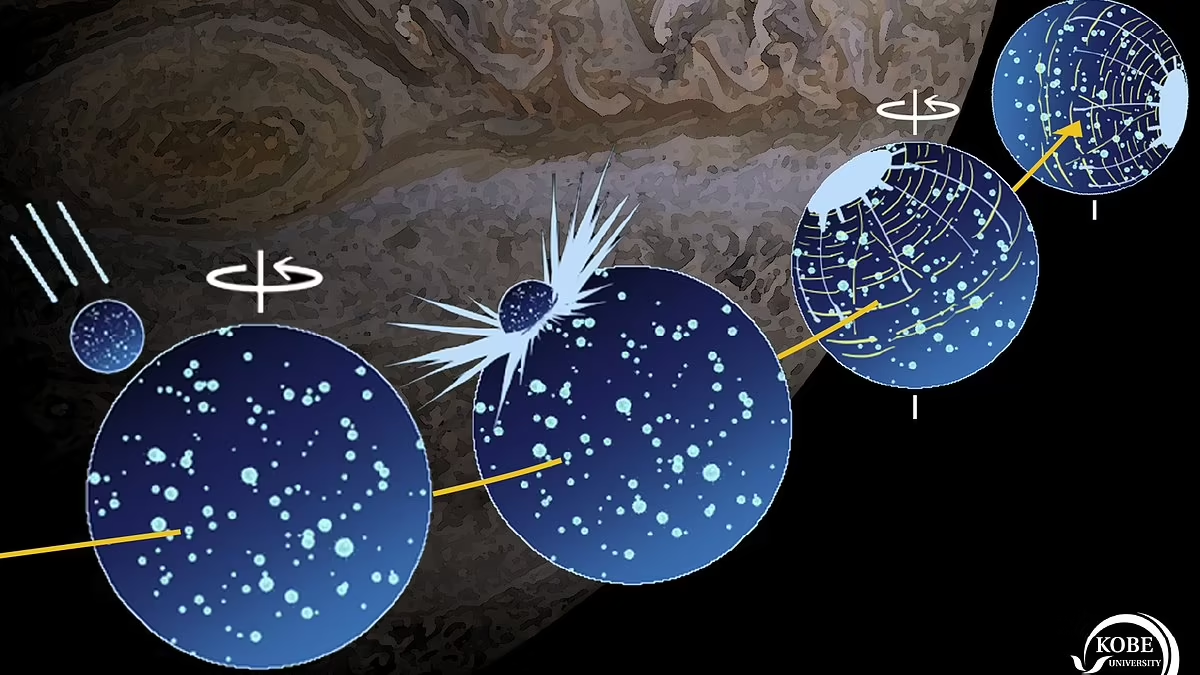
Jupiter’s largest moon, Ganymede, might have undergone a dramatic shift in its axis due to a colossal asteroid impact around 4 billion years ago, according to recent research. The study, published in Scientific Reports, suggests that an asteroid roughly 186 miles (300 kilometers) wide, 20 times larger than the one that caused the extinction of dinosaurs, created a massive crater on Ganymede, leading to significant reorientation of the moon. The impact, which resulted in furrows forming concentric patterns on the moon’s surface, may have been responsible for altering its rotational axis. This new research, spearheaded by Naoyuki Hirata from Kobe University, aims to shed light on Ganymede’s evolutionary history and internal structure. The European Space Agency’s Juice spacecraft, set to reach Jupiter in 2031, may provide critical data to further explore these findings and the potential changes in Ganymede’s geological features.