Yazılar

Samsung Set to Enhance Battery Technology in Upcoming Galaxy Ring and Galaxy Watch Models

Samsung Set to Revolutionize Wearable Devices with All-Solid-State “Dream Battery” Technology

Samsung is reportedly working on a breakthrough upgrade for its wearable devices, with a new all-solid-state battery technology, often referred to as the company’s “dream battery.” According to sources, this new battery will be incorporated into future models of the Galaxy Ring, Galaxy Buds true wireless stereo (TWS) earphones, and the Galaxy Watch. The solid-state batteries promise significant improvements in energy density and durability, enabling Samsung to enhance the battery life of these devices without increasing their size.

The “dream battery” uses solid electrolytes instead of the conventional liquid electrolytes found in current lithium-ion batteries. This innovation is expected to yield substantial benefits, especially for wearables, where battery life is a key concern for users. Samsung is reportedly targeting the next-generation Galaxy Ring as the first device to feature this new technology. Prototypes of the updated Galaxy Ring, equipped with all-solid-state batteries, are expected to be ready by the fourth quarter of 2025.

One of the major advantages of the solid-state battery is its improved energy density, which could translate to longer battery life for the Galaxy Ring and other devices without the need to make them bulkier. For example, the current Galaxy Ring lasts about a week on a single charge, but the new battery technology could extend this duration significantly, providing users with even better endurance. Additionally, Samsung is working on increasing the capacity of its all-solid-state battery from 200Wh/L to 360Wh/L, further enhancing its performance.

Samsung’s focus on all-solid-state battery technology could potentially set a new standard for wearables in terms of both performance and safety. Solid-state batteries are known for being more stable and less prone to issues like overheating, which makes them a promising option for portable devices. As Samsung continues to refine this technology, its future wearables could offer not only longer-lasting power but also a more reliable and durable user experience.

Samsung Explores 360° Dual-Folding Phone in New Patent

Samsung Patent Reveals Ambitious 360° Foldable Phone Design

Samsung may be preparing to revolutionize the foldable phone market yet again, with a new patent that showcases a device capable of folding both inward and outward. The patent, recently published by the United States Patent and Trademark Office (USPTO), outlines a sleek, ultra-thin foldable phone design with a 360-degree hinge system. This dual-folding mechanism allows the device to open into a tablet-sized display or fold backwards to function as a secondary cover screen—potentially eliminating the need for an additional outer display altogether.

According to the filing, labeled US 2025/0107013 A1, the phone features a large flexible screen with two distinct folding areas. These hinge points enable the screen to bend in either direction, offering more versatility than the single-direction fold seen in current Galaxy Z Fold and Z Flip models. The diagrams included in the application reveal how the flexible display can contour smoothly along the device’s frame, suggesting that Samsung has made notable progress in flexible display durability and hinge engineering.

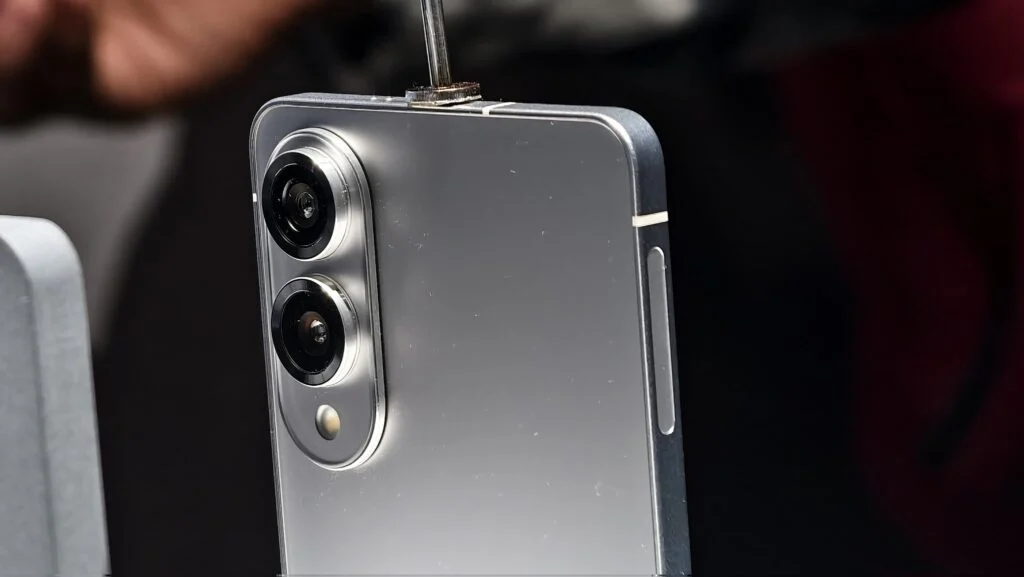
This isn’t Samsung’s first flirtation with dual-folding concepts. Back in 2023, the company unveiled a prototype capable of similar 360-degree folding at tech expos, but no commercial product ever emerged from that concept. The reappearance of this idea in an official patent may signal renewed interest from the company in pushing this design closer to production, although Samsung has not yet announced any plans to launch a device based on this technology.

If brought to market, a phone with full 360-degree folding capability could dramatically simplify foldable phone design by merging both inner and outer displays into a single flexible panel. It could also pave the way for thinner and lighter foldable phones, potentially giving Samsung a significant edge in the next generation of mobile hardware innovation.

Smart Samsung Fridges Locate Phones, Control Air Conditioners

Samsung Electronics is taking smart home integration to a new level with its latest Bespoke AI refrigerator lineup. Previously, customers used Galaxy Watches to locate misplaced phones—but now, Samsung’s fridges can do the job. With a built-in nine-inch display and voice-enabled assistant, users can simply say, “Hi Bixby, find my phone,” and the fridge will ring the correct device, recognizing different family members’ voices for tailored assistance.

Beyond phone-finding, these AI fridges act as a central control hub for the smart home. Users can give voice commands to adjust air conditioners or control window blinds, and the system responds based on real-time weather data to ensure optimal comfort. This was among several innovative features Samsung unveiled during its latest product showcase event in Seoul, where the company highlighted its expanding use of artificial intelligence in everyday appliances.

Samsung’s broader strategy is clear: to lead the next generation of smart living by embedding AI into a wide range of home products—from refrigerators and robot vacuums to washing machines. The aim is to create a more seamless, personalized, and connected user experience. These enhancements are part of a calculated push to maintain market leadership while redefining how consumers interact with their living spaces.

According to Moon Jeong Seung, head of the digital appliance R&D division, the increased integration of AI is expected to drive strong sales in the coming year. With expertise spanning both mobile and home electronics, Samsung is uniquely positioned to develop an expansive, interconnected ecosystem. By linking the half-billion devices it sells annually, the company envisions a future where homes are not just smart—but intelligent and intuitive.