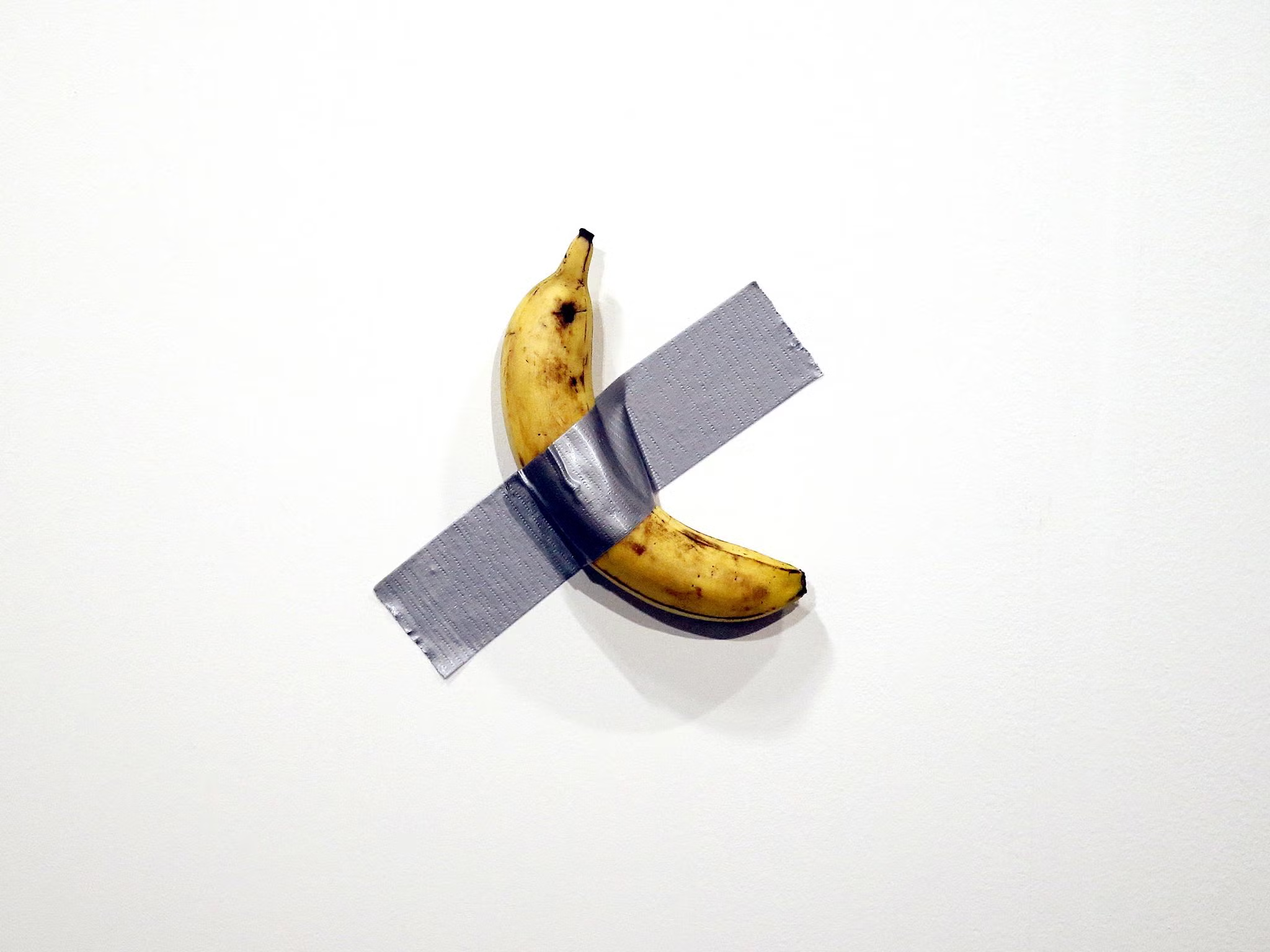
Viral Banana Artwork “Comedian” Sells for $6.24 Million at Auction
Overview
Maurizio Cattelan’s conceptual artwork, Comedian — a banana duct-taped to a wall — has once again captured global attention by selling for a staggering $6.24 million at a Sotheby’s auction in New York. This sale far surpassed its initial estimate of $1 million to $1.5 million, with bidding starting at $800,000.
The artwork was purchased by Justin Sun, a Chinese cryptocurrency entrepreneur, who views the piece as a cultural symbol bridging art, memes, and the digital community.
The Artwork and Its Cultural Significance
Comedian debuted in 2019 at the Art Basel Miami Beach fair, priced at $120,000. The original piece featured a banana sourced from a local grocery store and affixed to a wall using duct tape. The banana is meant to be replaced periodically, reflecting the transient nature of its physical components. Buyers receive installation instructions, a roll of tape, and a certificate of authenticity.
Cattelan described the work as a commentary on societal values, provoking discussions on the definition and worth of art. Critics have likened it to conceptual art milestones like Marcel Duchamp’s Fountain, challenging traditional notions of value and permanence in art.
Controversial Moments
Since its debut, Comedian has sparked debates and memorable incidents:
- Performance Art at Miami: In 2019, artist David Datuna ate the banana in front of stunned attendees, calling his act “artistic performance” rather than vandalism.
- Exhibit in South Korea: In 2023, a student at the Leeum Museum in Seoul ate the banana, citing hunger. The museum replaced it promptly.
- Global Exhibition: Before the recent auction, Sotheby’s showcased Comedian in cities like New York, Paris, London, Tokyo, and Dubai, amplifying its international allure.
The Auction and Future Plans
The recent sale marks the first time Comedian was auctioned, reinforcing its status as a conceptual masterpiece. Sotheby’s auctioneer Oliver Barker praised its disruptive nature, calling it both “iconic” and an embodiment of Cattelan’s thought-provoking genius.
Justin Sun, the winning bidder, plans to consume the banana as part of the “artistic experience,” in homage to its cultural significance. His statement underscores the intersection of art and popular culture, with Comedian serving as a symbol of its generation.
Critics and Legacy
Art critics remain divided over Comedian. While some celebrate its intellectual provocation, others dismiss it as a joke. David Galperin, Sotheby’s head of contemporary art for the Americas, praised the work as “defiant” and “genius,” emphasizing its role in defining contemporary art discourse.
For Cattelan, the artwork remains a reflection on societal values, its fluctuating monetary worth a testament to its central question: What do we truly value?