
Yazılar

Moon and Sun Take Center Stage in 2026’s Lineup of Cosmic Events

The moon and the sun will headline a busy calendar of celestial events in 2026, from major eclipses to lunar missions and eye-catching supermoons.

The year begins with renewed focus on the moon as NASA prepares to send astronauts past it for the first time in more than 50 years under its Artemis program. Alongside human missions, a wave of robotic landers is planned, including Blue Origin’s oversized Blue Moon prototype, as well as landers from U.S. and Chinese companies targeting scientifically rich regions of the lunar surface.

Solar activity will also draw attention, highlighted by two major eclipses. A rare “ring-of-fire” annular solar eclipse will occur over Antarctica in February, followed by a total solar eclipse on Aug. 12 that will sweep across parts of the Arctic, Greenland, Iceland and Spain. Several lunar eclipses are also scheduled throughout the year.

Skywatchers can expect planetary spectacles as well. Six planets will line up in late February, with most visible to the naked eye, while Mars joins a similar parade in August. Jupiter, Saturn, Venus and Mercury will be the easiest to spot shortly after sunset, weather permitting.

Three supermoons will brighten the night skies in 2026, including a particularly close and bright one on Christmas Eve. These full moons appear larger than usual as the moon reaches the closest point in its orbit around Earth.

Meanwhile, scientists expect continued bursts of solar activity, increasing the chances of vivid auroras in lower latitudes, though activity should gradually ease as the sun moves into the quieter phase of its 11-year cycle. For astronomers and casual stargazers alike, 2026 promises no shortage of cosmic drama.
China Sends Youngest Astronaut Yet to Its ‘Heavenly Palace’ Space Station

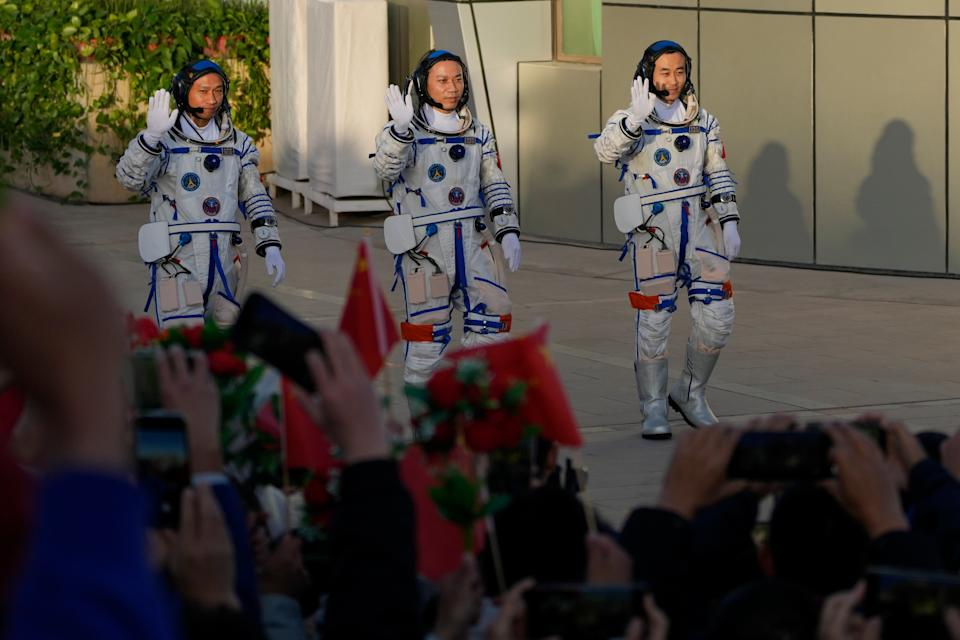
China has launched its Shenzhou-21 mission, sending a three-member crew — including the nation’s youngest astronaut to date — to the Tiangong (“Heavenly Palace”) space station, state media reported Friday.

The crew blasted off atop a Long March-2F rocket from the Jiuquan Satellite Launch Centre in northwest China, marking the seventh crewed mission to the permanently inhabited station since its completion in 2022.

The new team will spend six months aboard Tiangong, taking over duties from the Shenzhou-20 astronauts, who are expected to return to Earth in the coming days.

The mission’s commander, Zhang Lu, 48, previously flew on Shenzhou-15, while first-time astronauts Zhang Hongzhang, 39, and Wu Fei, 32 — China’s youngest astronaut ever to fly — complete the trio.

Joining them are four black mice, the first small mammals taken to the Chinese space station. They will be used in biological experiments to study reproduction in low Earth orbit, part of China’s broader push into space-based life sciences.

Biannual launches have now become standard for the Shenzhou program, which in recent years has achieved major milestones — including the first crewed missions by astronauts born in the 1990s, record-breaking spacewalks, and plans to send Pakistan’s first astronaut to Tiangong in 2026.

China’s rapid expansion in space exploration has drawn increasing attention from Washington, where NASA is racing to return American astronauts to the Moon before Beijing does. Both powers are also establishing rival frameworks for lunar exploration — the U.S.-led Artemis Accords and the China–Russia International Lunar Research Station initiative.

Chang’e-6 Lunar Samples Uncover Water-Rich Material from Ancient Asteroids

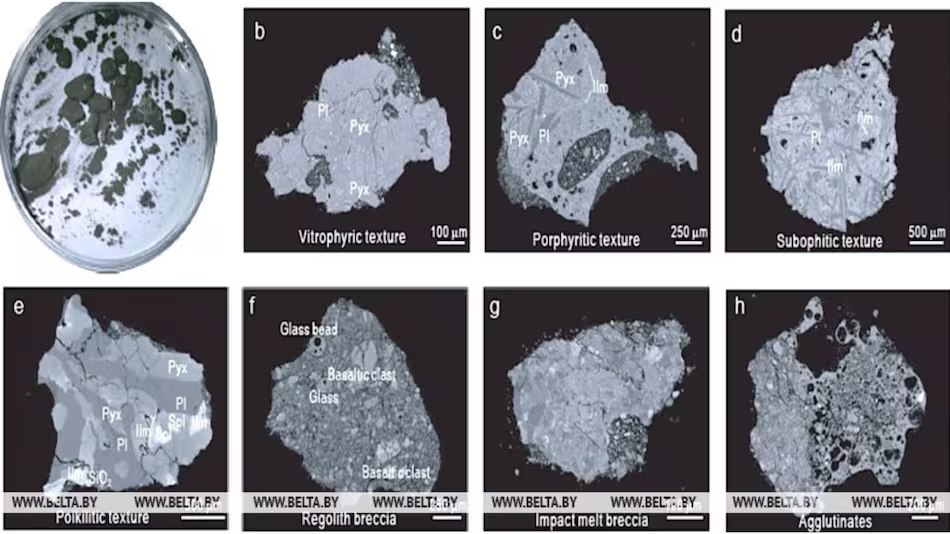
Scientists analyzing lunar soil returned by China’s Chang’e-6 mission have identified rare meteorite fragments that suggest the Earth and Moon were struck by water-rich asteroids more frequently than previously believed. The mission, which collected the first-ever samples from the Moon’s far side in June 2024, yielded two grams of dust containing microscopic olivine-bearing clasts. These fragments share the chemical signature of CI carbonaceous chondrites, a class of asteroid known for being rich in water and organic molecules. Such delicate space rocks rarely survive passage through Earth’s atmosphere, making their discovery on the Moon particularly valuable. Devamını Oku