
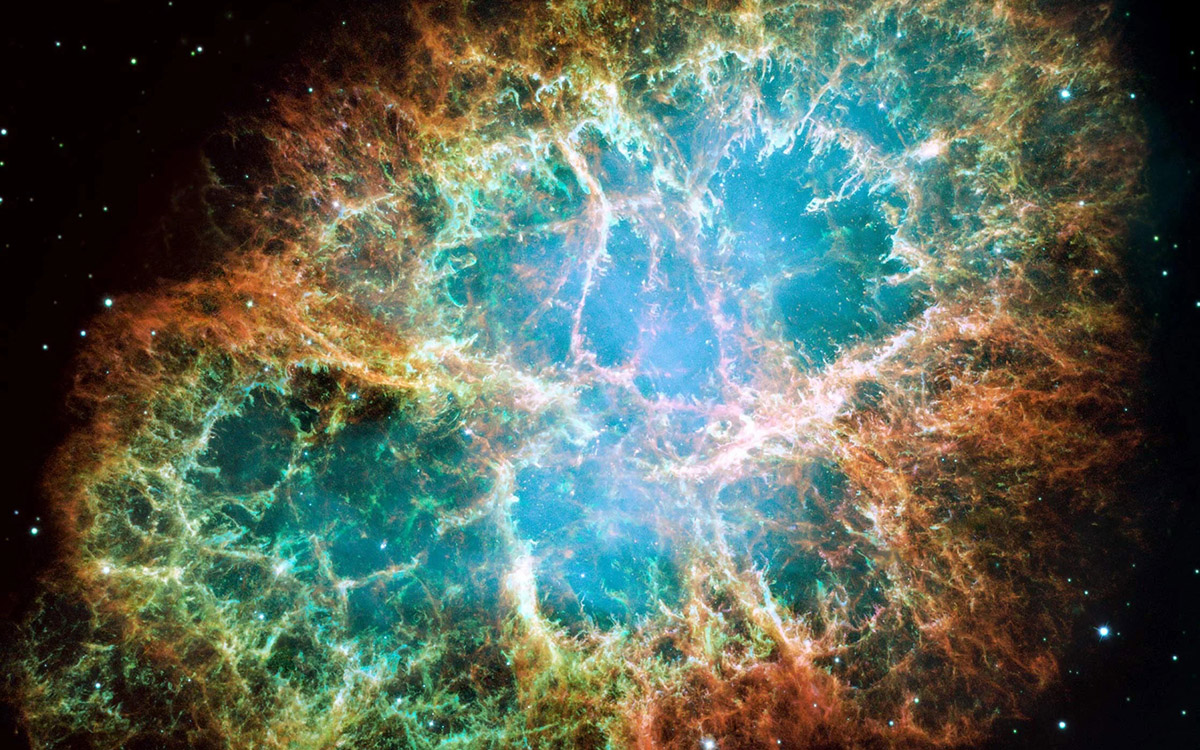
Researchers have proposed a groundbreaking explanation for the enigmatic zebra-like radiation pattern emitted by the Crab Pulsar, a neutron star nestled 6,000 light-years away at the heart of the Crab Nebula. This pulsar, born from the remnants of a supernova explosion recorded in 1054, has long fascinated scientists due to its high-frequency emissions, which stand out among the broader population of pulsars.
A recent study, published in Physical Review Letters on November 15, sheds light on this phenomenon. The zebra-like radiation, characterized by distinctive spectral stripes, was analyzed by physicist Mikhail Medvedev from the University of Kansas. Medvedev’s research offers a new perspective on the unique patterns observed in the pulsar’s emission, paving the way for deeper insights into the behavior of neutron stars.
According to the study, the zebra-like effect arises from the diffraction of electromagnetic waves within the pulsar’s magnetosphere, a region dominated by intense magnetic fields and plasma. As the pulsar spins, its radiation beams sweep across space like a cosmic lighthouse, with the diffraction caused by the plasma introducing the characteristic striped patterns. These findings highlight the critical role of plasma density and magnetospheric dynamics in shaping the observed emissions.
The discovery not only enhances our understanding of the Crab Pulsar but also provides a framework for studying similar phenomena in other extreme astrophysical environments. By revealing how plasma interacts with electromagnetic waves in such conditions, the research contributes to broader efforts to decode the mysteries of pulsars and the fundamental physics governing their behavior.

Emily Calandrelli made history as the 100th woman to travel to space. The momentous occasion occurred aboard Blue Origin’s New Shepard rocket, launching from the company’s West Texas facility. The suborbital flight reached an altitude of 106 kilometers, surpassing the Kármán line and officially entering space. This milestone was part of Blue Origin’s ongoing effort to make space travel more accessible to civilians, and it carried six passengers, marking the company’s ninth human spaceflight.
Calandrelli’s flight was not only a personal achievement but also a significant moment for the broader scientific community. The mission lasted about ten minutes, during which the passengers experienced approximately four minutes of weightlessness. Alongside Calandrelli, the passengers included Marc and Sharon Hagle, a couple returning for their second spaceflight with Blue Origin; Austin Litteral, who won a seat through Whatnot, a livestream shopping platform; former game warden J.D. Russell; and Canadian CEO Hank Wolfond. Their collective journey underscores the growing trend of private space tourism, where people from all walks of life can now experience space firsthand.
As a strong advocate for STEM education, Calandrelli has long been a role model for young women aspiring to careers in science, technology, engineering, and mathematics. Known as “The Space Gal” on social media, she has dedicated much of her career to inspiring the next generation of women in aerospace. Calandrelli’s journey to space was the realization of a dream she had been working toward for years, fueled by her background in aerospace engineering. In her own words, her flight was a step toward greater representation of women in space, inspiring young girls to follow in her footsteps.
One of the most meaningful moments for Calandrelli on her flight was the inclusion of a photo montage featuring the 99 women who had flown in space before her. She carried this tribute with her as a token of appreciation for the trailblazers who paved the way for future generations. As the 100th woman to reach space, Emily Calandrelli’s historic mission symbolizes both personal achievement and a larger cultural shift toward greater gender equality in the exploration of space.