Yazılar

Astronomers Discover Hidden Supermassive Black Holes Concealed Behind Cosmic Gas and Dust

Recent astronomical discoveries have revealed that the universe may be home to far more feeding supermassive black holes than scientists had originally thought. These enormous black holes, which range in mass from millions to billions of times that of our Sun, are believed to be hidden behind dense clouds of gas and dust. This cosmic veil prevents traditional telescopes from detecting their activity, which typically involves the black hole pulling in matter, emitting vast amounts of radiation in the process. Researchers now estimate that nearly 30 to 50 percent of these actively feeding supermassive black holes could be obscured by such material, remaining undetected in many parts of the universe.

The newly uncovered information challenges previous models of black hole distribution and activity. Astronomers have long known that supermassive black holes reside at the centers of most large galaxies, but the idea that so many of these black holes remain hidden adds a layer of complexity to our understanding of the cosmos. The gas and dust that conceal these cosmic giants act as a sort of cloak, making it difficult for traditional observatories, which rely on visible light or other electromagnetic radiation, to capture any signs of their existence or the intense energy they emit as they feed on surrounding material.

Scientists have made these groundbreaking observations by employing more advanced techniques and newer types of telescopes that can see beyond the optical spectrum. Instruments capable of detecting X-rays, infrared radiation, and other wavelengths have helped to reveal the true extent of these hidden black holes. For example, some of the most recent observations from the James Webb Space Telescope have provided crucial insights into the obscured regions of space, allowing astronomers to peer through the gas and dust and uncover previously invisible black holes that are actively feeding.

This discovery is reshaping how researchers approach the study of supermassive black holes and their role in galaxy formation and evolution. By identifying and understanding the vast number of these unseen black holes, scientists can refine models of galactic evolution and improve our understanding of the forces at play in the most distant corners of the universe. As new technologies continue to evolve, more of these elusive cosmic entities may soon come into view, offering even greater insights into the most mysterious objects in the universe.

Scientists Finally Decode the Mystery Behind White Dwarf’s Unexplained Rapid Spin

A fascinating discovery has been made regarding a white dwarf star, situated about 1,700 light-years from Earth. This white dwarf, known as RX J0648.0–4418, is part of a unique binary system where it is continuously drawing stellar material from its companion star, HD 49798, a helium-burning hot subdwarf. Despite its shrinking size, the white dwarf maintains a surprisingly rapid spin, completing a full rotation approximately every 13 seconds. This rapid rotation has raised new questions about the dynamics of binary star systems and the potential fate of this star in the future.

The white dwarf’s behavior is especially intriguing as it appears to be approaching a critical mass known as the Chandrasekhar limit. Once a white dwarf reaches this mass, it can no longer support itself against gravity and may explode in a supernova. In the case of RX J0648.0–4418, this could occur within the next 100,000 years, providing a rare opportunity to study the final stages of a star’s life. The discovery, published in a study by Dr. Sandro Mereghetti of the National Institute of Astrophysics (INAF), shines a light on this star’s exceptional rotational speed and its interaction with its companion.

What makes this system particularly remarkable is the nature of the interaction between the two stars. In most X-ray binary systems, a neutron star or black hole typically pulls material from its companion, but in this case, it’s the white dwarf that is accreting material from a hot subdwarf star. This evolutionary phase is quite rare and typically short-lived, which makes the RX J0648.0–4418 system even more exceptional. The relationship between the two stars offers a unique glimpse into the diverse ways binary systems can evolve.

One of the greatest mysteries surrounding this white dwarf is its incredibly rapid spin, which cannot be fully explained by the material it is accumulating from its companion. The accretion rate has been measured, and it turns out to be too low to account for the extraordinary spin observed. This suggests that there may be other factors at play, possibly related to the star’s internal structure or its history of material accumulation. Further study of RX J0648.0–4418 could offer valuable insights into the complex behavior of white dwarfs and their eventual fate in the cosmos.

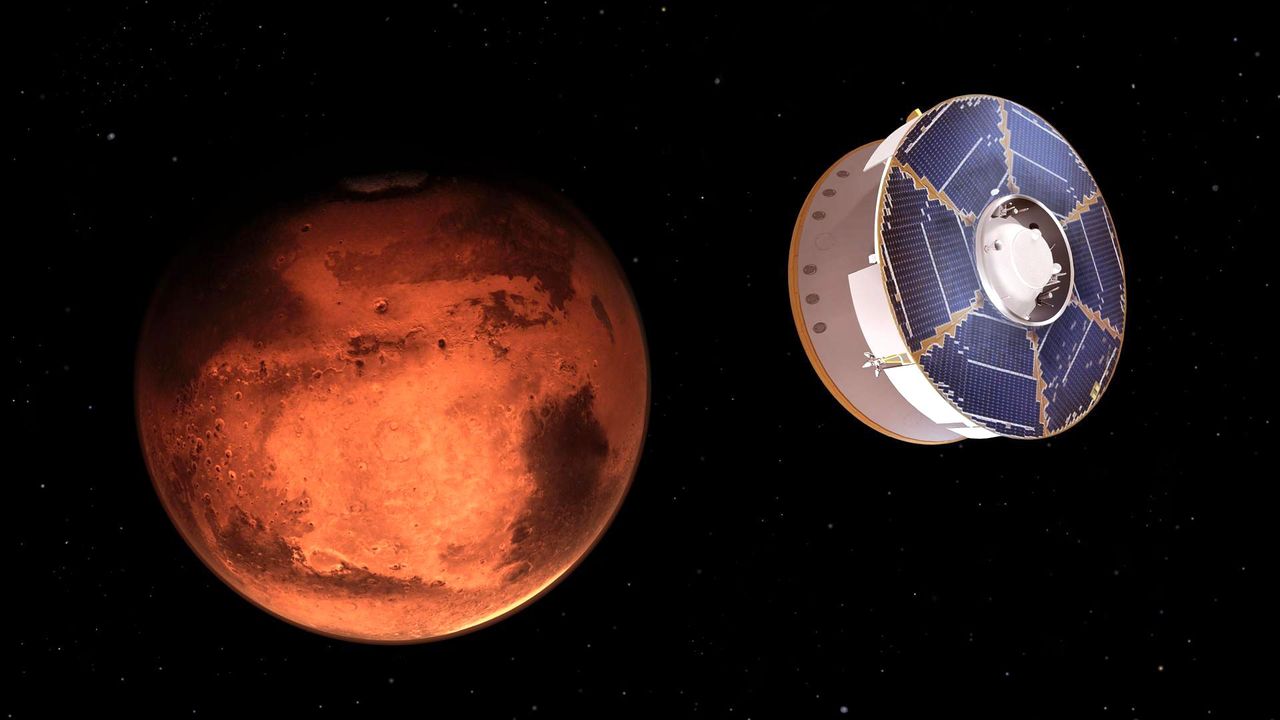
Mars May Harbor Hidden Methane Deposits Beneath Its Crust, Potentially Supporting Alien Life

Scientists have identified potential habitats on Mars where life may exist, particularly in deep underground regions where methane has been detected. Over the years, seasonal variations in methane levels observed by rovers on the Martian surface have raised significant interest. These findings have led researchers to explore the possibility that Mars could host microbial life, despite its harsh environmental conditions. With subzero temperatures, a thin atmosphere, and high levels of cosmic radiation, the surface of Mars is far from hospitable. However, underground areas may offer a more stable and protective environment for certain forms of life.

A recent study published in the journal Astrobiology examined Earth environments that resemble conditions on Mars to better understand the potential for life on the Red Planet. Researchers focused on places where methanogens, microbes that produce methane as a byproduct, are known to thrive. These microorganisms are capable of surviving in extreme environments, much like those believed to exist on Mars.

One such Earth analog is microscopic fractures found deep within bedrock, where methanogens can survive by metabolizing minerals. Similarly, subglacial freshwater lakes and highly saline deep-sea basins have been identified as habitats where methanogens flourish. These environments are characterized by their isolation from the surface, extreme pressure, and the presence of minerals that could support microbial life, similar to what may be found beneath Mars’ surface.

The existence of methane-producing microbes in these Earth environments suggests that life forms capable of surviving in Mars’ subsurface could also be possible. If methane is indeed being produced underground on Mars, it could indicate active microbial processes, offering a compelling reason to explore these regions further. The potential for life beneath Mars’ crust continues to intrigue scientists, and future missions to the planet may focus on these hidden, methane-rich areas to unlock the mysteries of Martian life.