
Carlos Alcaraz Stunned by Botic van de Zandschulp in US Open Second Round Upset

In a stunning turn of events at the US Open, world No. 3 Carlos Alcaraz was ousted in the second round by Dutchman Botic van de Zandschulp on Thursday. The 21-year-old Spaniard, who had recently triumphed at Wimbledon and won an Olympic silver medal, fell in straight sets, 6-1, 7-5, 6-4, at Arthur Ashe Stadium in New York.

Van de Zandschulp, ranked 74th globally, produced one of the biggest upsets in recent tennis history, overpowering Alcaraz in a shocking performance. Despite Alcaraz’s stature as a top contender, the Dutchman maintained his composure throughout the match and claimed his first career victory over a top-10 player at a Grand Slam event.

Alcaraz, known for his relentless energy and shot-making ability, struggled from the outset, finishing with 28 unforced errors. He was unable to gain control of the match, allowing van de Zandschulp to dictate play and close out with an ace. The defeat ended Alcaraz’s 15-match winning streak at the US Open, marking his earliest Grand Slam exit since Wimbledon 2021.

After the match, van de Zandschulp expressed his disbelief at the result, saying on the ESPN broadcast, “It’s been an incredible evening here. First time for me, night session at Arthur Ashe. The crowd was amazing.” Despite nerves during the closing stages, he managed to stay focused and executed his strategy with remarkable calm.

Alcaraz, gracious in defeat, congratulated van de Zandschulp before leaving the court. The loss is a significant blow for the Spaniard, who had entered the tournament as one of the favorites to contend for the title.

Van de Zandschulp will now face British 25th seed Jack Draper in the third round on Saturday, hoping to build on his extraordinary victory.
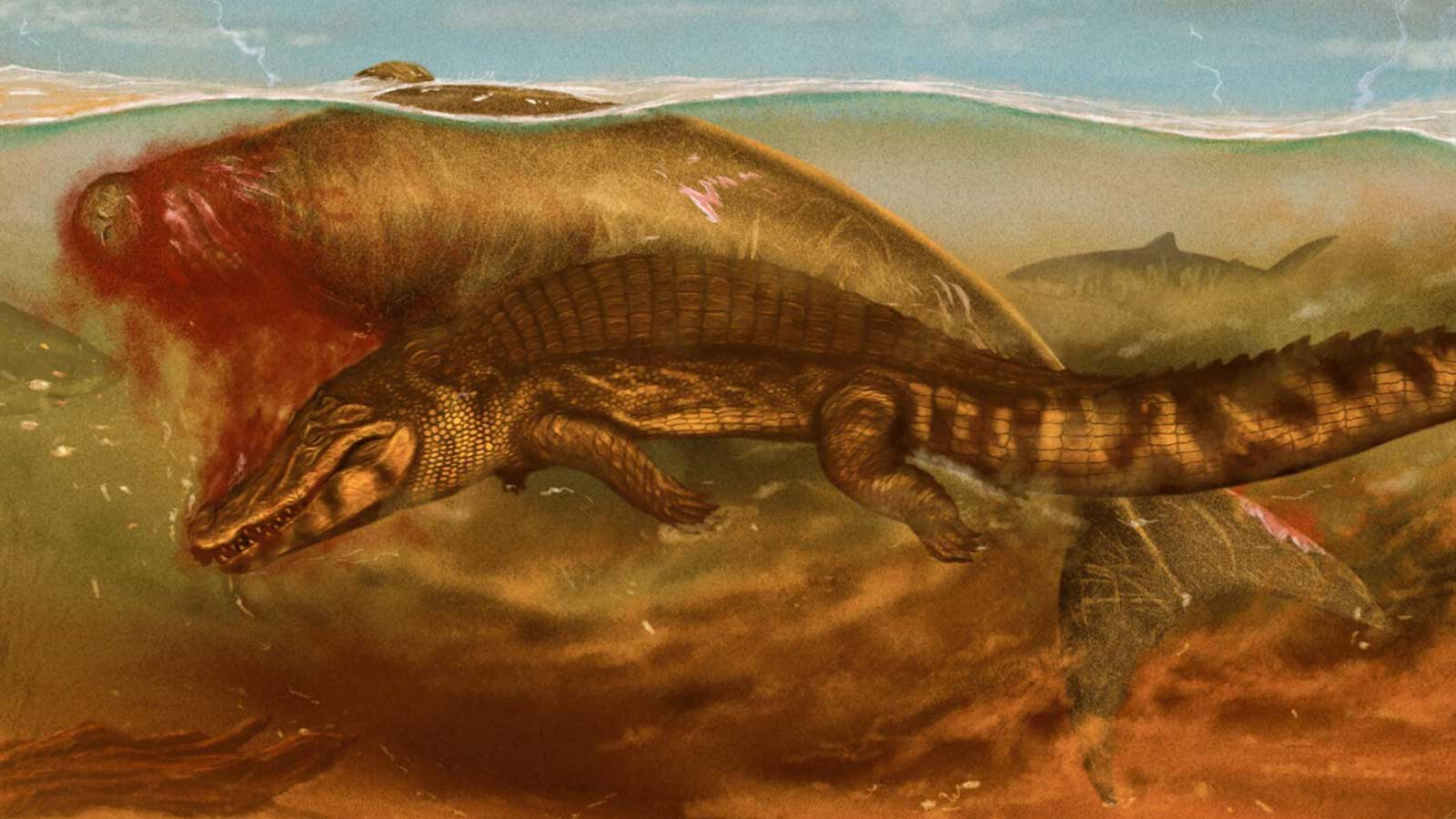
Fossil Discovery in Venezuela Uncovers Prehistoric Sea Cow Preyed Upon by Both Crocodile and Shark

A rare fossil unearthed in Venezuela has revealed a prehistoric sea cow’s grim demise at the jaws of both a crocodile and a tiger shark approximately 15 million years ago. The fossil, belonging to an extinct species of dugong known as Culebratherium, provides a rare glimpse into a violent episode from the Miocene Epoch when this manatee-like marine mammal was attacked by two apex predators.

Scientists analyzed the fossil—a partial skull and 13 vertebrae—and identified evidence of a coordinated attack from both predators. The crocodile, likely a large species measuring between 13 and 20 feet long, appears to have struck first, leaving deep bite marks on the sea cow’s snout, likely in an attempt to suffocate it. Other large incisions suggest that the crocodile dragged the animal during a vicious “death roll,” a behavior seen in modern crocodiles that helps to subdue prey.

The sea cow’s ordeal, however, did not end with the crocodile. After the initial attack, a tiger shark—identified by the discovery of a fossilized tooth lodged in the sea cow’s neck—joined in, scavenging the remains. According to researchers, the bite marks found throughout the sea cow’s body, combined with their irregular distribution and varying depth, suggest that the tiger shark was primarily feeding on the leftovers from the crocodile’s assault.

Aldo Benites-Palomino, the study’s lead author and a doctoral student at the University of Zurich, remarked that finding evidence of two predators on a single specimen is extremely rare and offers invaluable insights into the dynamics of prehistoric food chains. The study, published in the Journal of Vertebrate Paleontology, sheds light on the interactions of marine predators and prey during the Miocene Epoch, roughly 11.6 to 23 million years ago.

Picture background

Despite the compelling findings, determining whether the sea cow was actively hunted by both predators or scavenged postmortem remains a challenge. Dean Lomax, a paleontologist from the University of Bristol who was not involved in the study, pointed out that without direct evidence, it is difficult to say with absolute certainty whether the dugong was alive during both attacks. He noted that it is possible the sea cow had already died and was later scavenged by the two predators.

The fossil discovery came about by chance when a farmer in southern Venezuela stumbled upon the remains in an area not previously known for fossils. Initially, the research team struggled to identify the fossils but eventually recognized them as belonging to a dugong, an ancestor of today’s manatees and dugongs, which can grow up to 16 feet in length.

Today, dugongs and manatees are still preyed upon by sharks and crocodiles, but their size makes them less vulnerable to attacks compared to their prehistoric ancestors. The rare fossil underscores the significance of conducting paleontological research in underexplored regions like South America, where new fossil sites can provide fresh insights into ancient ecosystems.

The research team believes this discovery highlights the need to continue searching for fossils in non-traditional areas such as Venezuela, where the untapped fossil record could hold many more secrets of prehistoric life. As Benites-Palomino expressed, “We have been going to the same fossil sites in North America and China for a long time, but every time we work in these new areas, we constantly find new fossils.”

Uzbekistan Turns to Electric Vehicles in Its Push for Green Energy Transition

Uzbekistan, Central Asia’s most populous country, is taking bold steps to reduce its carbon emissions and shift towards a greener economy, with electric vehicles (EVs) playing a pivotal role in this transition. Historically dependent on fossil fuels for electricity, Uzbekistan has been ranked as one of the world’s most carbon-intensive economies by the World Bank. To combat this, the nation has introduced significant measures to encourage the adoption of EVs as part of a broader green growth strategy.

In a bid to make electric and hybrid cars more affordable, Uzbekistan eliminated excise and customs duties on these vehicles five years ago. This move slashed prices by as much as 50%, according to estimates, leading to a surge in EV sales. Over the past three years, sales of electric cars have grown tenfold, reflecting the country’s increasing commitment to green energy.

For consumers like Timur Chutbaev, a project manager based in Tashkent, the lower prices were a strong incentive to invest in an electric car. Chutbaev explained that powering his EV is far cheaper than using diesel or gasoline vehicles, given Uzbekistan’s government-subsidized electricity rates. Charging his car at home costs him just $5 for 500 kilometers (310 miles) of driving, making EV ownership both economically and environmentally attractive.

Although EVs currently account for a small share of the market, their numbers are rising. In 2022, 25,000 electric vehicles were sold out of a total of 1.7 million car sales. Chinese EV giant BYD, which dominates Uzbekistan’s imports, has further entrenched its presence by opening a plant in the Jizzakh region. With an annual capacity of 50,000 plug-in hybrids, the facility marks BYD’s first venture outside of China and is expected to serve the broader Central Asian market.

Picture background

However, the rise of EVs in Uzbekistan would not have been possible without investments in infrastructure. Alexander Abdullaev, CEO of local EV dealership Megawatt Motors, recalls the initial challenges of selling electric vehicles without an adequate network of charging stations. To promote EV adoption, his company built several charging points across Tashkent and surrounding regions and offered free charging services for two years. Today, hundreds of charging stations operate throughout the country, helping EVs become more accessible.

Despite the progress, Uzbekistan faces challenges in meeting its ambitious climate targets. By 2030, the country aims to reduce its emissions per unit of GDP by one-third from 2010 levels. While increasing the number of EVs on the road is a crucial step, it will not be enough on its own. The electricity grid that powers these vehicles is still primarily fueled by natural gas, a fossil fuel. In 2021, over 80% of the nation’s electricity came from gas, which significantly contributes to global warming.

Uzbekistan is actively investing in renewable energy to address this issue. Over the past five years, the country has boosted its renewable energy mix from 12% to 20%, with growing interest in hydropower and solar technology. David Knight, the World Bank’s lead country economist for Central Asia, emphasized that improving energy efficiency and reducing emissions are critical for Uzbekistan as its economy rapidly expands.

For now, demand for EVs remains strong, and Megawatt Motors is expanding its operations by training salespeople to cater to this burgeoning market. Abdullaev believes that Uzbekistan’s established automobile industry, which began in 1995, provides a solid foundation for producing homegrown electric vehicles in the near future. With the country’s green energy transition in full swing, Abdullaev is optimistic: “Anything is possible.”