
China’s Local Government Debt Problems Are a Hidden Drag on Economic Growth

China’s persistent consumption slowdown is increasingly linked to the country’s real estate slump, which has deep financial ties to local governments and their growing debt. Over the past two decades, much of Chinese household wealth was funneled into real estate, but since Beijing began cracking down on developers’ high reliance on debt in 2020, property values have fallen. This has, in turn, cut into local government revenues, especially from land sales—a crucial source of funding.

According to analysts at S&P Global Ratings, local government finances may take three to five years to recover, but delays in revenue recovery could exacerbate the already growing debt levels. Wenyin Huang, director at S&P Global Ratings, highlighted how macroeconomic challenges continue to weaken the revenue-generating capacity of local governments, particularly when it comes to taxes and land sales. Over the last two or three years, the drop in land sale revenues and tax cuts dating back to 2018 have further reduced operating revenue by an average of 10% across China.

Local governments are scrambling to reclaim lost revenue, putting additional strain on businesses already hesitant to expand or raise wages amid ongoing economic uncertainty. This pressure has led to an increase in back-tax collection efforts, with some companies reporting notices to repay taxes for operations dating back decades. These unexpected financial demands have further damaged fragile business confidence, with the CKGSB Business Conditions Index reflecting a contraction in August.

Picture background

In an effort to diversify revenue streams, certain provinces such as Jiangsu, Shandong, Shanghai, and Zhejiang have seen non-tax revenue growth exceeding 15% in 2024. However, this shift has done little to alleviate the underlying challenges. Camille Boullenois, an associate director at Rhodium Group, noted that the aggressive tax collection “shows how desperate [local governments] are to find new sources of revenue.”

The Chinese government has denied any widespread or targeted tax inspections but acknowledged that local governments have issued notices in compliance with existing laws. Despite these claims, the strain on local government budgets remains evident, as essential services like education and civil servant salaries cannot be cut, leaving limited room to reduce spending.

Efforts to spur growth by pivoting toward consumption-based models have struggled to take hold. Analysts have pointed out that the investment-led approach is not delivering the desired nominal GDP growth, which is contributing to higher debt ratios. Since 2021, China’s debt-to-GDP ratio has risen by 30 percentage points, reaching 310% in the second quarter of 2024, and is projected to rise further by year-end. Growth, meanwhile, is expected to lag behind the official target, with GDP projected to rise by just 4.5% in the third quarter, shy of the government’s 5% goal.

Local government financing vehicles (LGFVs), which have taken on substantial debt for public infrastructure projects, now pose a significant risk to the banking sector. Experts like Alicia Garcia-Herrero, chief economist for Asia-Pacific at Natixis, believe LGFVs are an even greater risk than the real estate sector, describing them as a “grey rhino” — a metaphor for high-probability, high-impact risks that are being ignored. Chinese banks are now more exposed to LGFV loans than to real estate developers, creating a precarious situation for the financial system.

S&P Global Ratings’ Laura Li warned that while the government is trying to manage liquidity issues to maintain stability, there are no quick fixes to the mounting debt problem. The central and local governments simply do not have enough resources to address the issue all at once, leaving the country’s economic recovery and long-term growth prospects under threat.

 

‘Shogun’ and ‘Hacks’ Claim Top Honors at TV’s Emmy Awards

The historical epic Shogun triumphed at the Emmy Awards on Sunday, winning the coveted Best Drama award, while Hacks pulled off a surprise victory in the Best Comedy category, beating out the expected frontrunner, The Bear. The Emmy Awards, celebrating the best in television, also honored Shogun stars Hiroyuki Sanada and Anna Sawai with acting awards for their roles in the sweeping tale of political intrigue in 17th-century Japan.

In the comedy realm, Hacks, which tells the story of a 70-something comedian and her millennial writer, emerged as a surprise winner for Best Comedy Series. This upset was particularly notable as The Bear, a show about a Chicago restaurant, was heavily favored to take home the award. Nevertheless, The Bear managed to secure three out of four comedy acting Emmys, with stars Jeremy Allen White and Ebon Moss-Bachrach both taking home their second consecutive awards. White, who portrays Chef Carmen “Carmy” Berzatto, delivered an emotional speech, reflecting on the personal and professional transformation the show brought to his life. Moss-Bachrach won for his role as Cousin Richie, a restaurant manager navigating family and career pressures.

The evening also brought a surprise victory for Baby Reindeer, a chilling Netflix limited series about a bartender being stalked by a customer, which was named Best Limited Series. Jean Smart, starring as the ambitious stand-up comedian Deborah Vance in Hacks, received her third Emmy for Best Actress in a Comedy, earning a standing ovation as she took to the stage. With her signature wit, Smart quipped, “I appreciate this because I just don’t get enough attention.”

In a surprising turn, Liza Colón-Zayas claimed the Best Supporting Actress in a Comedy award for her portrayal of Chef Tina Marrero in The Bear. Her win was unexpected, given the competition from acting legends Meryl Streep and Carol Burnett, both nominated in the same category.

The night also featured the father-and-son duo Eugene and Dan Levy, stars of Schitt’s Creek, as co-hosts of the awards show. Eugene Levy brought humor to the evening with his deadpan delivery, joking, “If things go south, my name is pronounced Martin Short,” referencing the star of Only Murders in the Building, who was present in the audience. Dan Levy also poked fun at the industry, calling the Emmys “broadcast TV’s biggest night for honoring movie stars on streaming services.”

The Emmy winners were chosen by the nearly 22,000 members of Hollywood’s Television Academy, representing a wide array of performers, producers, directors, and others involved in the television industry.

Floods Claim More Lives as Torrential Rain Pounds Central Europe

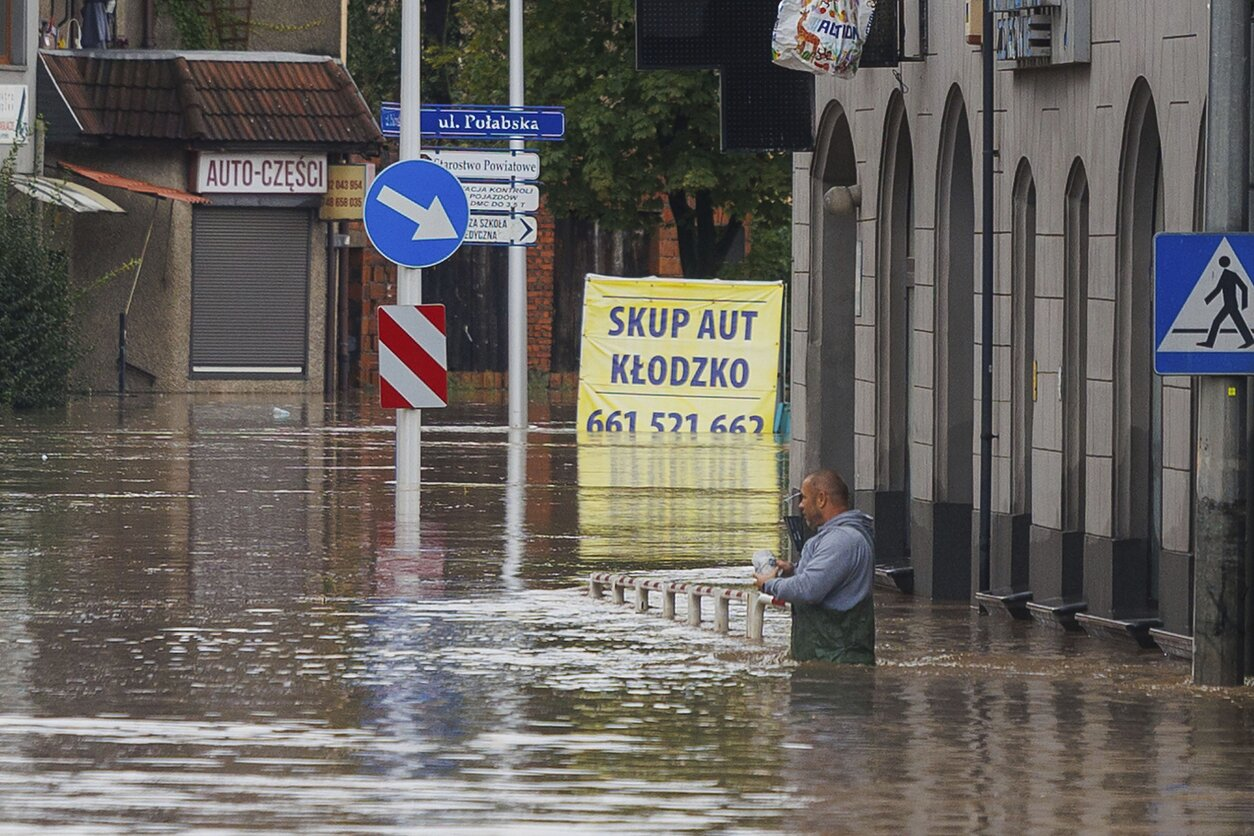
The death toll from widespread flooding in central Europe reached eight on Sunday, as torrential rains continued to cause devastation across the region. Thousands were forced to evacuate their homes in the Czech Republic, where rivers overflowed after days of relentless downpours. The severe weather, triggered by a low-pressure system named Boris, has brought some of the worst flooding in nearly three decades, particularly affecting areas in the Czech Republic and Poland.

The heavy rains, which are forecast to continue until Monday, have already wreaked havoc, with thousands of homes damaged, bridges washed away, and power outages affecting approximately 250,000 households, mostly in the Czech Republic. In Poland, one person drowned on Sunday, while in Austria, a firefighter involved in rescue efforts was tragically killed. In Romania, four people lost their lives on Saturday, and two more fatalities were reported on Sunday.

Lower Austria, the province surrounding Vienna, has been declared a disaster zone following the death of the firefighter. Authorities are urging residents to avoid non-essential travel due to the dangerous conditions. In Poland, two bridges collapsed, one in the historic town of Glucholazy and another in the mountain town of Stronie Slaskie, where a dam burst, further complicating rescue efforts.

Polish Prime Minister Donald Tusk announced plans to declare a state of disaster and request European Union aid to help with the recovery. Meanwhile, in the Czech Republic, emergency services are continuing to search for three individuals who were swept away in their car near the village of Lipova-lazne. The area has experienced nearly 500 mm (19.7 inches) of rainfall since Wednesday, causing severe damage to homes and infrastructure.

Locals in the Czech Republic described the current flooding as worse than the devastating floods of 1997. Residents of some areas, such as the village of Visnova, are bracing for further flooding, as waters from nearby mountains are expected to flow into the region within hours. Emergency crews, including helicopter teams, have evacuated over 10,000 people in the Czech Republic alone.

In Hungary, officials in Budapest have raised forecasts for the Danube River to reach dangerous levels later this week, nearing the record set in 2013. As rain subsides in Romania, recovery efforts are underway, with workers restoring power to around 11,000 homes and beginning the cleanup process. However, many residents, like Victoria Salceanu from the village of Slobozia Conachi, are left devastated by the destruction of their properties.