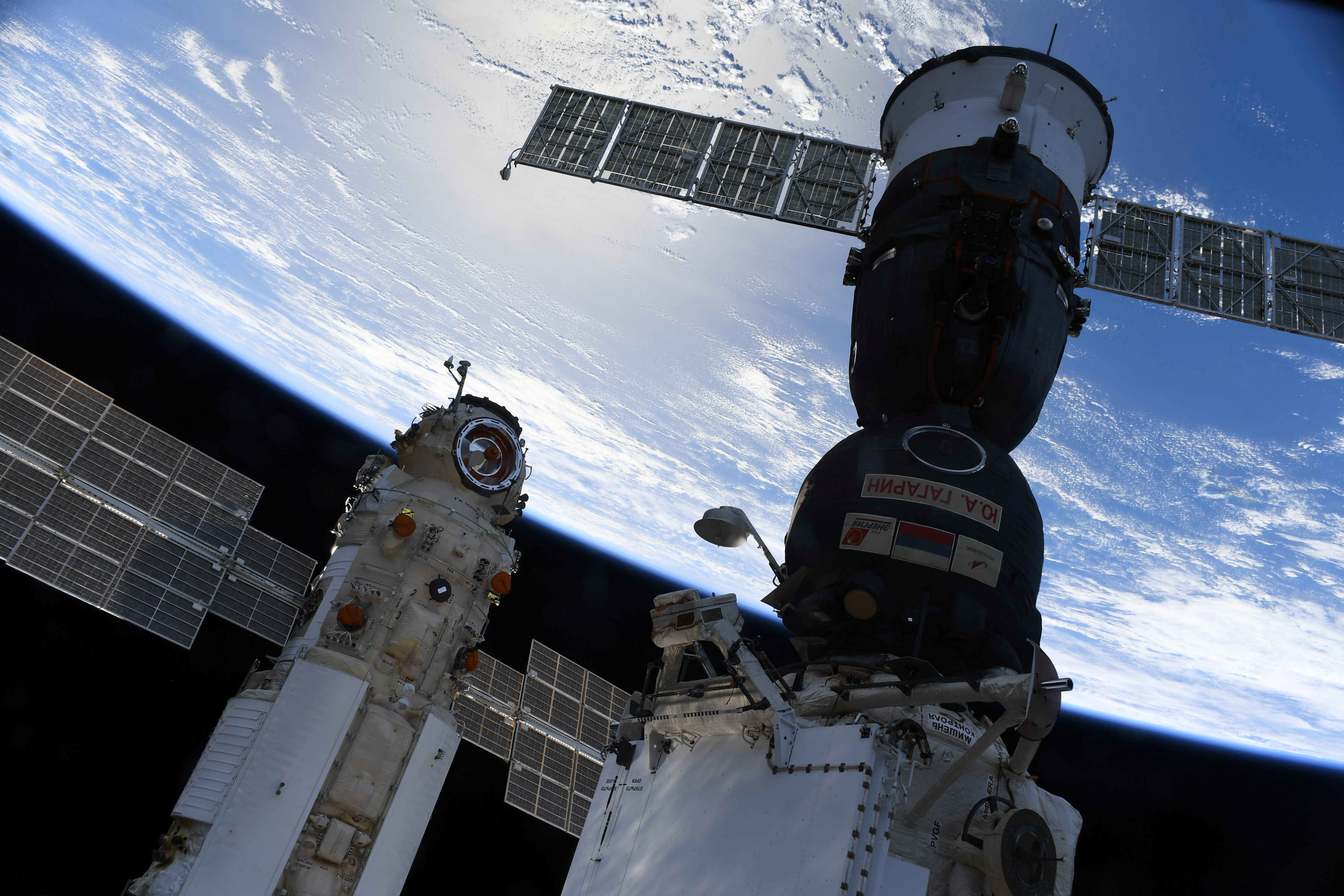
Russian Spacecraft Odor Forces Brief Lockdown on ISS Module

A recent incident on the International Space Station (ISS) prompted Russian cosmonauts to briefly seal off part of the station after detecting an “unusual odor” emanating from the Russian Progress 90 cargo spacecraft. This occurred over the weekend, with NASA reporting the situation on Sunday.

According to NASA, the smell, accompanied by “droplets” observed by the cosmonauts, was likely due to “outgassing” from materials inside the Progress capsule. NASA clarified that the issue was not related to the spacecraft’s fuel—unsymmetric-dimethylhydrazine and nitrogen tetroxide—which is highly toxic to humans. Instead, it stemmed from materials within the spacecraft that had been exposed to the harsh conditions of space.

Kelly O. Humphries, NASA’s news chief at Johnson Space Center, reassured that there were no immediate safety concerns for the crew. “Outgassing” is a common occurrence in space when materials release gases in the absence of Earth’s atmosphere, and the extreme temperatures and radiation of space exacerbate this effect.

Once the unusual odor was detected, the cosmonauts quickly shut the hatch connecting the Poisk module to the rest of the ISS. Ground control teams then activated air scrubbers as part of standard protocol, which helped clear the air inside the station. NASA confirmed that air quality remained normal and that cargo transfer operations continued as planned.

The uncrewed Progress 90 spacecraft, which arrived on November 21 from the Baikonur Cosmodrome in Kazakhstan, was carrying essential supplies including food, fuel, and scientific materials. Despite the odor-related setback, the cosmonauts were able to access the cargo without further delay.

This event adds to ongoing concerns about the Russian-controlled modules on the ISS, including the Zvezda module, which has been largely sealed due to a slow air leak. The ISS continues to operate as a joint venture between Russia, the United States, and several international space agencies, though Russia’s commitment beyond 2028 remains uncertain.


Elon Musk’s Mars Settlement Plan Faces Reality Check in New Book

While Elon Musk’s goal of settling Mars within the next 30 years has sparked excitement about humanity’s future as a multiplanetary species, a new book casts serious doubts on the feasibility of such a vision. In A City on Mars: Can We Settle Space, Should We Settle Space, and Have We Really Thought This Through?, authors Kelly and Zach Weinersmith argue that settling the red planet is far more challenging—and dangerous—than many realize.

The Weinersmiths, a biologist and a cartoonist, explore the myriad obstacles humans would face in establishing a sustainable presence on Mars, from environmental dangers to the complexities of human reproduction. Their research, which led to their skepticism about space colonization, earned their book the 2024 Royal Society Trivedi Science Book Prize.

Initially intrigued by the possibility of space settlements, the authors delved into the harsh realities of Martian living. Kelly Weinersmith explains, “We were pretty excited about space settlement happening… but the more we got into it, we realized there’s a lot we don’t know—and doing this too soon could lead to an ethical catastrophe.”

The Harsh Reality of Mars

The book argues that the idea of leaving Earth for Mars is akin to escaping a messy room only to end up in a toxic waste dump. The Martian environment, with its weak gravity, extreme radiation, thin atmosphere, and toxic soil, poses significant threats to human life. “Mars just lacks a lot of the stuff that we have on Earth,” says Zach Weinersmith, noting the planet’s hostile conditions, including a 40% gravity compared to Earth, high radiation levels, and perchlorate-laden soil, which could disrupt human health and development.

The authors are particularly concerned about human reproduction on Mars. With limited data on how humans will respond to Mars’ conditions, the risks for pregnant women and babies could be catastrophic. Studies from space stations suggest that microgravity weakens bones and muscles, which would worsen on Mars, where gravity is only 38% of Earth’s. Kelly Weinersmith points out that even a slight bone loss could prove fatal during childbirth, emphasizing the need for more research into reproduction in space.

Slow, Steady Progress for Research

While the Weinersmiths are not dismissive of space exploration, they argue that short-term colonization is impractical. Instead, they see potential for incremental progress, such as setting up research stations on the Moon and conducting experiments on animal life in space. The authors predict that in the near term, humans may land on Mars, conduct scientific exploration, and return to Earth, but permanent settlements and reproduction will remain out of reach for now.

The biggest challenges lie in sustaining life on Mars. Technologies to build space farms, establish safe habitats, and produce oxygen in closed-loop systems are still underdeveloped. “We don’t really know how to do that,” says Zach Weinersmith, highlighting the immense research needed for survival in such a sealed, extreme environment.

Ethical and Geopolitical Concerns

The Weinersmiths also raise significant ethical and geopolitical issues. The Outer Space Treaty of 1967, which governs activities in space, provides little guidance on issues like resource extraction and territorial claims on Mars. This ambiguity could lead to international tensions, particularly between space powers like the United States and China, as they race to control valuable sites on Mars and other celestial bodies.

A Reality Check on Space Settlements

Ultimately, A City on Mars presents a cautionary tale about the complexities of interplanetary settlement. While space exploration holds tremendous potential for scientific advancement, the authors argue that the dream of colonizing Mars in the immediate future is a dangerous and unrealistic venture. Their book calls for a more measured approach, emphasizing research, ethical considerations, and long-term planning over the rush to claim Mars as humanity’s second home.


Orange Partners with OpenAI and Meta to Develop AI Models for African Languages

French telecom giant Orange has announced a collaboration with OpenAI and Meta to create artificial intelligence (AI) models that cater specifically to regional African languages. This initiative aims to address the gap in AI systems’ understanding of lesser-represented languages, starting with Wolof and Pulaar, spoken by millions across West Africa.

Orange plans to leverage OpenAI’s Whisper and Meta’s Llama open-source models, fine-tuning them to recognize and process these languages. According to Steve Jarrett, Orange’s chief AI officer, global AI systems often fail to understand African text and voice communications due to the lack of culturally and linguistically relevant training data.

“By fine-tuning open models, we introduce additional information, enabling AI systems to understand West African regional languages that are currently ignored by mainstream AI,” Jarrett explained.

Rollout and Focus on West Africa

The first phase of this initiative will integrate Wolof and Pulaar into Orange’s AI models by early 2025. Wolof is predominantly spoken in Senegal, the Gambia, and southern Mauritania, while Pulaar is common in Senegal. The project will expand to cover all 18 West African countries where Orange operates.

Orange will provide these customized AI models under a free license for non-commercial applications like public health and education. This approach aligns with the company’s commitment to enhancing accessibility and addressing unmet needs in the region.

Sovereign AI and Localization

The project reflects a growing global trend toward “sovereign AI,” emphasizing localized data processing and infrastructure. By hosting OpenAI’s systems in European data centers, Orange seeks to ensure secure data handling while accessing advanced AI capabilities. The company’s initiative also promotes cultural and linguistic representation, helping to build systems that resonate with local contexts.

Jarrett stressed the importance of using AI responsibly, balancing innovation with environmental concerns. The models will focus on targeted applications, avoiding the extensive energy demands of massive language models when unnecessary.

Broader Applications

Beyond language processing, Orange is integrating AI into its core business operations. The company uses AI to optimize its mobile networks, identifying and predicting failures before customers are affected. Additionally, AI-driven voice systems are being developed to improve customer service across its contact centers.

This partnership represents a step toward bridging the technological gap for underrepresented regions, fostering greater inclusivity in the global AI landscape.