Groundbreaking Study Uncovers the Role of Dynamo Reversals in Shaping Mars’ Magnetic History

New Insights into Mars’s Magnetic Field Dynamics
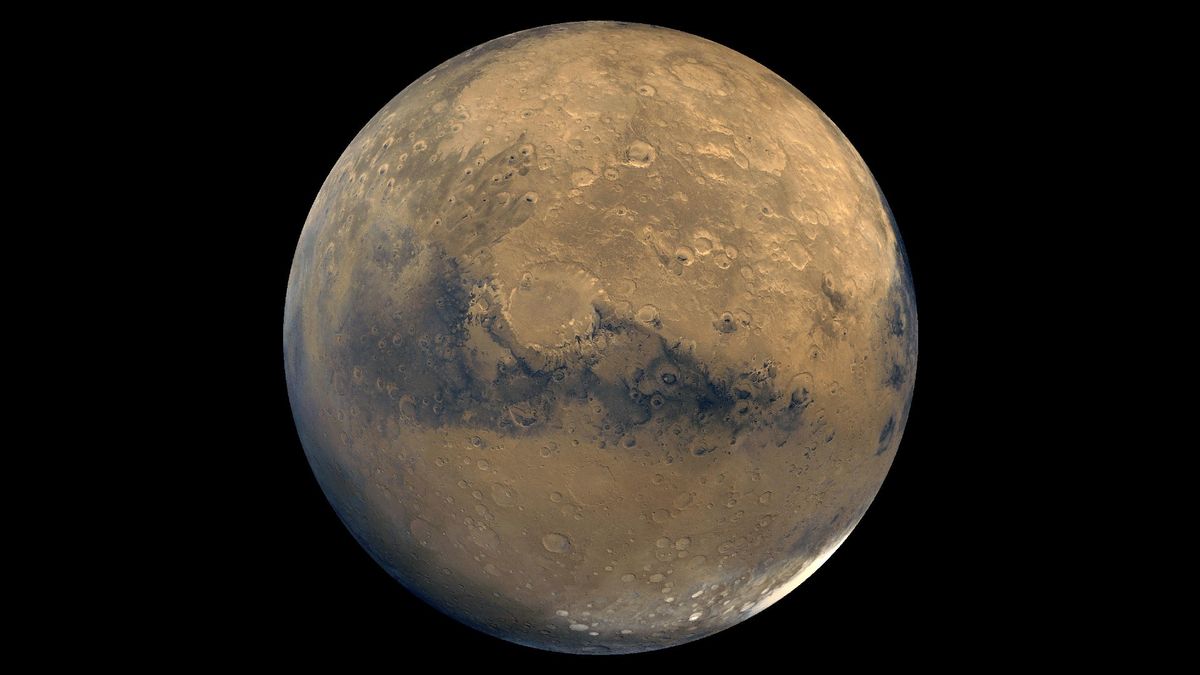
Martian impact basins, previously thought to be demagnetized due to the early cessation of Mars’s planetary dynamo, may instead provide evidence of a reversing magnetic field, according to a new study. Led by Dr. Silpaja Chandrasekar, the research suggests that Mars’s dynamo—the mechanism generating its magnetic field—was active longer than previously believed, with significant implications for our understanding of the planet’s evolution.

Impact Basins and Reversing Fields
Published in Nature Communications, the study delves into the magnetic anomalies in large Martian impact basins, which exhibit weaker magnetism than surrounding regions. Rather than indicating a permanently inactive dynamo, the researchers propose that these weak signals result from prolonged cooling and frequent polarity reversals. By modeling cooling processes within these basins, they demonstrated how these magnetic field reversals diminished the strength of magnetism, creating a demagnetized appearance. This overturns the notion that a dying dynamo alone explains the anomalies.

Extended Dynamo Activity
Traditionally, Mars’s dynamo was assumed to have ceased early in the planet’s history, but recent evidence, including young volcanic rocks and the meteorite Allan Hills 84001, suggests otherwise. The study posits that Mars’s dynamo may have persisted until around 3.7 billion years ago. During this time, the magnetic field experienced regular reversals, forming oppositely magnetized layers in cooling impact basins. This process likely contributed to the weak magnetic signatures detected today.

Implications for Planetary Evolution
These findings reshape our understanding of Mars’s magnetic history and its broader planetary evolution. A prolonged, reversing dynamo could have influenced Mars’s climate stability and surface conditions, offering clues about its transition from a warmer, wetter environment to the arid planet we see today. The study also highlights how magnetic field dynamics play a pivotal role in shaping planetary crusts, offering new perspectives for studying other celestial bodies with similar features.

Automakers Push Trump Administration to Retain EV Tax Credits and Promote Self-Driving Cars

Key Appeals from Automakers

Preserve EV Tax Credits

  • The Alliance for Automotive Innovation, representing major automakers like General Motors, Toyota, and Volkswagen, has urged President-elect Donald Trump to retain the $7,500 consumer tax credit for electric vehicle (EV) purchases.
  • Eliminating the credit, a move reportedly under consideration by Trump’s transition team, could further stall the already sluggish EV adoption in the U.S.

Encourage Self-Driving Cars

  • Automakers emphasized the need for federal initiatives to accelerate the deployment of autonomous vehicles, pointing out that China is already creating a supportive regulatory framework for self-driving technology.

Reconsider Stringent Safety and Emission Rules

  • The group expressed concerns over existing and proposed regulations:
    • Vehicle Emissions: They called for “reasonable and achievable” standards, arguing that current regulations—especially in California and aligned states—raise consumer costs and fail to align with market realities.
    • Automatic Emergency Braking Systems: Automakers requested a review of rules requiring advanced braking systems in nearly all new vehicles by 2029, deeming them technologically unfeasible under current conditions.

Regulatory Backdrop and Political Shifts

Trump Administration’s Proposed Rollbacks

  • The Trump transition team is reportedly planning to:
    • Eliminate the EV tax credit.
    • Target Biden-era regulations aimed at improving fuel efficiency and mandating at least 35% EV production by 2032.

Contrasts with Biden’s Policies

  • The Biden administration’s measures incentivize EV production and aim for a gradual shift away from fossil-fuel-powered vehicles.
  • Automakers fear losing ground against China, where EVs benefit from heavy subsidies and favorable policies.

Industry Concerns and Market Impacts

Global Competition

  • Automakers cited unfair competition from Chinese EVs and technologies benefiting from substantial subsidies.
  • The industry is seeking U.S. regulatory adjustments to remain competitive internationally.

Consumer Costs

  • The automakers argued that inconsistent emissions regulations across states increase costs for buyers.

Technology Feasibility

  • Automakers flagged potential challenges in meeting both safety and emissions standards without significant technological advancements or support.

Implications

For EV Transition

  • Removing the EV tax credit could dampen consumer interest and investment in EV infrastructure.
  • The U.S. risks lagging behind other nations, particularly China, in EV and autonomous technology adoption.

For Federal Policy

  • The automakers’ letter highlights tensions between federal and state regulations, particularly California’s more stringent policies.
  • Balancing consumer affordability, industry competitiveness, and environmental goals remains a significant challenge for the incoming administration.

Amazon Likely to Face EU Investigation Under Digital Markets Act in 2024

Key Developments

Potential Investigation

  • Amazon is expected to undergo a formal investigation by the European Union in 2024 over allegations of favoring its own brand products on its online marketplace.
  • The probe will evaluate whether Amazon violated the EU’s Digital Markets Act (DMA), landmark legislation aimed at curbing the power of Big Tech.

Possible Penalties

  • If found guilty, Amazon could face a fine of up to 10% of its global annual turnover.
  • Amazon shares dipped 3% to $196.91 following the news.

Leadership Transition

  • The decision on launching the investigation will fall to Teresa Ribera, the incoming EU antitrust chief, who is set to replace Margrethe Vestager next month.

Amazon’s Position and Compliance Claims

  • Amazon asserts it is fully compliant with the DMA and has cooperated with the European Commission since two of its services were designated as “gateways” under the DMA rules.
  • In its March compliance report, Amazon stated its ranking algorithms do not favor Amazon-branded products or distinguish between Amazon Retail and third-party sellers.

Broader Context of the Digital Markets Act

Scope of the DMA

  • Introduced in 2022, the DMA imposes stringent obligations on seven major tech companies, including Amazon, Apple, Google, and Meta.
  • Key provisions include prohibitions against self-preferencing and mandates for fair treatment of third-party businesses on dominant platforms.

Ongoing Investigations

  • Other Big Tech firms, such as Apple, Alphabet (Google), and Meta Platforms, are already under scrutiny for potential breaches of the DMA.
  • Ribera is expected to decide the outcomes of these cases in her tenure.

Implications for Amazon and the Tech Industry

Market Impact

  • A potential fine and increased scrutiny could have long-term implications for Amazon’s operations and financial performance.
  • The case highlights the growing regulatory pressure on dominant digital platforms in the EU.

Consumer and Business Dynamics

  • The investigation could reshape how Amazon prioritizes products on its platform, potentially benefiting third-party sellers and consumers by ensuring fair competition.