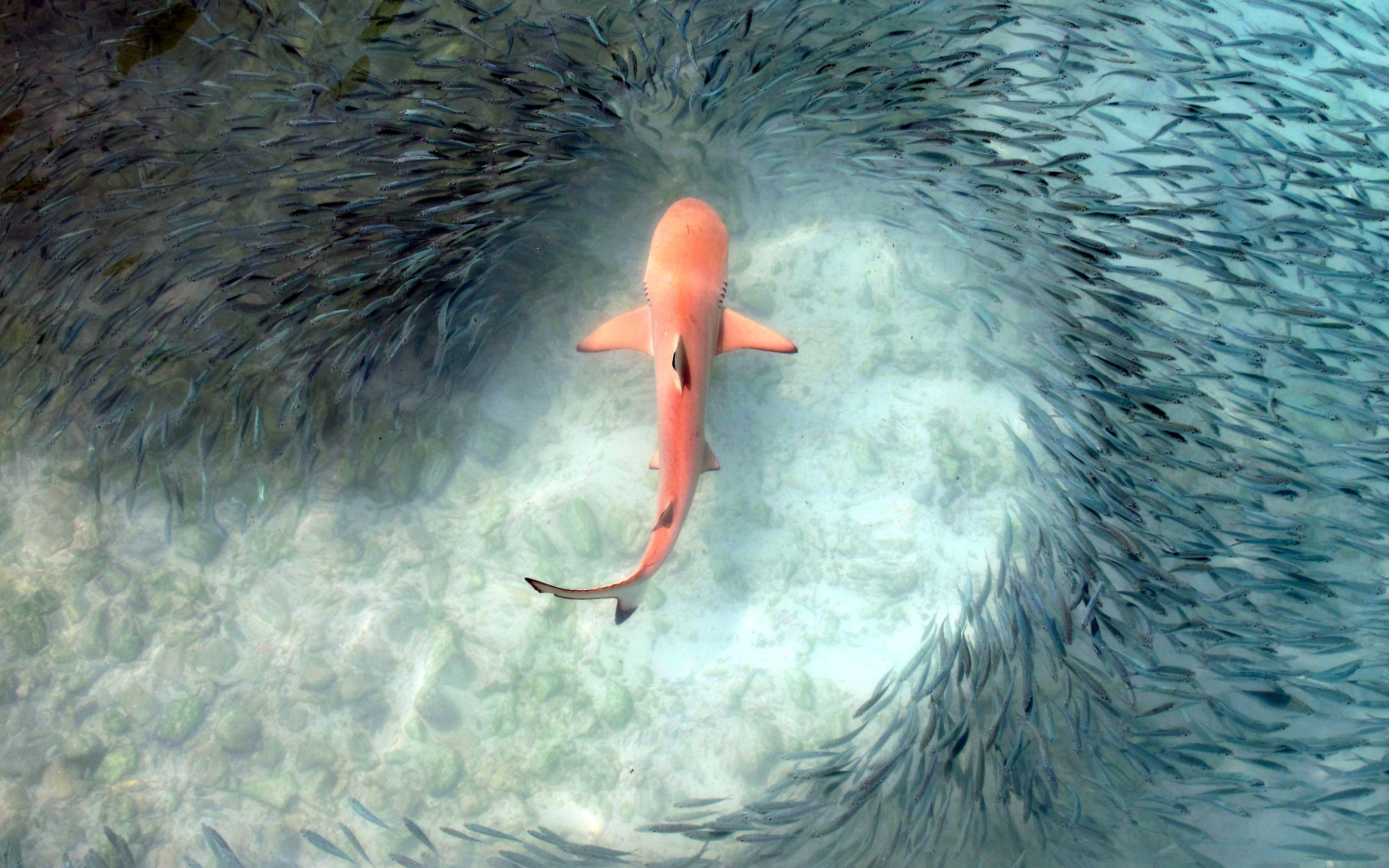
Striking Drone Image of Sharks Hunting Fish Wins Royal Society Photography Prize

A breathtaking drone image capturing young sharks hunting fish in the shallow waters of the Maldives has won the top prize at this year’s Royal Society Publishing Photography Competition. The photograph, taken by Angela Albi, a postdoctoral researcher at the Max Planck Institute of Animal Behaviour in Germany, showcases the dramatic interaction between predator and prey. Albi collaborated with drone pilot August Paula to capture the image, which depicts a school of silverside fish being pursued by four young reef sharks.

The photo was taken during the early morning or late evening when the Maldives’ shallow waters offer crystal-clear visibility, providing the perfect conditions to witness the hunting behavior of the sharks. “Just after sunrise or before sundown, the shallow waters of the Maldives become a clear, see-through surface,” Albi explained, adding that these are the moments when shark-prey interactions are most visible.

The judges were impressed by the raw dynamics captured in the photograph. Hugh Turvey, a member of the competition’s judging panel, remarked that the image highlights “the raw instincts of nature,” with the school of fish moving in unison before splitting to evade the sharks.

Albi’s image won in the behavior category and was also named the overall winner of the competition. The contest features five categories: astronomy, behavior, Earth science and climatology, ecology and environmental science, and microimaging.

In the astronomy category, photographer Imran Sultan took an intricate shot of two nebulae in the Cassiopeia constellation, located over 7,000 light-years away. Meanwhile, David Garcia’s stunning photograph of a supraglacial melting lake in Greenland won the top award in the Earth science and climatology category, taken with an iPhone during a brief moment of light on his flight over the region.

In the microimaging category, “Tired eyes,” an image of the eyes of a bark scorpion, won first place. Photographer Jose Manuel Martinez Lopez captured the image by taking 110 photos of a dried specimen. Lastly, Peter Hudson’s photo of a secretary bird preparing to feast on a locust claimed the prize in the ecology and environmental science category.

A selection of the winning and runner-up images can be viewed in the competition’s online gallery.
NASA Restores Contact with Voyager 1, But Its Power Supply is Dwindling

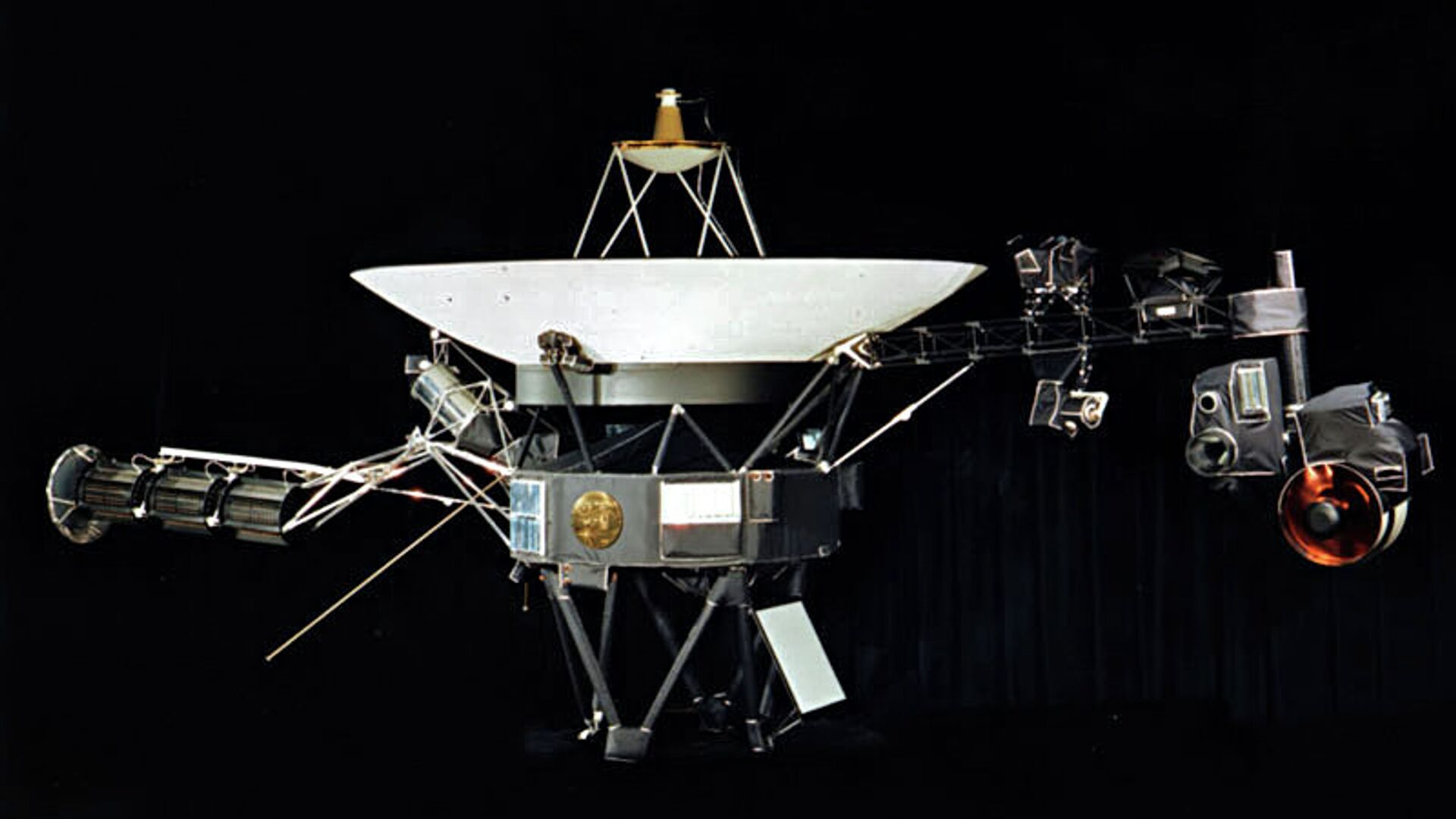
NASA engineers have successfully re-established contact with Voyager 1, which is currently located 15.4 billion miles (24.9 billion kilometers) from Earth, marking a crucial recovery after weeks of communication blackout. The issue began in October when Voyager 1 switched from its primary X-band radio transmitter to a weaker S-band transmitter due to a power shortage. This change, prompted by a command to activate a heater, led to difficulties in receiving data from the spacecraft.

The autonomous transmitter switch caused nearly a month of silence, but NASA engineers managed to restore the X-band transmitter in early November. The spacecraft is now operating normally, resuming its scientific observations and data transmission.

Voyager 1, launched in 1977 as part of NASA’s mission to explore the outer planets, has far outlived its original mission. Now in interstellar space, it continues to send valuable data despite a steadily decreasing power supply. The spacecraft’s plutonium-powered thermoelectric generators lose about 4 watts of power annually, equivalent to the energy used by a small light bulb. This gradual power decline has led the mission team to turn off non-essential systems over the years, ensuring the remaining instruments can continue to operate for as long as possible.

However, challenges persist. The spacecraft’s power situation is increasingly uncertain, as seen when the fault protection system was triggered by the heater command. This issue highlights the limitations of the spacecraft’s power models and suggests that the probe’s ability to maintain its current operations is becoming more precarious.

Despite these hurdles, the Voyager mission team remains determined to keep the spacecraft functioning as long as possible. Both Voyager 1 and its twin, Voyager 2, have far exceeded their expected lifespans, providing unprecedented data from the distant reaches of our solar system and beyond.

Currently, only four instruments remain operational on each probe, studying plasma, magnetic fields, and particles in interstellar space. These observations offer invaluable insights into an uncharted region of space, and while the loss of some science data during the transmitter outage is regrettable, the mission team is more focused on extending the operational life of these instruments.

As Voyager 1 continues its journey into the unknown, the mission team is working to make the most of every remaining watt of power. With each passing year, they are faced with tough decisions on which systems to keep running, as the spacecraft edges closer to the end of its mission.


Cyborg Cockroaches: The Future of Search and Rescue Robots

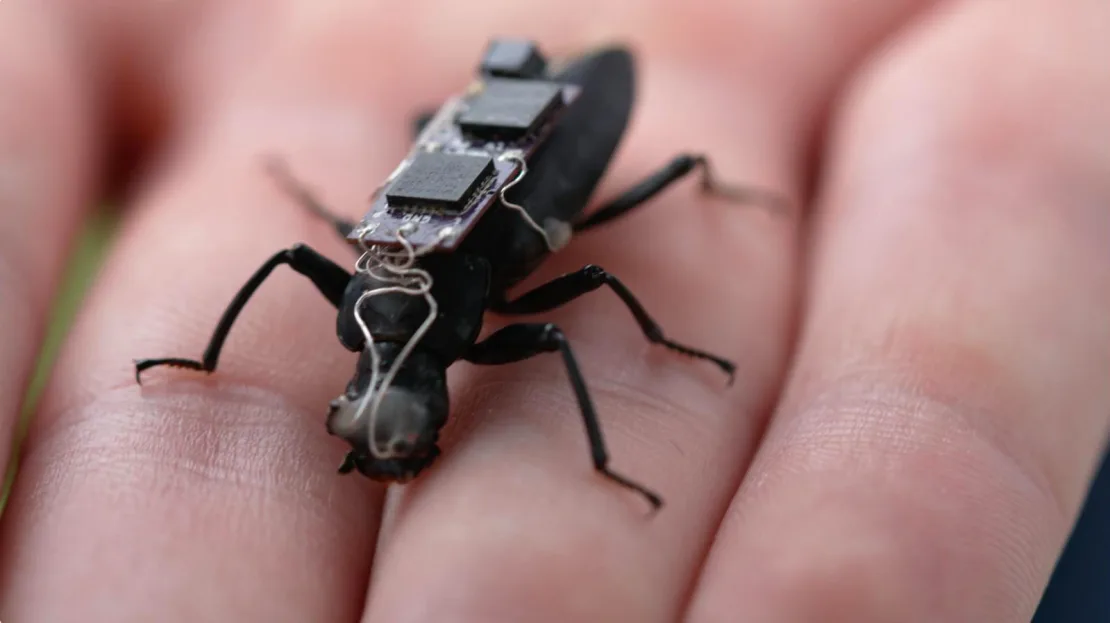
Researchers at the University of Queensland are creating cyborg insects that could revolutionize search and rescue operations. By implanting tiny circuits into the backs of beetles, they are crafting biohybrids—part-living, part-machine robots that could help in situations where human access is impossible, such as after natural disasters like earthquakes or bombings.

Lachlan Fitzgerald, a student studying mathematics and engineering, is leading the project. The beetles are outfitted with backpack-like devices that send electrical pulses to their antennae, allowing Fitzgerald to control their movements. This technology harnesses the insects’ natural agility, enabling them to navigate tight and hazardous environments with ease. Fitzgerald envisions a future where swarms of cyborg beetles could be deployed in disaster zones to find survivors or deliver life-saving drugs before human rescuers can safely enter.

The project also involves implanting control backpacks on giant Australian burrowing cockroaches and darkling beetles. These species are chosen for their adaptability and ability to navigate complex environments, making them ideal candidates for disaster response. Unlike traditional robots, insects can navigate with little computational effort, making them more efficient in unpredictable, real-world situations.

Despite their small size, cyborg insects could play a significant role in saving lives by quickly locating survivors in disaster zones and delivering essential aid. However, Fitzgerald acknowledges that there are still challenges to mastering the control of these insects, and it may take years before this technology is fully operational.

Fitzgerald is not the only researcher experimenting with biohybrid robots. At the California Institute of Technology (Caltech), researchers have implanted pacemakers into jellyfish to control their swimming and gather data from the deep ocean. Meanwhile, researchers at Cornell University have used king oyster mushrooms to control robots, which could be used for environmental sensing, like detecting soil chemistry for crop management.

While the rise of biohybrid robots sparks debates about ethical concerns, Fitzgerald and his team argue that the potential benefits, such as saving lives in urban disaster zones, outweigh the risks. He also assures that the beetles used in the project have normal life expectancies and aren’t harmed by the technology. However, he acknowledges the need for ongoing ethical discussions and proper regulation in this emerging field.