Circle, Issuer of USDC, Files for IPO with US SEC: Key Details Revealed

Circle, USDC Issuer, Files for IPO with SEC: Plans for Public Offering Revealed

Circle, the company behind the popular USDC stablecoin, has officially announced plans to go public. The US-based crypto firm recently submitted its registration paperwork for an initial public offering (IPO) with the US Securities and Exchange Commission (SEC). Pending approval, Circle intends to list its shares on the New York Stock Exchange (NYSE) under the ticker symbol “CRCL.” As part of the IPO process, Circle has filed the SEC’s S-1 form, a comprehensive document that provides crucial information about the company’s business and financial performance to both regulators and potential investors.

The filing reveals important details about Circle’s stock structure. The company plans to issue three classes of common stock: Class A shares, which will have one vote per share; Class B shares, offering five votes per share but capped at 30% of total voting power; and Class C shares, which will be non-voting. Despite the dual-class voting system that grants extra power to the founders, Circle has clarified that it will not be classified as a “controlled company” under NYSE rules, meaning it will still have to adhere to standard corporate governance practices.

While the specific number of shares Circle plans to offer and its target IPO price remain undisclosed, the filing does provide insight into the company’s financial performance. As of December 31, 2024, Circle reported that its assets under management were valued at approximately $1.6 billion (around Rs. 13,694 crore). This indicates strong financial standing and the company’s potential for future growth as it looks to expand its public presence.

In its S-1 form, Circle also highlighted the growth of its stablecoin-related reserves, which have surged from $735.9 million (around Rs. 6,299 crore) in 2022 to $1.7 billion (around Rs. 14,554 crore) by 2024. The company noted that 99% of its revenue last year came from the reserves associated with its stablecoin, USDC. Additionally, Circle generates income through yield-bearing Treasury bills, further diversifying its revenue streams. This filing marks a significant step for Circle as it prepares for what could be one of the most high-profile crypto-related IPOs to date.
Realme GT 7 Set for April Launch, Powered by MediaTek Dimensity 9400+ SoC

Realme GT 7 Set to Launch in April, Powered by MediaTek Dimensity 9400+ SoC

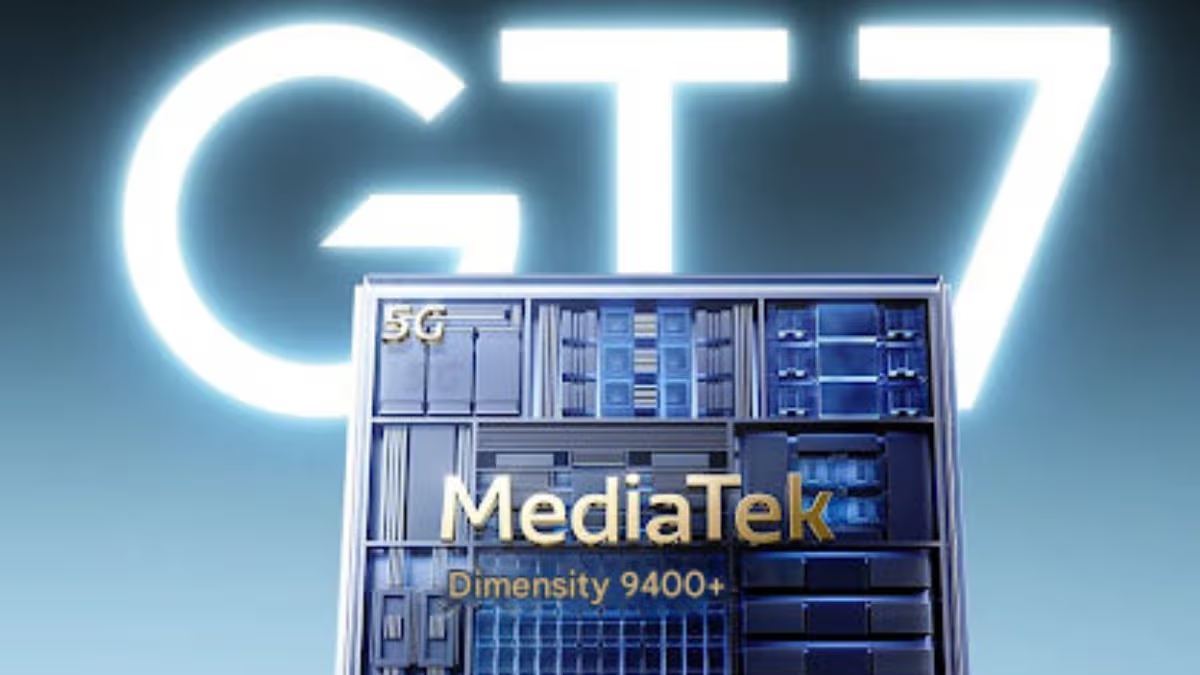
Realme has officially confirmed that the highly anticipated Realme GT 7 will be unveiled in China later this month. While the company has yet to announce the exact launch date, it has provided key details about the device’s performance capabilities. The upcoming smartphone will be powered by the MediaTek Dimensity 9400+ SoC, built on the advanced 3nm process, promising top-tier performance and efficiency. Recent leaks also hint at significant upgrades in design, with the Realme GT 7 expected to be thinner and lighter compared to its predecessor, the Realme GT 6, which debuted in July 2024 with a Snapdragon 8 Gen 3 chipset.

The Realme GT 7’s official launch will take place in April, according to a post on the company’s Weibo account. Although the exact date is still under wraps, the announcement has sparked excitement within the tech community. The post also confirmed that the device will feature the cutting-edge MediaTek Dimensity 9400+ SoC, which is expected to enhance the phone’s processing power, making it one of the most powerful smartphones in its segment. An official microsite for the handset is already live, teasing more details ahead of the release.

In addition to the powerful chipset, Realme Vice President Xu Qi Chase shared in a separate Weibo post that the GT 7 will incorporate the new GT Performance Engine 2.0. This performance optimization technology is designed to maximize the capabilities of the Dimensity 9400+ chip, offering smoother gameplay and more efficient processing. The GT 7 will also feature AI-driven enhancements, making it smarter and more responsive to user needs. According to Chase, the device will come equipped with advanced cooling solutions, ensuring optimal performance even under heavy usage.

Moreover, the Realme GT 7 is expected to provide impressive endurance, with industry-leading battery life and advanced power management systems. The phone will also offer high frame rate stabilization for an enhanced gaming experience. These features position the Realme GT 7 as a performance powerhouse, aimed at users who demand both speed and efficiency in their devices. With the April launch fast approaching, all eyes are now on Realme to see how these promises translate into a real-world experience.

Samsung Set to Enhance Battery Technology in Upcoming Galaxy Ring and Galaxy Watch Models

Samsung Set to Revolutionize Wearable Devices with All-Solid-State “Dream Battery” Technology

Samsung is reportedly working on a breakthrough upgrade for its wearable devices, with a new all-solid-state battery technology, often referred to as the company’s “dream battery.” According to sources, this new battery will be incorporated into future models of the Galaxy Ring, Galaxy Buds true wireless stereo (TWS) earphones, and the Galaxy Watch. The solid-state batteries promise significant improvements in energy density and durability, enabling Samsung to enhance the battery life of these devices without increasing their size.

The “dream battery” uses solid electrolytes instead of the conventional liquid electrolytes found in current lithium-ion batteries. This innovation is expected to yield substantial benefits, especially for wearables, where battery life is a key concern for users. Samsung is reportedly targeting the next-generation Galaxy Ring as the first device to feature this new technology. Prototypes of the updated Galaxy Ring, equipped with all-solid-state batteries, are expected to be ready by the fourth quarter of 2025.

One of the major advantages of the solid-state battery is its improved energy density, which could translate to longer battery life for the Galaxy Ring and other devices without the need to make them bulkier. For example, the current Galaxy Ring lasts about a week on a single charge, but the new battery technology could extend this duration significantly, providing users with even better endurance. Additionally, Samsung is working on increasing the capacity of its all-solid-state battery from 200Wh/L to 360Wh/L, further enhancing its performance.

Samsung’s focus on all-solid-state battery technology could potentially set a new standard for wearables in terms of both performance and safety. Solid-state batteries are known for being more stable and less prone to issues like overheating, which makes them a promising option for portable devices. As Samsung continues to refine this technology, its future wearables could offer not only longer-lasting power but also a more reliable and durable user experience.