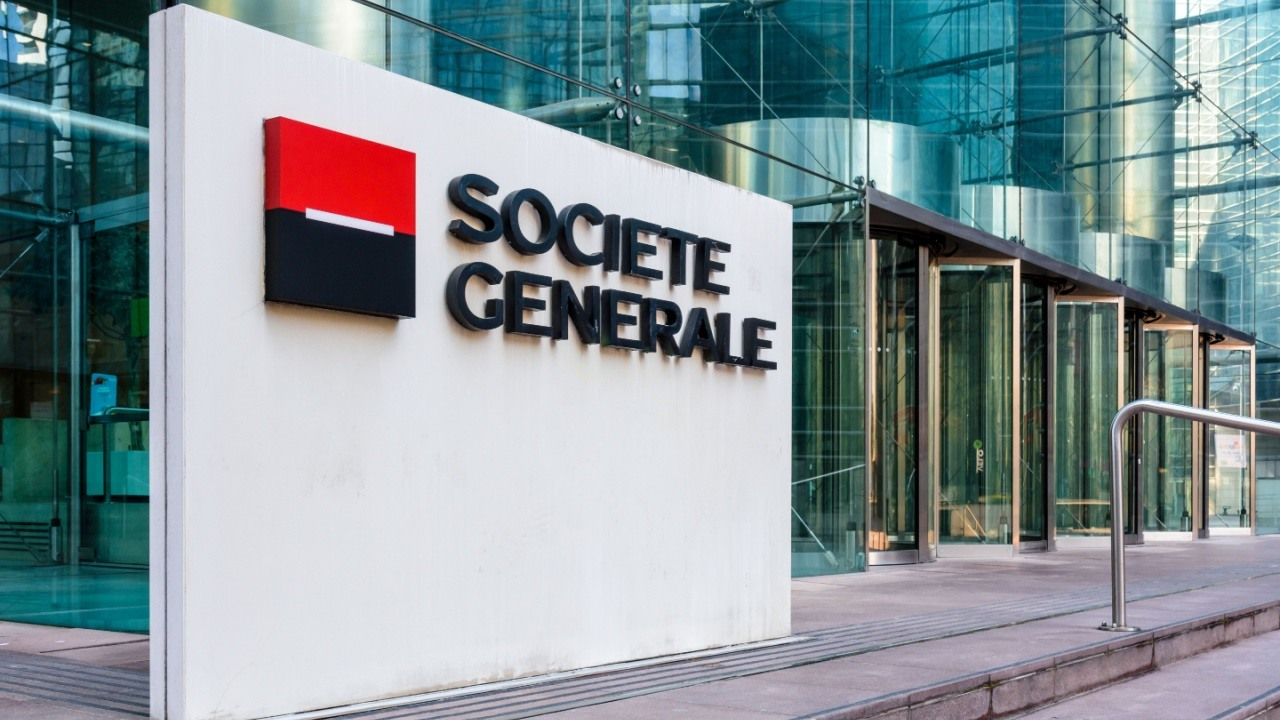
Societe Generale Becomes First Major Bank to Launch Dollar-Pegged Stablecoin

France’s Societe Generale announced plans to launch “USD CoinVertible,” a dollar-backed stablecoin through its digital asset subsidiary SG-FORGE, marking the first time a major global bank enters the dollar-pegged stablecoin market. The new cryptocurrency will be issued on both the Ethereum and Solana blockchains, with public trading set to commence in July.

Stablecoins, which are cryptocurrencies pegged to traditional currencies such as the U.S. dollar, allow for the movement of significant funds across blockchain networks without relying on conventional banking systems. The sector has rapidly expanded, led by crypto company Tether, which has issued $155 billion worth of its dollar-backed tokens.

SG-FORGE previously launched a euro-backed stablecoin in 2023, but adoption has been limited, with only €41.8 million ($47.6 million) in circulation. Unlike unregulated counterparts, SocGen’s stablecoins will be classified as e-money tokens and regulated under the EU’s Markets in Crypto-Assets Regulation (MiCA), adopted in 2023. Tether, by contrast, does not hold a MiCA license to operate within the EU.

Jean-Marc Stenger, CEO of SG-FORGE, emphasized strong market demand for a regulated dollar-based stablecoin, noting significant interest from corporate clients, financial institutions, and crypto exchanges seeking reliable and compliant offerings. “At the moment, there are no other banking-related players in that space,” Stenger said.

Stablecoin issuers typically hold customer deposits in dollars and invest them into yield-bearing assets such as government bonds for profit. Bank of New York Mellon (BNY) will act as custodian for SG-FORGE’s reserves, which will initially be held in cash before being allocated to other investments.

SG-FORGE’s USD CoinVertible will serve multiple functions including crypto trading, cross-border payments, foreign exchange transactions, and collateral management. While specific exchange listings have not yet been disclosed, the company stated that over 15 crypto exchanges and brokers are onboarding as clients.

In the United States, stablecoin regulation is also gaining momentum, with Congress preparing to adopt new legislation. Bank of America has signaled potential interest in launching its own stablecoin, and other major banks are considering joint initiatives.

Tether remains the world’s largest stablecoin issuer and recently disclosed it has become the seventh largest buyer of U.S. government debt in 2024 through its extensive Treasury holdings. Meanwhile, the second-largest stablecoin issuer, Circle, went public on the U.S. stock market on June 5, with its shares surging 48% shortly after listing.

Despite the rapid growth, regulators continue to caution that stablecoins could pose risks to financial stability by linking traditional finance with the more volatile cryptocurrency markets.

Tesla’s Self-Driving Strategy Threatened by Chinese Auto and Tech Giants

Chinese electric vehicle (EV) makers, led by BYD, are increasingly challenging Tesla not only in the affordable EV sector but now also in the race to develop self-driving technology. BYD’s aggressive pricing strategy—offering its advanced “God’s Eye” driver-assistance system for free—poses a direct threat to Tesla’s expensive Full Self-Driving (FSD) package, priced at nearly $9,000 in China.

According to Shenzhen-based BYD investor Taylor Ogan, God’s Eye outperforms Tesla’s FSD. Other Chinese competitors such as Leapmotor and Xpeng are also offering highly capable driver-assistance systems in vehicles costing as little as $20,000. This surge in advanced autonomous technology is heavily backed by the Chinese government, creating fierce competition within the world’s largest auto market.

Teardown analyses reveal that BYD’s assisted-driving hardware costs are similar to Tesla’s, despite BYD’s systems incorporating additional components like radar and lidar that Tesla omits in favor of a camera-only approach. Lower sensor costs in China—up to 40% cheaper than in Europe and the U.S.—helped Chinese firms maintain a cost advantage while delivering more comprehensive systems.

The competitive pressure from China coincides with broader challenges for Tesla CEO Elon Musk, whose global EV sales have been slipping. As Tesla shifts its focus toward robotaxis and autonomy to sustain its market valuation—currently around $1 trillion—the company now faces stiff competition from Chinese firms who are also advancing rapidly in autonomous vehicle development.

Huawei has emerged as a key player by partnering with major Chinese automakers such as Chery, SAIC, and Changan to supply driver-assistance technology. Reuters journalists recently observed Huawei’s Aito M9 autonomous system successfully navigating the congested streets of Shenzhen, showcasing China’s significant progress in real-world autonomous driving conditions.

Meanwhile, Tesla faces regulatory hurdles in China that prevent the company from using locally collected driving data to improve its AI models abroad. Negotiations to transfer such data to the U.S. have so far been unsuccessful. In contrast, Chinese companies benefit from Beijing’s policy support, government subsidies, and the massive scale of domestic EV sales, which provide extensive on-road data to refine their autonomous systems.

BYD’s decision to offer God’s Eye for free may reduce its 22% gross margins but is expected to boost sales volume, enhancing its AI capabilities through expanded data collection. The company sold 4.2 million vehicles last year—more than twice Tesla’s output—further improving its economies of scale and bargaining power with suppliers.

The intense competition in China’s EV sector has driven rapid technological innovation and reduced costs, allowing companies like BYD to pressure suppliers for further price reductions. This aggressive environment is viewed as entering a “knockout round” of competition, as described in a recent BYD communication to its supply chain partners.

Tesla, preparing to launch a limited robotaxi trial in Austin, Texas, with 10 to 20 vehicles, remains behind its Chinese rivals in delivering fully autonomous solutions. Tesla has yet to release a fully unsupervised version of FSD capable of true hands-off driving, while Chinese companies are advancing toward Level 3 autonomy certification under new regulatory frameworks.

Google Faces Potential Major Fine in Mexico Over Antitrust Allegations

Mexico’s antitrust authority, the Federal Economic Competition Commission (Cofece), is expected to deliver a ruling by June 17 on whether Google engaged in monopolistic practices in the country’s digital advertising market. If found guilty, the tech giant could face a fine of up to 8% of its annual revenue in Mexico, which would represent one of the largest penalties Cofece has ever imposed.

Although Google’s parent company, Alphabet, does not disclose country-specific revenues, its “Other Americas” segment, which includes Latin America, generated $20.4 billion in revenue in 2024. This makes Google the most significant company yet targeted by Mexico’s competition regulator.

Cofece’s investigation into Google Mexico began in 2020 and moved into its trial phase in 2023, allowing Google the opportunity to present counter-evidence. The regulator alleges that Google effectively built a monopoly in Mexico’s digital advertising sector. As part of its investigation, Cofece also sought Google’s financial information from Mexico’s tax authority (SAT). An oral hearing with Google, considered one of the final steps in the process, was held on May 20.

Under Mexican law, the maximum fine for monopolistic conduct is capped at 8% of a company’s annual revenue. Should Cofece rule against Google, the company may seek an injunction to delay the penalty while a specialized court reviews the decision.

This case aligns with broader global regulatory scrutiny of Google’s business practices. In the United States, Google has faced multiple antitrust cases. Last year, a U.S. district judge ruled that Google holds an unlawful monopoly in online search and search advertising. In another case, the U.S. Justice Department accused Google of illegally dominating online advertising technology markets and has suggested the company divest parts of its Google Ad Manager business.

Domestically, Google has also faced political friction in Mexico. President Claudia Sheinbaum has filed a lawsuit against Google over its renaming of the Gulf of Mexico to “Gulf of America” for U.S. Google Maps users following a decision under former U.S. President Donald Trump. Mexican lawmakers from the ruling Morena party have been urging Cofece to resolve the antitrust case against Google since last year.

Cofece and Google have declined to comment on the ongoing investigation.