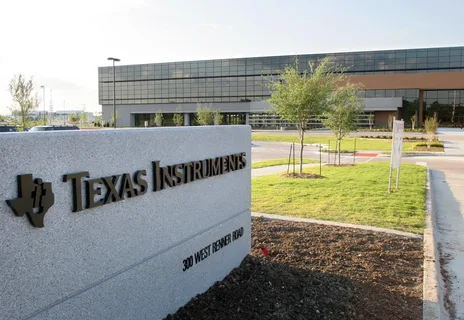
Texas Instruments Warns of Cooling Demand After Tariff-Driven Surge

Texas Instruments (TXN.O) said on Thursday that customer demand has slowed following a sharp spike in April, when buyers rushed to place orders ahead of U.S. President Donald Trump’s “Liberation Day” tariff announcement. Shares of the chipmaker fell nearly 4% after the update, delivered at the Citi Global TMT Conference by Chief Financial Officer Rafael Lizardi.

Lizardi explained that January-to-April demand was temporarily lifted by tariff-related market dynamics but noted that “things did slow down after April, or at least didn’t grow as they normally would have.”

The finance chief also addressed speculation about potential government stakes in semiconductor firms, clarifying that TI has not been approached about equity participation in exchange for CHIPS Act incentives. The Trump administration’s decision to take a 9.9% stake in Intel (INTC.O) has fueled debate about government involvement in the industry, but Lizardi said, “Nothing along those lines has been discussed or proposed” for TI.

Under the CHIPS and Science Act, the Commerce Department has earmarked up to $1.6 billion in funding for Texas Instruments. Lizardi said the agreement, initially signed under the Biden administration and later adjusted under Trump, saw only “minor, favorable changes.”

TI’s free cash flow remains under pressure from elevated capital expenditure, with share repurchases continuing but at a reduced pace. In July, the company issued a profit forecast that signaled weaker-than-expected demand for its analog chips, particularly from the automotive sector, which has been slow to rebound. Despite challenges, TI reiterated that four of its five end markets are showing recovery, with autos lagging due to broader economic uncertainty.


Chinese Tech Firms Still Pursuing Nvidia Chips Despite Government Pressure

Chinese tech giants including Alibaba (9988.HK) and ByteDance remain eager to secure Nvidia’s (NVDA.O) artificial intelligence chips despite regulators in Beijing discouraging such purchases, according to four sources familiar with procurement talks.

The companies are pressing for assurance that their orders for Nvidia’s H20 model—which regained U.S. approval for sale in China in July—are being processed. They are also closely tracking Nvidia’s development of a more advanced chip, tentatively called the B30A, based on its Blackwell architecture. Sources said the B30A could cost roughly twice as much as the H20’s current $10,000–$12,000 price tag but may deliver up to six times more power, making it an attractive option if cleared by Washington.

Both the H20 and B30A are downgraded versions of Nvidia’s global products, designed to comply with U.S. export restrictions. The issue of whether Chinese firms can access advanced chips remains a central flashpoint in the U.S.–China technology rivalry. While Washington has relaxed some curbs, U.S. President Donald Trump recently struck a deal requiring Nvidia to give 15% of its H20 revenue to the U.S. government.

China, meanwhile, is urging its companies to reduce reliance on U.S. chips. Regulators have summoned Tencent (0700.HK), ByteDance, and others to question their H20 purchases, citing potential information security risks. However, Beijing has not formally banned Nvidia products.

Strong demand persists due to limited domestic chip supply. Products from Huawei and Cambricon (688256.SS) remain constrained and, according to engineers at Chinese firms, perform less effectively than Nvidia’s. Nvidia itself acknowledged rising competition from local rivals but declined further comment.

Uncertainty over its China sales led Nvidia to issue a cautious forecast in August, excluding potential revenue from the world’s second-largest economy. The company’s shares have since fallen about 6%. CEO Jensen Huang has reassured Chinese customers about H20 availability and is reportedly preparing B30A samples for delivery to China as early as September. Nvidia is estimated to hold 600,000–700,000 H20 units in inventory and has asked TSMC to produce more.

Huang has previously said China could represent a $50 billion market for Nvidia if it maintains access to competitive products.

Salesforce Shares Slide as Weak Outlook Highlights Delayed AI Payoff

Salesforce (CRM.N) shares fell nearly 8% on Thursday after the company issued a disappointing third-quarter revenue forecast, raising investor concerns that returns from its artificial intelligence investments may take longer to materialize.

The company projected revenue between $10.24 billion and $10.29 billion, with the midpoint falling short of analysts’ average estimate of $10.29 billion, according to LSEG data. Despite announcing a $20 billion expansion of its share buyback program, Salesforce’s muted guidance weighed heavily on investor sentiment.

The outlook comes as software companies face mounting pressure to prove that billion-dollar AI investments will deliver meaningful returns, even as customers scale back spending in an uncertain economic environment. Matt Britzman, senior equity analyst at Hargreaves Lansdown, said the guidance gives “bears fresh ammo amid mounting fears that the software sector is ripe for disruption.”

Salesforce has been rapidly integrating AI across its cloud services, including the 2024 launch of Agentforce, an AI-powered agent platform designed to automate workflows and improve margins. However, the company continues to face macroeconomic headwinds. Analysts at Oppenheimer described the growth outlook as “uninspiring,” noting challenges for front-office software suppliers this year.

Shares of Salesforce are down about 24% year-to-date. To strengthen its offerings, the company has returned to acquisitions, including its $8 billion purchase of Informatica in May. Still, Salesforce trades at a forward earnings multiple of 20.96—well below Microsoft’s 31.26 and Oracle’s 30.84—suggesting potential upside.

J.P. Morgan analysts said second-quarter results, which beat revenue expectations, alongside management’s positive commentary, indicate that Salesforce stock may be undervalued compared to peers, leaving room for recovery.