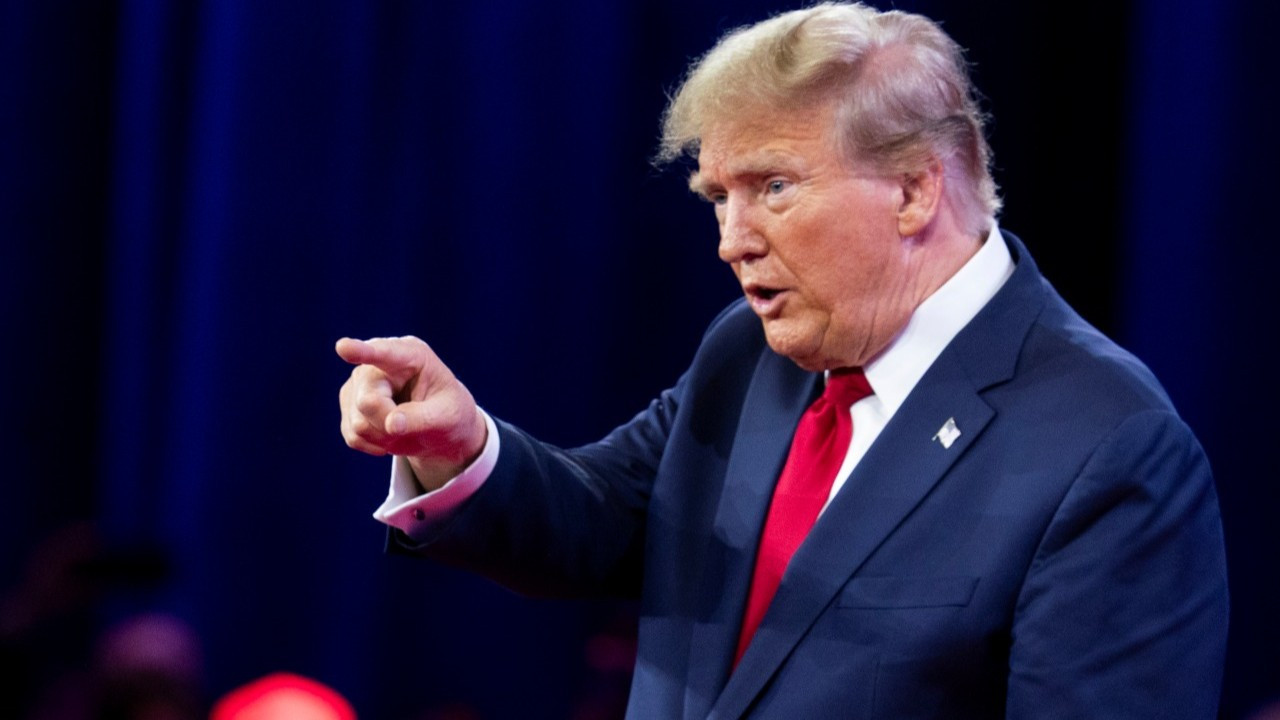
Trump jokes about AI “taking over the world” as U.S. and U.K. sign tech deal

U.S. President Donald Trump, speaking alongside U.K. Prime Minister Keir Starmer in London, quipped that artificial intelligence was “taking over the world” and admitted he hoped tech leaders understood it better than he did. The remarks came during Trump’s second state visit to Britain, at an event attended by Nvidia CEO Jensen Huang and other industry figures.

Departing from prepared remarks on the strength of U.S.-U.K. relations and new tech investments, Trump turned to Huang with a laugh: “Jensen, I don’t know what you’re doing here. I hope you’re right. All I can say is, we both hope you’re right.” His comments drew laughter from Starmer and the audience.

The two leaders signed a “Tech Prosperity Deal”, pledging deeper cooperation on artificial intelligence, quantum computing, and civil nuclear projects. Under the agreement, Nvidia will deploy 120,000 GPUs across Britain, marking its largest European rollout to date.

Trump, characteristically playful, joked with Treasury Secretary Scott Bessent before signing: “Should I sign this? If the deal’s no good, I’m blaming you, Scott.”

The partnership aims to strengthen transatlantic research and industry collaboration while addressing the disruptive potential of AI—a technology Trump acknowledged as both transformative and unsettling.

Xiaomi issues software update for 115,000 SU7 sedans over assisted driving risks

China’s Xiaomi will roll out a software update affecting more than 115,000 SU7 electric sedans to fix potential safety issues linked to its assisted driving system, according to a recall notice from the State Administration for Market Regulation (SAMR). The fix, delivered via over-the-air (OTA) update, marks the second time the model has been subject to recall protocols since its launch last year.

Regulators said the SU7’s Level 2 highway pilot system may not provide adequate early warnings or perform properly in extreme scenarios. The issue affects 116,887 standard SU7s manufactured between February 2024 and August 2025. Xiaomi confirmed the OTA update would be pushed out starting Friday.

China requires regulatory approval for OTA updates tied to autonomous driving, to ensure automakers cannot conceal defects or evade liability. The move comes as Beijing finalizes new safety rules for Level 2 automation, set to take effect in 2027. The draft standards were prompted in part by a fatal March accident involving a SU7 that caught fire after hitting a highway pole, just seconds after the driver disengaged the assistance system.

Level 2 automation allows the car to handle steering, acceleration, and braking, but still requires drivers to maintain constant attention. Analysts say China’s stricter oversight reflects both the growing popularity of advanced driver-assistance systems and heightened public concerns about road safety.

Google brings Gemini AI to Chrome after antitrust ruling spares breakup

Google announced it is rolling out its Gemini AI models directly into the Chrome browser for U.S. desktop users starting Thursday, marking one of the company’s most ambitious integrations of AI into its core products. The move comes just weeks after a federal judge spared Google from a forced breakup in a high-profile antitrust case but ordered it to share data with competitors to level the playing field in online search.

The Gemini add-on will first be available on Mac and Windows desktops in English, with plans to expand soon to Chrome’s iOS app. Business rollouts will follow in the coming weeks through Google Workspace, and mobile integrations are also on the way.

Gemini in Chrome will be tied more deeply into other Google services such as Calendar, YouTube, and Maps, enabling multi-step “agentic” capabilities in the coming months. These include finding previously visited webpages, summarizing content across multiple sites, and carrying out automated tasks on a user’s behalf.

The move positions Google against rivals developing “agentic browsers,” such as Perplexity, which recently offered $34.5 billion in cash for Chrome and launched its own AI browser, Comet.

Judge Amit Mehta’s September ruling allowed Google to keep control of Chrome and Android but barred exclusive contracts with device makers and browser developers. The decision still permits Google to pay partners like Apple to feature its search engine, reinforcing its dominance in search. Meanwhile, reports suggest Apple has discussed adopting Gemini AI to power a revamped Siri, further tightening ties between the two companies.