Panasonic targets breakthrough EV battery within two years

Panasonic (6752.T) said it aims to develop a new type of higher-capacity battery in about two years, a potential game-changer for electric vehicles and a boost for key customer Tesla (TSLA.O).

The Japanese company is working on an anode-free design that could deliver what it calls a “world-leading level” of energy density by the end of 2027. If successful, the innovation would increase battery capacity by about 25%, extending the range of Tesla’s Model Y by nearly 90 miles (145 km) without enlarging the pack.

Alternatively, Panasonic could use the technology to create lighter, potentially cheaper batteries that maintain current driving ranges with smaller packs. A company executive discussed the project ahead of a Thursday presentation by Shoichiro Watanabe, chief technology officer at Panasonic Energy.

The design removes the anode during manufacturing. Instead, a lithium metal anode forms inside the cell after its first charge, freeing up space for more cathode materials—nickel, cobalt, and aluminum—that boost capacity without increasing size. Panasonic also aims to cut the proportion of costly nickel.

While several global battery producers are pursuing similar technology, Panasonic stressed its version could deliver industry-leading performance. The company declined to provide details on manufacturing costs or whether the advance would allow Tesla to lower vehicle prices.

The push comes as Tesla faces growing competition. Reuters reported earlier this month that Tesla’s U.S. market share fell to its lowest in almost eight years in August, pressured by a flood of rival EV offerings and its aging product lineup.

Small U.S. defense stocks surge as demand rises for next-gen battlefield tech

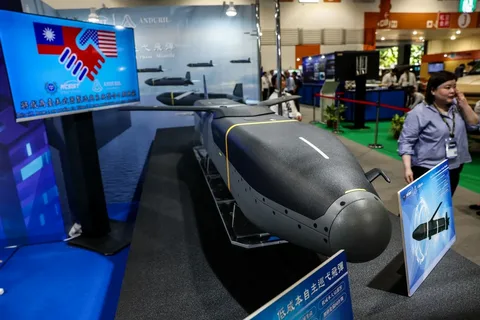
Smaller U.S. defense companies are delivering standout gains on Wall Street this year, driven by surging demand for low-cost, next-generation military technology designed for modern combat. Global conflicts in Ukraine and Gaza have fueled higher military spending, boosting stocks tied to AI-powered drones, unmanned vehicles, and software-enabled systems that reduce reliance on traditional ground troops.

“The winners in this new market will be those companies leaning into change and investing in low-cost, upgradable, and software-enabled weapon systems,” said Jon Siegmann, managing director for aerospace and defense at Stifel.

The NYSE Arca Defense Index (.DFII) has climbed about 34% in 2025, far ahead of the S&P 500’s (.SPX) 12% gain. Mid- and small-cap firms lead the rally, including drone makers Kratos Defense (KTOS.O) and AeroVironment (AVAV.O), components supplier Astronics (ATRO.O), and Mercury Systems (MRCY.O). Larger players such as RTX (RTX.N) and Northrop Grumman have also advanced, gaining 37% and 23% respectively.

Policy signals from Washington are shaping the surge. President Donald Trump has proposed renaming the Pentagon to the “Department of War,” while requesting $892.6 billion for fiscal 2026 defense spending, with nearly $6 billion earmarked for unmanned aircraft and counter-drone systems—a 78% jump from last year.

AeroVironment’s growth chief Church Hutton noted the administration’s push to get equipment to U.S. forces faster, a priority echoed by Defense Secretary Pete Hegseth.

Mergers and acquisitions in aerospace and defense are also climbing, though deal values remain modest. Lockheed Martin’s $360 million purchase of Amentum’s Rapid Solutions unit, aimed at expanding radar capabilities, is one recent example. Venture capital has followed suit, with startup funding in the sector hitting $14.17 billion by August, the highest in a decade.

“The demand signal we’re seeing is for tens of thousands of lower-cost munitions systems and unmanned systems,” said Lukas Czinger, CEO of Divergent Technologies, which 3D-prints parts for Lockheed, Raytheon, and others.

India’s upGrad targets Asia growth as U.S. student demand declines

Indian edtech startup upGrad is accelerating plans to partner with more universities in the Middle East and Asia-Pacific as fewer students choose the United States and the UK due to visa restrictions and rising costs, a senior executive told Reuters.

Founded by film producer Ronnie Screwvala and backed by Singapore’s Temasek, upGrad currently works with about 80 universities across 10 countries to deliver online MBAs and executive education programs. The company generates revenue by enrolling students in digital courses and facilitating transfers to overseas campuses to finish their degrees.

“Some of the top U.S. and UK schools have opened campuses in Dubai, Malaysia and Singapore. We are going in that direction too because geopolitical factors are restricting enrollment in the U.S. and UK,” said Praneet Singh, associate vice president for upGrad’s Study Abroad division. He highlighted expansion efforts in Japan, Singapore, Malaysia, and the broader Middle East and APAC region, without disclosing investment figures.

The strategy shift comes as applications to U.S. universities decline following policy changes under the Trump administration, which tightened student visa rules and even scrutinized applicants’ social media presence. According to upGrad, the share of Indian students choosing the U.S. dropped from 60% to 47% between fiscal 2024 and 2025, with more opting for affordable destinations closer to home.

Singh noted that universities such as Johns Hopkins, Carnegie Mellon, Birmingham, and Middlesex—some with campuses in Dubai or Doha—are part of upGrad’s expansion discussions, alongside institutions in Vietnam, Bangladesh, Nepal, and Sri Lanka. While the U.S. has traditionally been the top choice for Indian students, factors like visa hurdles and weaker job prospects are reshaping preferences. Singh added that this trend has continued into the current year.