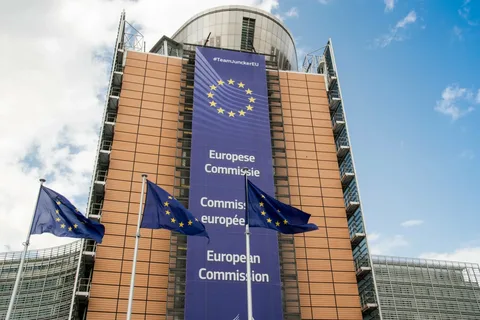
European Commission says MiCA rules already tackle stablecoin risks

The European Commission said on Friday that the EU’s landmark crypto regulation, MiCA, already provides a robust framework to handle risks linked to stablecoins, pushing back against the European Central Bank’s call for stricter safeguards.

Stablecoins—digital tokens tied to fiat currencies like the U.S. dollar or euro—have grown rapidly in recent years, prompting debate over how they should be regulated. While the United States has moved to promote their use, the ECB has warned that some models could threaten financial stability.

At the center of the dispute is whether multinational stablecoin issuers can treat tokens created inside and outside the EU as interchangeable under MiCA’s “multi-issuance” model. In a letter to EU Commissioner Maria Luis Albuquerque this week, six crypto trade groups, including Circle, urged Brussels to clarify that such structures are allowed.

A Commission spokesperson told Reuters that MiCA already provides “a proportionate framework for addressing risks” and said guidance confirming how multi-issuance operates will be published “as soon as possible.”

The ECB’s Systemic Risk Board, chaired by Christine Lagarde, argues that cross-border token issuance could lead to runs on EU reserves if holders outside the bloc attempt to redeem with EU entities during market stress. Stablecoin issuers, however, maintain that adequate reserve management can prevent such instability.

Analysts at J.P. Morgan said this week that 99% of all stablecoins are pegged to the U.S. dollar, noting that the sector’s global expansion could further boost demand for the greenback.
OpenAI warns EU regulators of Big Tech dominance in AI market

OpenAI has raised competition concerns with European Union regulators, warning that entrenched tech giants such as Google are using their market power to dominate the fast-growing artificial intelligence sector.

The company confirmed Thursday that its arguments to EU officials last month “mirrored its public positions” on the need to ensure fair competition in AI. During a September 24 meeting with EU antitrust chief Teresa Ribera, OpenAI said it faced major hurdles competing against vertically integrated platforms that control both infrastructure and distribution, according to meeting notes cited by Bloomberg News.

The firm urged regulators to prevent large companies from “locking in users” through their ecosystems — a reference to concerns that firms like Alphabet and Microsoft could tie AI products to existing search, cloud, and software services.

The European Commission has already been investigating how major technology platforms are extending dominance into AI through intercompany agreements and exclusive data access. Neither the Commission nor Google responded to requests for comment.

OpenAI’s outreach to EU authorities comes as it cements its own global influence. Following a secondary share sale last week, the ChatGPT-maker is now valued at $500 billion, making it the world’s most valuable startup with over 800 million weekly users.

Analysts say the move signals that OpenAI wants to shape the regulatory debate in Europe — not only to challenge rivals like Google and Anthropic, but also to secure its place in a market increasingly defined by antitrust scrutiny and AI sovereignty policies.

Global space investment hits record $3.5 billion as funding widens beyond SpaceX and OneWeb

Global space investment soared to a record $3.5 billion in the third quarter, almost doubling last year’s figure, as money flowed into a broader range of startups and defense-related projects, according to a new report from Seraphim Space.

The data marks a shift in the fast-growing industry, with capital now spread across multiple players instead of being dominated by giants such as SpaceX and OneWeb. “We’re seeing a far more diverse set of investable companies, signaling that space has evolved into a broader, more mature market,” said Lucas Bishop, investment associate at Seraphim.

The surge was led by U.S. defense and aerospace firms like Hadrian, Apex, and Hermeus, which raised large rounds focused on advanced manufacturing and hypersonic technologies. In China, Galactic Energy took the top spot with a $336 million raise in September.

Governments are fueling the boom as they expand domestic space and defense initiatives, with the U.S., China, and Europe all channeling funds into satellite networks and orbital infrastructure. The report said this momentum would likely continue into 2026, supported by dual-use technologies bridging civilian and military applications, such as SpaceX’s Starshield and OneWeb’s network expansion.

Publicly traded space firms have also surged. Rocket Lab and Planet Labs have more than doubled their market value in recent months, while AST SpaceMobile has tripled after demonstrating satellite-to-phone broadband connectivity — a milestone for direct-to-device communication.