Apple Sees Record 2025 as iPhone Shipments in India Hit 14 Million
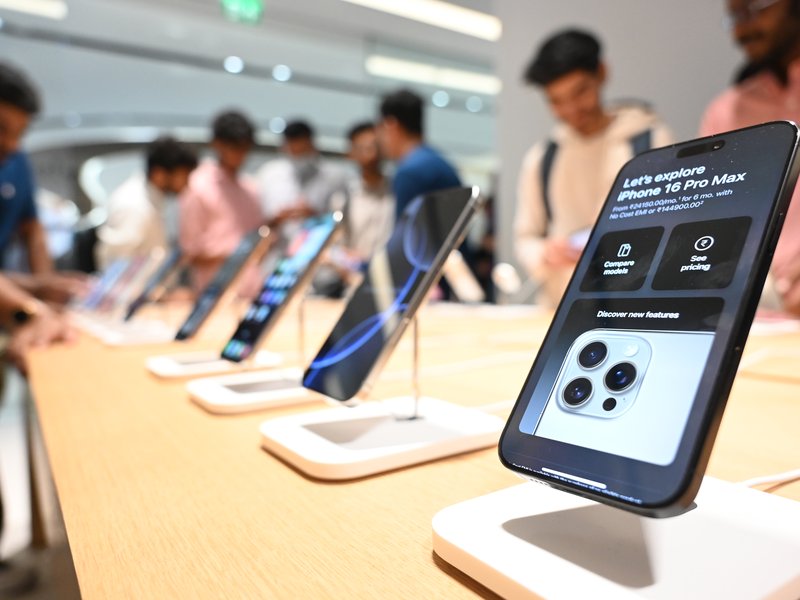
Apple slated for record iPhone shipments in 2025 | LinkedInApple slated for record iPhone shipments in 2025 | LinkedInApple's India shipments likely to hit record 14-15 million units this year

Apple appears to have delivered its strongest-ever performance in India in 2025, as iPhone shipments surged and pushed the company to new milestones in one of its most important markets. Fresh market data suggests the Cupertino giant capitalized on growing demand despite broader industry headwinds, reinforcing India’s role in Apple’s global growth strategy.

According to a report citing Counterpoint Research, iPhone shipments in India climbed to around 14 million units in 2025, helping Apple secure a record 9% market share, up from roughly 7% the previous year. This marks Apple’s best annual showing in the country, even as total smartphone shipments across India stayed relatively flat at approximately 152 million units.

Analysts point to Apple’s expanded product lineup as a major growth driver. From the latest iPhone 17 series to the still-popular iPhone 16 models and the more accessible iPhone 16e, Apple offered options across multiple price segments, appealing to a wider range of consumers.

Another key factor behind Apple’s momentum was improved accessibility. Broader online and offline availability, combined with attractive financing schemes such as no-cost EMIs and bank discounts, made iPhones more attainable for Indian buyers. Together, these strategies helped Apple outperform the market and cement 2025 as a record-breaking year for the brand in India.


Apple slated for record iPhone shipments in 2025 | LinkedInApple slated for record iPhone shipments in 2025 | LinkedIn

Motorola Edge 70 Fusion Appears on Geekbench With Snapdragon 7s Gen 4

Motorola Edge 70 Fusion Geekbench Leak: Snapdragon 7s Gen 4 Performance  Revealed.

The Motorola Edge 70 Fusion appears to be inching closer to its official debut, and fresh evidence is strengthening that belief. After a recent wave of leaks, the upcoming Edge-series smartphone has now surfaced on Geekbench, offering an early look at its real-world performance. The benchmark listing confirms that Motorola is sticking with a Snapdragon-powered setup and plans to ship the device with the latest Android version, signaling a solid generational upgrade over the Edge 60 Fusion.

According to the Geekbench database, the Motorola Edge 70 Fusion scored 1,215 points in the single-core test and 3,186 points in the multi-core test. These figures place the phone comfortably in the upper mid-range segment. The listing also reveals 11.14GB of RAM, which strongly suggests the phone will be marketed as having 12GB RAM, aligning with current industry standards for performance-focused smartphones.

The benchmark details further hint at the chipset powering the device. The CPU configuration includes a 2.71GHz prime core, three performance cores capped at 2.40GHz, and four efficiency cores running at 1.80GHz. This layout closely matches the architecture of the Snapdragon 7s Gen 4, pointing to a meaningful boost in efficiency and sustained performance. While earlier leaks mentioned the Snapdragon 7s Gen 3, this new data suggests Motorola may opt for the newer, more capable silicon instead.

Beyond raw performance, expectations for the Motorola Edge 70 Fusion remain high. The phone is rumored to feature a 6.78-inch AMOLED display, a massive 7,000mAh battery, and up to five color options, making it both visually appealing and endurance-focused. If these specifications hold true, the Edge 70 Fusion could become one of the most compelling mid-range Android smartphones of its generation, balancing power, battery life, and modern software in one package.

EU Plan to Phase Out High-Risk Tech Draws Fire From China’s Huawei

The European Union plans to phase out components and equipment from so-called high-risk technology suppliers in critical sectors, under proposed revisions to the EU Cybersecurity Act that have drawn sharp criticism from Huawei.

The draft proposal, released by the European Commission, aims to strengthen protections against rising cyber and ransomware attacks, foreign interference and espionage risks, while reducing Europe’s dependence on non-EU technology providers. Although the Commission did not name specific companies or countries, Huawei is widely expected to be among those affected.

EU technology chief Henna Virkkunen said the measures would improve security of critical ICT supply chains and bolster Europe’s technological sovereignty. The new rules would apply to 18 key sectors, including telecom networks, cloud services, semiconductors, energy systems, medical devices, drones and connected vehicles.

Under the proposal, mobile operators would have 36 months after publication of a high-risk supplier list to phase out key components. Additional timelines for fixed and satellite networks will be set later. Any restrictions would follow formal risk assessments and market impact studies.

Huawei said excluding suppliers based on country of origin rather than technical evidence violates EU legal principles and World Trade Organization obligations, echoing criticism from China’s foreign ministry. Industry group Connect Europe warned the measures could impose billions of euros in extra costs. The proposal must still be negotiated with EU governments and the European Parliament before becoming law.